
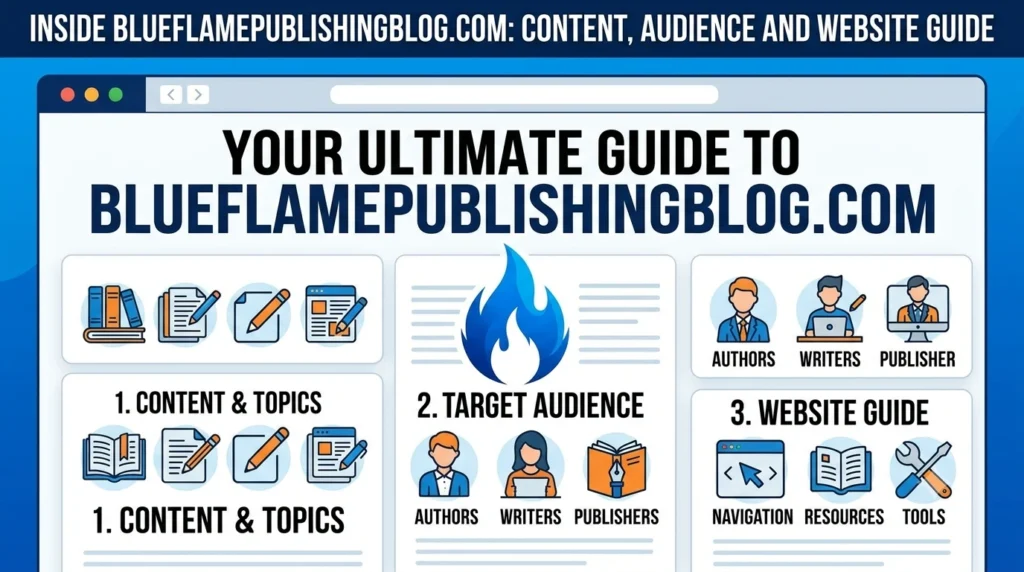
Inside BlueFlamePublishingBlog.com: Content, Audience and Website Guide.
Introduction
When you discover a website with an unfamiliar name, it is worth understanding what it offers before relying on its information. BlueFlamePublishingBlog.com is one such website. Its name suggests a connection with publishing and writing, but its homepage features articles across several different subjects.
The website includes content related to business, technology, health and travel. Recent examples range from advice on choosing an inspection company to articles about facial massage, entrepreneurship and travel destinations. This variety makes it more useful to assess as a general-interest content website than by its name alone.
In this guide, we explore BlueFlamePublishingBlog.com, the types of content visitors can find, its potential audience, and practical ways to evaluate the quality of its articles. We will also explain what readers should check before using information from the website to make important decisions.
Quick Answer: What Is BlueFlamePublishingBlog.com?
BlueFlamePublishingBlog.com is an online blog that publishes articles across multiple subject categories, including business, technology, health and travel. Its homepage also features general blog-related content and articles on lifestyle and other informational topics.
The website may be useful for readers looking for introductory information, practical guides and general-interest articles. However, its content should be assessed individually. The presence of an article on a website does not automatically establish that the information is accurate, independently verified or written by a qualified specialist.
If you are looking for a traditional book publisher, do not assume that the domain provides book publishing, manuscript evaluation or author services simply because its name includes the word “publishing.” Check the website’s current service information before making that decision.
1. What Is BlueFlamePublishingBlog.com?
BlueFlamePublishingBlog.com is an online content website that provides articles on a variety of topics. Its homepage features category navigation, article previews, publication dates and links to individual posts.
Rather than focusing exclusively on books or literary publishing, the website presents a broader selection of informational content. Readers may encounter business guidance, health-related explainers, travel inspiration and technology topics while browsing its pages.
The homepage is the best starting point for understanding the website’s current focus. At the time of review, its main navigation included Business, Technology, Health and Travel. The displayed articles also included subjects related to blogging and digital content.
This broad structure can appeal to readers who enjoy exploring different topics in one place. Nevertheless, it means that the quality and usefulness of each article should be judged according to its specific subject.
What is the purpose of the website?
The apparent purpose is to make online articles available to readers interested in practical information and general-interest topics. Some posts aim to introduce a subject, while others provide lists, recommendations or step-by-step guidance.
For example, a business article may explain what to ask before hiring an inspection company. A travel post might discuss destinations for a particular type of holiday. Meanwhile, a health article may introduce a wellness topic.
These formats can help readers begin researching a subject. However, an introductory blog post should not automatically be treated as a substitute for professional advice, original research or authoritative documentation.
2. What Topics Does the Website Cover?
The range of content is one of the most noticeable features of BlueFlamePublishingBlog.com. Its current homepage displays several broad categories, each serving a different type of reader.
Business
The Business category includes material related to business decisions, entrepreneurship and practical professional topics. For instance, the homepage has featured an article about questions to ask before hiring an inspection company in Thailand, as well as content discussing modern entrepreneurship.
Readers can use this type of content to identify questions worth investigating before making a decision. For a real business purchase or contract, though, it is important to compare the article’s advice with the relevant company’s documentation, credentials and terms.
Technology
Technology is listed in the site’s main navigation. This category may interest people researching digital tools, online platforms and technology-related subjects.
Before relying on a technology article, check whether it identifies the product or version being discussed, provides accurate instructions and links to relevant official documentation. Software features and online services can change, so publication dates matter.
Health
The Health category contains articles on wellness and health-related subjects. Examples displayed on the homepage include content about sleep, vitamin D, cholesterol, mindfulness and facial massage.
Health information requires particular care. An article can be a useful introduction, but readers should confirm medical claims with recognised health organisations or qualified healthcare professionals. Avoid changing medication, treatment or health routines based solely on a general blog post.
Travel
Travel content includes destination guides, holiday ideas and travel-related recommendations. The homepage has featured articles about destinations in India and a trip to Bordeaux, France.
These articles may help readers develop ideas for a holiday or shortlist places to explore. Before booking, verify practical details such as transport, entry requirements, prices, accommodation availability and local conditions through current official sources.
Blogging and digital content
The website has also featured articles about blogging platforms and digital content. Such posts may be relevant to people who want to learn about publishing online, growing a blog or understanding digital tools.
If you are researching a particular platform, compare the article’s claims with the platform’s official website. Look for current pricing, clearly explained features and evidence that supports any performance claims.
Important: Categories and article listings can change over time. Visit the live website to confirm which sections and posts are currently available.
3. Who May Find the Website Useful?
The usefulness of BlueFlamePublishingBlog.com depends on what you want to learn. Its broad content mix may appeal to several kinds of readers.
Casual readers
People who enjoy reading short articles on different subjects may appreciate a multi-topic website. They can browse business, health, travel and technology content without needing to visit a specialist publication for every introductory question.
Beginners researching a subject
Someone encountering a topic for the first time may use a general article to understand basic terminology and identify further questions. This can be a practical first step before moving on to more detailed resources.
For example, a beginner researching entrepreneurship might use an introductory article to identify common business considerations, then consult official business guidance for the details that apply to their situation.
Travellers planning a trip
Destination articles can help readers discover places they might want to visit. However, travel planning involves details that can change quickly, so readers should confirm schedules, entry conditions and costs before making bookings.
People exploring digital publishing
Readers interested in blogging or online content may find relevant articles among the website’s digital-content topics. Those considering publishing their own work should also investigate the specific platform, service or publisher they intend to use.
Readers comparing different sources
The website can be one starting point in a broader research process. Reading an overview may help you understand a subject before checking the original evidence or consulting a specialist source.
It is less suitable as the sole source for decisions involving medical treatment, legal obligations, financial commitments or other high-impact matters.
4. How Is the Website Organised?
Understanding a website’s structure makes it easier to locate relevant content and determine whether it meets your needs.
Homepage and article previews
The homepage displays selected article titles, excerpts, category labels and publication dates. These previews help visitors decide which articles to open.
Start by scanning the title and description. Then open the full article to see whether it provides the explanation, evidence and practical detail you need.
Category navigation
The main menu provides access to broad subject areas. Selecting a category can help narrow your search when the homepage contains articles on unrelated topics.
For example, a visitor researching travel ideas can begin with the Travel category rather than searching through every article.
Individual article pages
Each article should be assessed on its own merits. Look for a clear headline, relevant subheadings, useful explanations, a publication or update date, and links to reliable sources where factual claims require support.
A page may look professional without necessarily being accurate. Likewise, a simple design does not automatically mean the information is poor. The substance of the article matters more than its appearance.
About and privacy information
Websites commonly provide pages explaining their purpose and describing how they handle visitor information. These pages can help readers understand the site’s stated identity and privacy practices.
Read the current About Us and Privacy Policy pages directly rather than relying on descriptions published elsewhere. If you cannot find basic information that you need, consider whether the website is appropriate for your intended use.
5. Is BlueFlamePublishingBlog.com a Traditional Book Publisher?
The name may lead some visitors to expect a company that publishes books, accepts manuscripts or provides professional services to authors. Those are different activities from operating a general-interest blog.
A traditional book publisher typically provides identifiable information about its publishing programme, book catalogue, authors, submission process or publishing services. The exact business model varies, so no single feature proves that a company is legitimate or illegitimate.
The visible homepage of BlueFlamePublishingBlog.com focuses on online articles across multiple categories. That is not, by itself, evidence that the website operates as a traditional book publisher.
What if you want to publish a book?
If your goal is to find a publisher, editor or book production service, take the following steps before sharing your manuscript or paying a fee:
- Check whether the website explicitly offers the service you need.
- Look for a verifiable business identity and clear contact information.
- Request written details about pricing, services and deliverables.
- Read the agreement carefully, including ownership and rights clauses.
- Verify any claimed publishing history or previous titles independently.
- Avoid assuming that a blog’s name guarantees publishing expertise.
A website may publish articles about writing without offering book publishing services. Confirm the actual service before treating it as a potential publishing partner.
6. How to Evaluate the Website’s Credibility
No single design feature, domain name or article title can establish whether a website is trustworthy. A more reliable approach is to evaluate the evidence supporting its content.
Google’s guidance on helpful, reliable, people-first content encourages creators to focus on useful information, accuracy, originality and clear indications of who produced the content. These principles also offer a practical framework for readers assessing websites.
Check the author’s background
Look for an author’s name, biography and relevant experience. For specialised subjects, determine whether the writer has appropriate qualifications or a demonstrated record of working in that field.
A byline is useful, but it is not proof of expertise on its own.
Check the sources
Reliable articles should make it possible to verify important claims. Depending on the subject, useful sources may include government websites, academic research, recognised professional organisations, official product documentation or primary company announcements.
Be cautious if an article makes strong claims but provides no supporting evidence.
Check the publication date
Some subjects remain relatively stable, while others change frequently. A basic explanation of a long-established concept may remain useful for years, but information about software, travel conditions, financial products or health recommendations can become outdated.
Look for an original publication date and any meaningful update date. Confirm time-sensitive information with a current source.
Compare claims with independent sources
Search for the central claim in other credible sources. If multiple independent sources support the same information, that may increase confidence. However, several websites repeating the same unsupported statement do not constitute independent verification.
Where possible, trace a claim back to its original source.
Look for transparency
Review the website’s About Us, Contact and Privacy Policy pages. Consider whether the site clearly explains its purpose and gives readers a reasonable way to raise questions or report errors.
Missing details do not automatically prove misconduct. They do, however, limit what a reader can confidently verify.
Be especially careful with health and financial information
Articles on medical, financial or other high-impact topics deserve a higher level of scrutiny because inaccurate advice can have serious consequences.
Use general blog content to understand questions you may want to ask, not as the only basis for a major decision. Consult qualified professionals and relevant authoritative sources where appropriate.
7. Advantages and Limitations of a Multi-Topic Blog
A multi-topic website can be convenient, but its broad focus comes with trade-offs.
Potential advantages
Variety of subjects: Readers can explore several areas from a single homepage.
Easy discovery: Category menus and article previews can help visitors find topics that interest them.
Introductory explanations: Some articles may offer a straightforward starting point for people who are new to a subject.
Ideas for further research: A useful overview can help readers identify questions and locate more specialised resources.
Potential limitations
Uneven subject expertise: A website that covers many unrelated subjects may not have the same level of specialist expertise across every category.
Different evidence requirements: A travel recommendation, a software tutorial and a health article need different types of supporting information.
Variable freshness: Articles may be published or updated at different times, so their relevance can vary.
Broad rather than deep coverage: An introductory article may not provide enough detail for a professional, academic or high-stakes decision.
These are considerations for evaluating multi-topic websites generally, not proof that every article on BlueFlamePublishingBlog.com has the same strengths or weaknesses.
8. What to Check Before Relying on an Article
Before using information from BlueFlamePublishingBlog.com, apply a simple review process.
Step 1: Identify your purpose
Are you looking for general knowledge, travel inspiration, business guidance or advice that could affect your health or finances? Your purpose determines how much verification is necessary.
Step 2: Read beyond the headline
A headline may simplify a complicated subject to attract attention. Read the full article to see whether the content supports the promise made in the title.
Step 3: Verify important statements
Check names, dates, statistics, product features and other factual claims against reliable sources. Pay particular attention to claims that could influence a purchase or important decision.
Step 4: Assess the evidence
Look for references, direct links, examples and explanations. An article that clearly distinguishes documented facts from opinion is easier to assess than one that presents every statement as certain.
Step 5: Consider the writer’s expertise
Determine whether the subject requires professional qualifications or specialist experience. If so, verify the author’s background or look for independent expert guidance.
Step 6: Make a decision based on more than one source
For a low-risk question, a useful overview may be enough to orient your research. For a high-impact decision, seek confirmation from official documentation or a qualified professional before acting.
This process is useful for BlueFlamePublishingBlog.com and other online publications alike.
9. Final Thoughts
BlueFlamePublishingBlog.com is best approached as a multi-topic online content website. Its homepage features business, technology, health and travel sections, alongside other general-interest articles. This broad range may be convenient for readers who want to explore different subjects.
However, the value of any article depends on its accuracy, evidence, relevance and the expertise behind it. A well-written overview can help you understand a subject, but it should not replace independent verification when the stakes are high.
If you are researching the website itself, start with its official pages and current article listings. If you are considering a publishing service, verify that the specific service is genuinely offered and review all terms before committing.
Ultimately, the most useful approach is simple: judge the content rather than the name, check the evidence rather than relying on appearance, and confirm important information before acting on it.
What is BlueFlamePublishingBlog.com?
BlueFlamePublishingBlog.com is an online blog featuring articles across multiple topics, including business, technology, health and travel. Its homepage also displays other general-interest and digital-content articles.
Is BlueFlamePublishingBlog.com a book publisher?
The visible website primarily presents a multi-topic article blog. Its name alone does not establish that it operates as a traditional book publisher or offers manuscript, editing or book production services. Check the site’s current service pages before making assumptions.
What topics can I read on BlueFlamePublishingBlog.com?
The main navigation lists Business, Technology, Health and Travel. The homepage has also featured blogging and digital-content articles. Categories and published topics may change over time
Is BlueFlamePublishingBlog.com trustworthy?
Trustworthiness cannot be established from the domain name or appearance alone. Evaluate each article’s sources, author background, accuracy, publication date and transparency. Verify important claims independently, especially when they involve health, money or safety.
Can beginners use BlueFlamePublishingBlog.com for research?
Yes, it may serve as an introductory source for exploring a topic. Beginners should use additional sources to confirm key details and gain a deeper understanding before making important decisions.
Does the website provide professional advice?
The existence of an article on a particular subject does not prove that it constitutes professional advice. Check the author’s qualifications and the content’s evidence, and consult a relevant professional when your situation requires specialised guidance.