
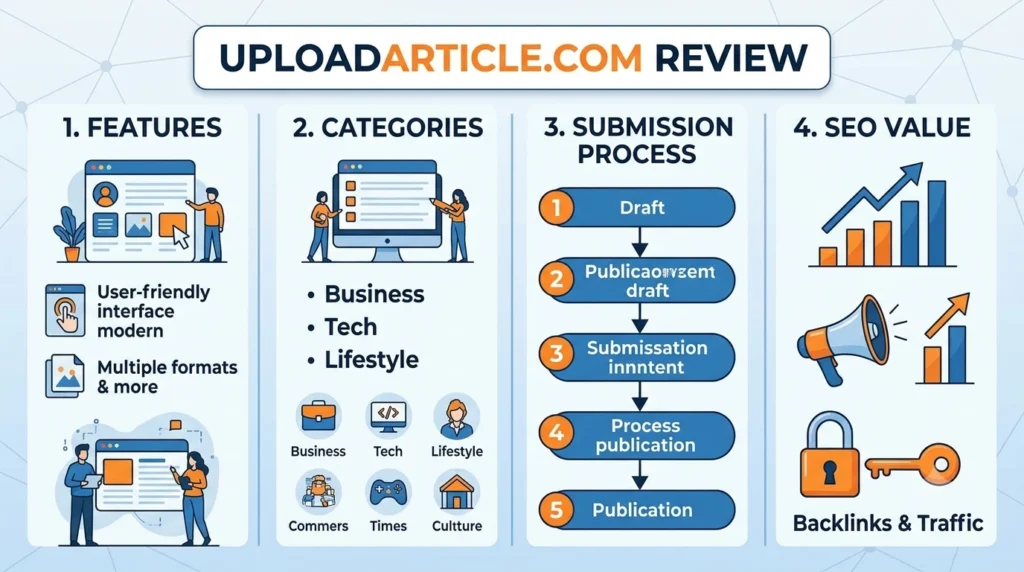
UploadArticle.com Review: Features, Categories, Submission Process and SEO Value.
Introduction
Finding a website where you can read articles, share knowledge or explore content across different subjects can be useful for both readers and writers. UploadArticle.com is an online publishing website that features articles covering topics such as education, business, travel, technology, health, finance and search engine optimisation.
However, before using an article publishing platform, it is important to understand what it offers, how its content is organised, what contributors should check before submitting an article and whether publishing there supports your wider content marketing goals.
For businesses and digital marketers, the most important question is not simply whether a website accepts articles. You should also consider its editorial standards, audience relevance, content quality and approach to external links.
This guide explores UploadArticle.com , its visible website features, article categories, contribution opportunities and potential SEO value. It also explains how to assess the platform before investing time or money in publishing content.
Quick Answer: What Is UploadArticle.com?
UploadArticle.com is an online article publishing website that hosts content across multiple categories. Its homepage displays article listings, category navigation, contributor-related pages and links to website policies.
The website includes topics such as education, health, business, travel, technology, SEO, finance and home and garden. It also has a “Write For Us” page, making it relevant to people researching article contribution opportunities.
For readers, the platform offers a way to discover articles on different subjects. For writers and businesses, it may be worth evaluating as a potential content distribution channel.
However, submitting an article does not automatically guarantee publication, referral traffic, a valuable backlink or improved search rankings. Those outcomes depend on the site’s policies, the quality and relevance of the content, and how readers discover and use the published material.
1. What Is UploadArticle.com?
UploadArticle.com is a website built around online articles and content publishing. Visitors can browse existing posts, explore subject categories and access pages related to contributing content.
The homepage includes article previews, author names, publication dates and category links. These elements help visitors identify topics of interest and navigate between different sections.
The website also publishes material related to SEO and digital marketing. Examples visible on the site include articles about guest posting, SEO agencies and content-related tools.
Who can use UploadArticle.com?
Different visitors may have different reasons for exploring the platform.
Readers can browse articles to learn about a subject, discover practical information or identify topics for further research.
Writers can investigate the contribution process and determine whether their expertise fits the website’s content categories.
Business owners may explore the website as one possible way to share useful information with an online audience.
Digital marketers can assess its editorial relevance, audience fit and linking policies before considering it for a content distribution campaign.
The website’s suitability depends on your goal. A platform that is useful for discovering general information may not necessarily be the best place to reach a specialist audience or support a particular marketing campaign.
2. What Categories Are Available on UploadArticle.com?
The website’s visible category menu includes several subject areas. These categories help visitors browse content without searching through every published post.
General
General content covers subjects that do not necessarily fit into one specialised category. It can include everyday questions, practical information and other broad topics.
When browsing this section, look for articles that provide clear answers and useful detail rather than relying solely on catchy headlines.
Health
Health-related articles may cover wellness, health education and related subjects. Because health information can affect important personal decisions, readers should verify medical claims through reliable healthcare sources.
Writers covering this category should use appropriate evidence and avoid unsupported treatment claims.
Business
The Business category may interest entrepreneurs, professionals and business owners looking for practical information.
Potential topics include business planning, operational decisions, professional services and other commercial subjects. For companies considering publication, the best contribution is one that addresses a genuine question rather than serving mainly as an advertisement.
Travel
Travel articles can help readers explore destinations, plan trips and discover travel-related ideas.
Before acting on travel information, confirm current details such as visa requirements, prices, transport schedules and opening hours through official sources.
Tech and Technology
The category navigation displays both “Tech” and “Technology”. These labels may represent separate site categories, so visitors should inspect each section rather than assume they contain identical articles.
Technology content can include digital tools, software, online services and emerging developments. Since products and platforms change frequently, publication dates and links to official documentation are particularly useful.
Education
Education content can help readers explore learning methods, educational terminology, career development and related subjects.
Students, parents and educators should check whether an article matches their location, education system and circumstances before relying on specific guidance.
SEO
The SEO category is especially relevant to website owners, content writers and digital marketers.
Articles in this area may cover search optimisation, link building, guest posting and content strategy. Readers should distinguish between practical recommendations supported by evidence and promotional claims that promise guaranteed rankings.
Home and Garden
This category may appeal to readers looking for household information, maintenance ideas, gardening guidance and home improvement topics.
For work involving electrical systems, structural changes or other significant safety risks, consult an appropriately qualified professional.
Finance
Finance articles may cover money management, trading, business finance and other financial subjects.
Readers should assess the evidence behind financial claims and avoid making investment or borrowing decisions based solely on a general online article.
Note: Category names and available content can change. Check the live website for its current navigation and published articles.
3. Key Features of the Website
When evaluating an article publishing website, it helps to examine its visible features and determine how they support the reader’s experience.
Article listings
The homepage displays article titles, previews and publication information. This allows visitors to scan the available content before opening a full post.
A useful article listing should communicate the topic clearly enough for readers to decide whether the page is relevant to them.
Category navigation
The category menu provides a starting point for finding related content. It is particularly helpful when a website covers several unrelated subjects.
For writers, category navigation can also help identify whether a proposed topic fits the website’s existing content structure.
Search functionality
A search field is visible on the website, allowing visitors to look for specific subjects. Search functionality can be useful when you know what you want to find but do not know which category contains it.
Write For Us page
UploadArticle.com provides a page titled “Write For Us”. This is the relevant starting point for investigating contributor opportunities.
Before preparing an article, review the current instructions to understand the submission requirements, acceptable subjects and any conditions concerning links or promotional content.
Contact and policy pages
The website also displays links to contact information and policies, including terms, a disclaimer and privacy information.
These pages are worth reviewing before you submit personal information, enter into a commercial arrangement or rely on the website for a specific service.
SEO and digital marketing content
The website includes SEO-related articles, making it potentially relevant to people researching content publishing and online marketing.
Nevertheless, the presence of SEO content alone does not establish the site’s authority, backlink quality or ability to improve another website’s search performance.
4. How to Submit an Article to UploadArticle.com
If you want to contribute content, begin by checking the website’s current “Write For Us” page. The precise requirements should be confirmed directly with the publisher because submission policies may change.
The following process provides a sensible preparation framework.
Step 1: Review the contribution guidelines
Visit the official website and locate the contributor instructions.
Check which topics are accepted, how articles should be submitted, whether author details are required and what rules apply to external links. If any information is unclear, contact the publisher before preparing a full article.
Step 2: Choose a relevant topic
Select a subject that fits an available category and addresses a real reader need.
For example, a digital marketing professional might propose an educational article explaining how to measure organic search performance. A home improvement specialist could offer a practical guide to planning routine maintenance.
Avoid choosing a topic only because it contains a keyword you want to promote.
Step 3: Research the subject
Gather accurate information from appropriate sources. Depending on the topic, these may include official documentation, government websites, research publications or recognised professional organisations.
Keep track of the sources used so you can verify factual claims and provide references where appropriate.
Step 4: Write original content
Prepare an article that contributes something useful beyond information already available elsewhere.
Include clear explanations, relevant examples and practical steps. Do not copy another article or lightly rewrite existing material without adding meaningful value.
Step 5: Edit and proofread
Check the article for grammar, spelling, factual accuracy and logical structure.
Use descriptive headings and manageable paragraphs. Remove repetitive explanations and ensure that the introduction accurately reflects what the article delivers.
Step 6: Review links and author information
If the guidelines permit author biographies or external links, include only information that is relevant to the article.
Use descriptive, natural anchor text. Avoid inserting multiple commercial links or repeating exact-match keywords simply to influence search rankings.
Step 7: Submit through the specified channel
Follow the submission method described in the current contributor instructions. Provide any requested author information, references and supporting material.
Keep a copy of your final article and submission details for your records.
Step 8: Wait for the editorial decision
Submission does not guarantee acceptance. The publisher may request revisions, ask for additional evidence or decline an article.
Do not assume that an article has been accepted or that a backlink will be provided until you receive clear confirmation.
5. What Makes a Good Article Submission?
A successful article should be useful to its intended audience first. Search optimisation can help readers discover content, but it should not replace quality or relevance.
Originality
Create material that reflects your own knowledge, research or experience.
A strong contribution provides a fresh explanation, a practical framework, an informed perspective or a useful example. Simply rearranging information from other websites rarely gives readers a compelling reason to choose your article.
Clear search intent
Understand what the reader is trying to accomplish.
Someone searching for “how to improve website speed” needs practical guidance. A person searching for “SEO services pricing” is more likely to want cost factors and comparison criteria.
Matching the content to the reader’s goal makes the article more useful than inserting keywords without context.
Accurate information
Verify statistics, product specifications, names, dates and other factual claims before submission.
For topics involving health, finance, law or safety, use appropriate sources and specialist expertise where needed. Outdated or unsupported information can undermine both reader trust and the publication’s credibility.
Readable structure
Organise the article around a clear progression of ideas.
Use an informative introduction, descriptive H2 and H3 headings, concise paragraphs and examples where they help explain a concept. Include a conclusion that gives readers a practical next step rather than repeating the introduction.
Relevant links
Every external link should serve a clear purpose. It might provide supporting evidence, direct readers to an official resource or explain a related concept in greater detail.
Links should not distract from the article or turn an educational contribution into a sales pitch.
Author transparency
Provide an accurate author name and relevant background when requested.
If you are writing about a specialist topic, describe your actual experience or qualifications without exaggeration. Readers should be able to understand the basis for your perspective.
6. Is UploadArticle.com Useful for SEO?
UploadArticle.com may be worth evaluating as a content publishing opportunity, but its SEO value should not be judged by the fact that it accepts or displays articles alone.
Search performance depends on many factors, including content quality, relevance, competition, technical accessibility and the usefulness of a page to its intended audience.
Content visibility
Publishing an informative article on an external website may introduce your expertise to people who would not otherwise encounter your business.
However, visibility depends on whether the article is discoverable, relevant to an audience and capable of attracting genuine interest. Publication alone does not guarantee visits or engagement.
Referral traffic
An article may generate referral traffic when readers find it useful and follow a relevant link to learn more.
To assess this outcome, track referral visits in your analytics platform and examine whether those visitors engage with your site or take meaningful actions.
A link that produces no relevant visitors may have limited direct marketing value, even if the article remains publicly accessible.
Backlinks and link quality
A backlink is a link from one website to another. Links can help people discover relevant resources, but their value cannot be determined by counting them alone.
Before pursuing a backlink, examine the context of the linking page, its topical relevance, editorial quality and the reason the link exists.
Google’s official spam policies identify manipulative link schemes as a violation of its guidelines. The policies include links created primarily to manipulate ranking signals, including paid links that pass ranking credit and large-scale guest-post campaigns with keyword-rich links.
Accordingly, do not treat article submission as a guaranteed link-building shortcut.
Brand awareness and expertise
An educational contribution can help explain your knowledge to a relevant audience. For example, a professional might publish a detailed guide that answers a question frequently asked by potential customers.
This approach can support brand awareness when the publication’s readership matches the business’s audience. Still, brand exposure should be evaluated separately from any claim about search ranking improvements.
How to assess SEO value before publishing
Use a broader checklist rather than relying on a single metric.
- Topical relevance: Does the website publish content related to your subject?
- Editorial quality: Are articles clear, useful and factually supported?
- Audience fit: Would the intended readers genuinely benefit from your contribution?
- Discoverability: Can readers find the article through the site’s navigation or search engines?
- Link policy: Are external links editorially justified and handled appropriately?
- Referral potential: Is there a realistic reason readers would visit your website?
- Measurement: Can you track visits, engagement and meaningful business outcomes?
A sensible decision considers the overall opportunity rather than assuming that a published link automatically improves SEO.
7. How to Evaluate the Website Before Publishing
Before committing time, money or marketing resources, review the website as you would any other potential publishing partner.
Examine recent articles
Read several articles across the categories relevant to your topic.
Check whether they answer the headline’s promise, contain useful information and provide adequate evidence. Look for repeated material, overly promotional writing and unsupported claims.
Check publication patterns
Review publication dates and the range of topics being covered. A large volume of posts is not inherently a problem, but it does not prove editorial quality or audience engagement.
Consider whether the website appears to maintain a coherent publishing standard across the pages that matter to your campaign.
Review author details
Look for identifiable writers and relevant biographies where appropriate.
For specialist subjects, author expertise and the quality of supporting sources are particularly important. Anonymous or unclear authorship may make it harder to evaluate the reliability of an article.
Read the website policies
Review the available terms, privacy policy, disclaimer and contributor instructions.
If you are paying for placement, ask for written details about the service, publication conditions, link attributes, revision process and any guarantees. Do not rely on vague promises about rankings or authority.
Verify the intended audience
A website can cover many topics without attracting the particular readers you want to reach.
Ask whether the site’s content, readership and editorial style match your audience. If reliable traffic or engagement information is available, use it to support your assessment rather than relying on promotional claims alone.
Start with a clear objective
Define what success would mean before publishing.
Your objective might be to share expertise, reach a new audience, generate qualified referral traffic or support a broader content campaign. The right evaluation criteria depend on the goal you choose.
8. UploadArticle.com for Businesses and Content Marketers
Businesses and marketers should approach external publishing as a content strategy rather than a task focused solely on acquiring links.
Share useful expertise
A business can contribute an article that answers a question customers regularly ask.
For example, a marketing agency might explain how businesses can assess website performance. A finance professional could write an educational guide to budgeting principles, provided the article uses suitable sources and makes the limits of general information clear.
The contribution should help readers even if they never become customers.
Reach a relevant audience
Choose subjects that connect naturally with your expertise and the publication’s readers.
An article that attracts a smaller but relevant audience may be more useful than a broad post that generates little meaningful engagement.
Support your wider content plan
External articles can complement your own website’s resources. A contributed guide might introduce a topic, while your website offers a deeper explanation, tool or related resource.
Make sure the two pieces serve distinct purposes. Copying the same article across several websites without adding value can create duplication and editorial problems.
Measure results
After publication, review available analytics to understand what happened.
Useful measures may include referral sessions, engaged visitors, newsletter subscriptions, enquiries and other relevant conversions. Do not attribute every change in organic rankings to a single external article without evidence.
Avoid unrealistic SEO promises
Be cautious of services promising guaranteed rankings, instant authority or a specific ranking benefit from every published link.
Search engines evaluate many signals, and no external publisher can guarantee a particular ranking outcome merely by accepting an article.
9. Common Mistakes to Avoid
Publishing content that adds little value
Articles created mainly to place a link may not meet readers’ needs. Provide original explanations, useful examples and evidence instead of padding the word count.
Overusing exact-match anchor text
Repeating a commercial keyword in external links can make a contribution appear manipulative. Use link text that accurately describes the destination and fits the context.
Ignoring the audience
A topic may be relevant to your business but unsuitable for a publication’s readers. Review the category, writing style and existing articles before submitting.
Assuming publication means endorsement
A published article or link does not necessarily indicate that the website independently endorses every claim made by the author.
Keep promotional claims accurate and make commercial relationships clear where required.
Skipping factual checks
Even a well-written article can mislead readers if its figures, references or recommendations are wrong. Verify important claims before submission and update content when material facts change.
Measuring success only by backlinks
A link count does not show whether an article reached the right audience or supported your business goals. Consider content quality, referral traffic and genuine reader value as well.
10. Final Thoughts
UploadArticle.com provides an online location for browsing articles across a range of subjects and offers a “Write For Us” page for people exploring contribution opportunities.
For readers, its category structure can help with content discovery. For writers and businesses, the website may be worth investigating as a potential publishing channel, provided its current guidelines and suitability are checked first.
The key is to evaluate the actual opportunity rather than relying on the domain name or promises about SEO. Review the site’s content, editorial standards, audience relevance and link policies before investing resources.
Most importantly, create articles that genuinely help people. Original research, clear explanations and relevant evidence provide a stronger foundation for sustainable content marketing than publishing solely to obtain a backlink.
A thoughtful publishing decision should benefit the reader, fit the publication and support a measurable objective. When those elements align, external content can become a useful part of a broader digital marketing strategy.
What is UploadArticle.com?
UploadArticle.com is an online article publishing website featuring content across multiple categories, including business, education, health, travel, technology, SEO, finance and home and garden.
Can writers submit articles to UploadArticle.com?
The website provides a “Write For Us” page for people investigating contribution opportunities. Review the current inst
Does publishing on UploadArticle.com guarantee a backlink?
What topics can be published on UploadArticle.com?
The visible category menu includes General, Health, Business, Travel, Tech, Technology, Education, SEO, Home and Garden, and Finance. Check the live website for current categories and any restrictions on submissions.
Is UploadArticle.com useful for SEO?
It may be worth evaluating as one possible content distribution channel. Its usefulness depends on editorial quality, topical relevance, audience fit and the actual outcomes you can measure. Publishing an article does not guarantee a backlink benefit or improved search rankings.
Should I pay for an article placement?
Assess the offer carefully before paying. Request written details about publication, audience, editorial review, link attributes and costs. Avoid services that promise guaranteed rankings or rely on manipulative link schemes.