
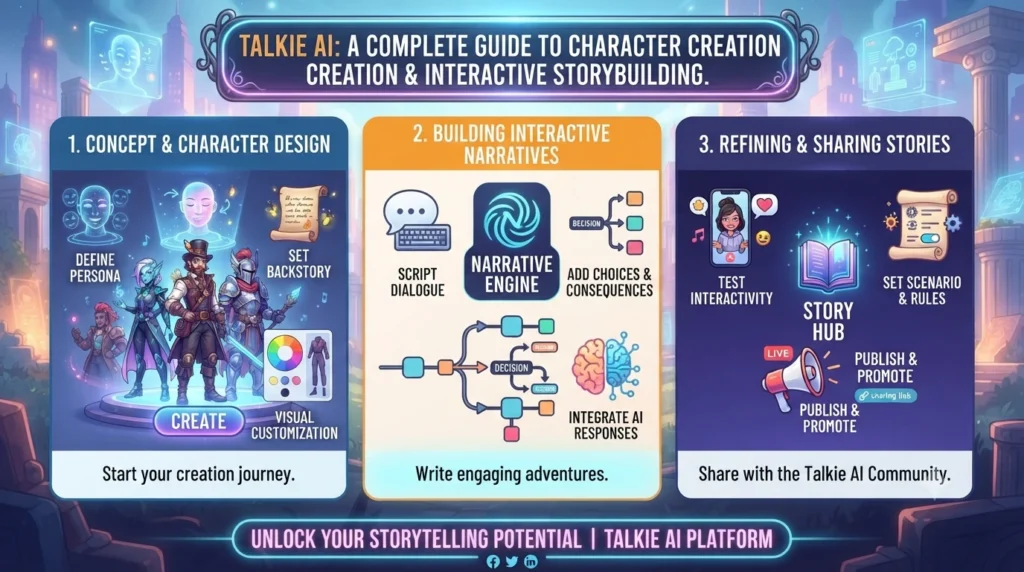
Talkie AI: How to Create Characters and Build Interactive Stories
Introduction
What if you could create a fictional character, give it a personality and have conversations with it whenever you wanted? That is the idea behind Talkie AI. Instead of limiting users to conversations with a general-purpose chatbot, the platform focuses on interactive AI characters that can take part in roleplay, storytelling and casual conversations.
Users can explore characters created by other people or develop their own virtual personalities. These characters can have different backgrounds, appearances, voices and conversational styles, making the experience feel more like participating in a fictional world than using a traditional chatbot.
Talkie AI is particularly interesting for people who enjoy creative writing, character development, fandoms and interactive entertainment. However, understanding how character creation works, what the platform offers and what limitations to consider can help users get more value from it.
This guide explores Talkie AI from a creative perspective, including its character-building features, storytelling possibilities, community experience, privacy considerations and practical tips for getting started.
What Is Talkie AI?
Talkie AI is an AI-powered character interaction platform developed by SUBSUP PTE. LTD. It allows users to discover, create and interact with virtual characters through AI-generated conversations.
Unlike a conventional chatbot that mainly responds to questions, Talkie AI places more emphasis on personality-based interactions. A character might be designed as a fantasy adventurer, fictional detective, historical personality, friendly companion or someone created entirely from a user’s imagination.
The platform combines several creative elements:
-
AI-powered conversations with virtual characters
-
Character creation and customisation
-
Roleplay and fictional storytelling
-
Voice-based character experiences
-
Community-created characters
-
Interactive entertainment and collectible elements
The experience depends on the character and the tools available in the user’s version of the platform. Some characters are designed for casual conversations, while others are created around specific fictional settings or scenarios.
According to Talkie’s official app information, its creative tools support character development and interactive roleplay. This makes it useful as an entertainment and storytelling environment rather than simply a question-and-answer chatbot.
How Does Talkie AI Work?
Talkie AI uses artificial intelligence to generate responses based on the character’s configuration and the ongoing conversation.
When a user selects a character, the platform provides a chat interface where they can send messages and receive AI-generated replies. The character’s personality, background and conversational instructions help shape how it responds.
For example, imagine selecting a fictional detective character. You might ask it to investigate a mysterious disappearance. Instead of giving a standard informational answer, the character may respond as though it is participating in a detective story.
The interaction generally follows this process:
-
Choose a character: Browse available characters and select one that matches your interests.
-
Start a conversation: Send a message or introduce a situation.
-
Receive an AI response: The character generates a reply based on its configured personality and the conversation.
-
Continue the interaction: Ask questions, introduce new events or change the direction of the story.
-
Explore other experiences: Try different characters or create one of your own.
The AI does not need to follow a fixed script for every conversation. Its responses can change depending on what the user says.
However, the technology is not perfect. A character may misunderstand instructions, produce repetitive replies or forget details from an earlier part of a long conversation. Talkie’s FAQ also acknowledges that AI memory has technical limitations.
Main Features of Talkie AI
Talkie AI brings together character-based conversations and creative tools. Here are some of the main features that shape the platform’s experience.
1. AI Character Discovery
One of the first things users can do is explore characters created by the platform’s community.
These characters may represent different personalities, fictional settings and conversational styles. Someone interested in fantasy might look for a magical character, while another user may prefer a friendly companion or a mystery-solving personality.
Character discovery gives users an opportunity to experience different types of AI interactions without having to create everything themselves.
It can also provide inspiration for people who want to build their own characters later.
2. Custom Character Creation
Character creation is an important part of Talkie AI.
Rather than only interacting with existing chatbots, users can develop characters based on their own ideas. This can include deciding what a character looks like, how it behaves and what kind of conversations it should support.
For example, a user writing a fantasy story could create a character with the following details:
| Character element | Example |
|---|---|
| Name | Arin |
| Role | Travelling explorer |
| Personality | Curious and adventurous |
| Background | Lives in a fictional kingdom |
| Interests | Ancient maps and hidden places |
| Conversation style | Friendly and imaginative |
These details help establish the character’s identity and provide direction for future interactions.
A well-defined character is generally easier to interact with than one with a vague description.
3. Personality-Based Conversations
Talkie AI focuses on characters with different personalities.
A character’s personality can influence its tone, vocabulary and responses. For example, a fictional professor might communicate in a thoughtful and educational way, while a fantasy warrior might use more dramatic language.
This gives conversations a specific direction.
However, users should remember that personality is generated through AI instructions and models. The character is not a real person and does not have genuine human emotions or personal experiences.
4. Interactive Roleplay
Roleplay is one of the most interesting ways to use Talkie AI.
Instead of asking isolated questions, users can create a scenario and allow the character to participate in it.
Some possible roleplay ideas include:
-
A detective investigating a fictional crime.
-
A traveller exploring an imaginary kingdom.
-
A student attending a fictional magic academy.
-
Two characters discussing a mystery.
-
A space explorer discovering an unfamiliar planet.
-
A writer testing dialogue between fictional characters.
For example, you could begin a conversation with:
“You are an explorer who has discovered an abandoned city. I am your travel companion. What do you see when we enter the main gate?”
The AI can then generate a response that moves the fictional situation forward.
This approach can make storytelling more interactive because the user can influence what happens next.
5. Voice and Visual Customisation
Talkie also offers creative features involving character appearance and voice.
Users can customise character profiles and explore voice-based interactions where supported. These features can make a character feel more distinctive and add another dimension to the conversation.
Visual presentation is particularly useful for character-based entertainment because users can associate a personality with a specific appearance.
The available creation tools may vary depending on the platform version, account and region. Users should check the current app interface for the features available to them.
6. Community-Created Content
Talkie AI is not limited to characters created by one development team. Users can explore content made by other creators.
This community element allows people to discover different character concepts, storytelling styles and creative ideas.
It also gives creators an opportunity to share their work with other users.
Before publishing a character, creators should review the platform’s community guidelines. Talkie restricts harmful content, harassment, exploitation and other inappropriate material.
7. Collectible Cards and Virtual Rewards
Talkie’s experience also includes collectible elements.
Its official FAQ describes a system in which conversations can lead to character-related cards. These cards may be traded among users for virtual currency, which can be used within the platform.
This adds a game-like element to the experience.
However, virtual rewards and collectible features should be understood as part of the platform’s entertainment system. Their availability and rules may change, so users should review the current in-app information before spending money or making decisions based on virtual items.
How to Create Your Own Character on Talkie AI
Creating a character is a good starting point for users who want something more personal than browsing existing AI personalities.
The exact interface may change with app updates, but the general character-building process can be approached in the following way.
Step 1: Decide What Your Character Will Be
Start with a simple idea.
Think about the type of character you want to create. It could be a fictional friend, fantasy creature, detective, teacher, historical-inspired personality or original character for a story.
Try to avoid making the concept too complicated at the beginning.
For example, “a friendly space explorer who enjoys discovering unusual planets” is a clear starting point.
Step 2: Choose a Name and Background
A character becomes easier to understand when it has a name and a basic background.
Consider questions such as:
-
Where does the character come from?
-
What does the character do?
-
What are its main interests?
-
What kind of world does it live in?
-
What makes it different from other characters?
You do not need to write a complete biography. A few useful details can provide enough context for a basic character.
Step 3: Define Its Personality
Personality is one of the most important parts of character creation.
Think about how the character should communicate. Should it be funny, serious, curious, confident, calm or mysterious?
You can also describe its communication style.
For example:
“Arin is a curious and friendly explorer. He enjoys discussing unusual places, asking questions and sharing imaginative stories. He communicates in a relaxed and encouraging manner.”
This gives the AI clearer instructions than simply describing the character as friendly.
Step 4: Add Appearance and Voice Details
Where supported, customise the character’s visual appearance and voice.
Try to make these details consistent with the character’s background.
A futuristic scientist might have a different visual style from a medieval knight. Similarly, a calm narrator may suit a different voice style from an energetic adventure character.
Step 5: Test the Character
Once the character has been created, start a few conversations.
Ask questions that relate to its personality and background. Check whether its responses match the type of character you intended to build.
If the replies feel too generic, consider improving the description or adding more specific instructions.
Step 6: Review Before Sharing
If you plan to publish your character, review its profile and content carefully.
Make sure it follows Talkie’s community guidelines and does not include private information, harmful material or content that violates intellectual property rights.
A clear character description can also help other users understand what kind of interaction to expect.
How Talkie AI Can Help With Creative Writing
Talkie AI can be useful for people who enjoy writing stories but sometimes struggle to develop ideas or dialogue.
It offers a different way to experiment with fictional situations. Instead of writing every line yourself, you can interact with a character and see how an AI-generated response develops the scene.
Here are some practical applications.
Developing Fictional Characters
Writers often create detailed character profiles before starting a story.
Talkie AI can provide an interactive way to test those personalities. You can ask a fictional character questions and observe whether its responses match the personality you have planned.
For instance, if your character is supposed to be impatient and sarcastic, you can test different situations to see whether its replies reflect those traits.
The responses may give you ideas for improving the character.
Testing Dialogue
Dialogue can sometimes sound unnatural when every line is written from one person’s perspective.
Interacting with an AI character can help writers explore alternative responses.
You might introduce an argument between two fictional characters and use the conversation to generate possible dialogue directions.
The results should be treated as creative suggestions rather than finished writing.
Exploring Story Ideas
If you have a basic story concept but do not know how to develop it, roleplay can help you explore different possibilities.
For example, you could introduce a character into a fictional world and ask what happens when an unexpected event occurs.
This may help you discover new plot directions, conflicts or character motivations.
Overcoming Writer’s Block
Sometimes the hardest part of writing is getting started.
A short conversation with a fictional character can help you experiment with ideas without worrying about producing a perfect first draft.
You can use the interaction to explore settings, character relationships and possible story endings.
Still, AI-generated material should be reviewed, edited and checked before being included in a finished publication.
Talkie AI for Entertainment and Everyday Conversations
Although creative writing is one possible use, Talkie AI is also designed for entertainment.
Some users may simply want to have a casual conversation with a fictional personality or explore different characters during their free time.
Common entertainment uses include:
-
Casual conversations with virtual characters.
-
Exploring fictional worlds and scenarios.
-
Participating in interactive roleplay.
-
Discovering characters created by other users.
-
Experimenting with different personalities.
-
Collecting virtual character-related rewards.
The experience is different from talking to a general-purpose AI assistant.
A traditional assistant is usually designed to help with information, tasks and problem-solving. Talkie AI focuses more on character interaction and entertainment.
It is important not to treat AI-generated conversations as a replacement for real friendships, professional advice or human support.
Is Talkie AI Free to Use?
Talkie AI offers access to its platform with additional in-app features and purchases.
However, not every feature necessarily comes at no cost.
The platform’s official FAQ describes Talkie+ as a subscription service with additional benefits. It also discusses virtual currency, recharges and collectible features.
Subscription prices, available benefits and purchase options can vary by region and may change over time. Therefore, users should check the current pricing displayed in their app or account before purchasing anything.
Before subscribing, consider:
-
Which features are included in the free experience?
-
What additional benefits does the subscription provide?
-
Are virtual currency purchases optional?
-
Does the subscription renew automatically?
-
How can you manage or cancel a subscription?
-
What are the refund conditions?
It is sensible to understand the payment terms before making a purchase, especially when virtual currency or recurring subscriptions are involved.
Talkie AI Privacy and Safety: What Should Users Know?
AI character platforms can involve personal conversations, user-created content and account information. Understanding privacy and safety is therefore important.
Talkie’s privacy policy explains that the service may collect account details and information users provide while interacting with the platform. It also describes how conversation information may be processed to support personalised interactions and improve the service.
The policy states that conversation content is not used or disclosed for marketing or advertising purposes. Users should still read the full policy to understand the platform’s data practices, rights and settings.
Avoid Sharing Sensitive Personal Information
Even when a conversation feels private, it is better not to share information that could expose your identity or create security risks.
Avoid entering details such as:
-
Passwords and login credentials.
-
Bank account or payment information.
-
Government identification numbers.
-
Home or workplace addresses.
-
Private contact details.
-
Personal information about family members.
This is a sensible precaution when using any online chatbot or social platform.
Understand That AI Responses Can Be Incorrect
AI characters can generate convincing responses, but that does not mean every answer is accurate.
Talkie’s FAQ also advises users to exercise judgement because AI-generated information may be inaccurate or unverified.
Do not rely on a fictional character for medical, legal, financial or other high-stakes advice. Verify important information through appropriate professional or authoritative sources.
Check the Age Requirements
Talkie’s terms state a general minimum age of 14, with higher minimum ages applying in certain countries. For example, the terms list 16 as the minimum in several countries and 15 in others.
The Australian eSafety Commissioner lists Talkie as 16+ in its guide. This demonstrates why users should check the rules applicable to their location rather than assuming one age requirement applies everywhere.
Parents and guardians should also consider the nature of AI character interactions, user-generated content and in-app purchases before allowing younger people to use the platform.
Follow Community Guidelines
Talkie’s community guidelines prohibit content involving harassment, hateful behaviour, exploitation, harmful activities and other inappropriate material.
Users should review these rules before creating or sharing characters.
If they encounter content that appears unsafe or violates platform standards, they can use the available reporting options.
Common Limitations of Talkie AI
Talkie AI offers creative possibilities, but users should understand that it has limitations.
| Limitation | What it means for users |
|---|---|
| Limited AI memory | Characters may forget earlier conversation details |
| Inconsistent responses | Replies may not always match the intended personality |
| Incorrect information | AI-generated answers may contain mistakes |
| Moderation delays | Character changes may take time to appear |
| Feature availability | Tools may differ across versions and regions |
| In-app purchases | Some additional benefits may require payment |
Characters May Forget Previous Conversations
One common issue with AI chatbots is limited memory.
A character might remember recent messages but lose track of details from an earlier conversation. This can interrupt a long roleplay or make a fictional character behave inconsistently.
One practical solution is to briefly remind the character of important details when continuing a story.
AI Responses May Feel Repetitive
Sometimes a character may repeat similar phrases or respond in a predictable way.
This can happen when the character description is too general or the conversation lacks a clear direction.
Try providing more specific context or introducing a new situation to encourage different responses.
Customisation May Require Moderation
Talkie’s FAQ explains that character modifications can go through moderation. As a result, changes may not appear immediately, and content that is flagged may be temporarily removed.
Users should allow time for review and make sure their character descriptions follow the platform’s rules.
Talkie AI vs Traditional AI Chatbots
Talkie AI and general-purpose AI chatbots both use artificial intelligence, but their main purposes are different.
| Comparison | Talkie AI | Traditional AI chatbot |
|---|---|---|
| Main purpose | Character interaction and entertainment | Information, assistance and tasks |
| Conversations | Personality-based | Usually task or question-based |
| Roleplay | A central use case | Often an additional capability |
| Character creation | Focuses on creating virtual personalities | Varies by platform |
| Creative storytelling | Interactive character scenarios | Writing and idea generation |
| Community content | User-created characters and experiences | Depends on the service |
Neither approach is automatically better.
Someone who wants to explore fictional personalities may prefer Talkie AI. Someone who needs help with research, writing, coding or everyday tasks may find a general-purpose assistant more suitable.
The right choice depends on what the user wants to accomplish.
Tips for Getting Better Results From Talkie AI
A good experience often depends on how clearly you communicate with the character.
Here are a few practical suggestions.
1. Give the conversation a clear direction. Instead of sending random messages, introduce a situation or topic that the character can respond to.
2. Choose characters carefully. Read their descriptions and select personalities that match the type of interaction you want.
3. Use detailed character instructions. If you are creating a character, explain its background, personality and communication style.
4. Remind characters about important details. If an AI forgets something from an earlier conversation, briefly provide the missing context.
5. Experiment with different scenarios. Try storytelling, fictional interviews, mystery-solving or imaginative conversations.
6. Be careful with personal information. Keep sensitive details out of chatbot conversations.
7. Check spending options. Review subscription and virtual currency terms before making purchases.
8. Treat AI responses as generated content. Enjoy the interaction, but do not assume every response is factual or reliable.
Conclusion
Talkie AI offers a creative approach to AI-powered conversations by placing virtual characters, roleplay and interactive storytelling at the centre of the experience. Users can explore existing personalities, build original characters and experiment with fictional situations without having to write every part of a conversation themselves.
Its character creation tools and community features make it interesting for people who enjoy storytelling, imaginative conversations and AI-based entertainment. At the same time, limitations such as imperfect memory, repetitive replies, moderation delays and paid features are worth understanding.
The best way to approach Talkie AI is to treat it as a creative platform rather than a replacement for real human interaction or a source of guaranteed information. With clear character instructions, thoughtful prompts and sensible privacy habits, users can explore its creative possibilities while keeping realistic expectations.
What is Talkie AI mainly used for?
Talkie AI is mainly used for interacting with AI-generated characters. People can explore virtual personalities, participate in roleplay, create characters and experiment with interactive storytelling.
Can I create my own characters on Talkie AI?
Yes. Talkie provides character creation tools that allow users to develop virtual personalities. Depending on the available tools, users can customise character details, appearance, profile information and voice.
Are Talkie AI characters real people?
No. Talkie characters are AI-generated virtual personalities. Their responses are produced using AI technology rather than being sent by real people controlling the characters.
Can Talkie AI be used for storytelling?
Yes. Users can create fictional scenarios and interact with characters to explore dialogue, plot ideas and different story directions. It can be useful for creative experimentation, although the generated content may need editing.
Does Talkie AI remember previous conversations?
Talkie AI has limitations when it comes to remembering conversation history. Its official FAQ acknowledges that characters may forget older details because of technical memory limitations.