
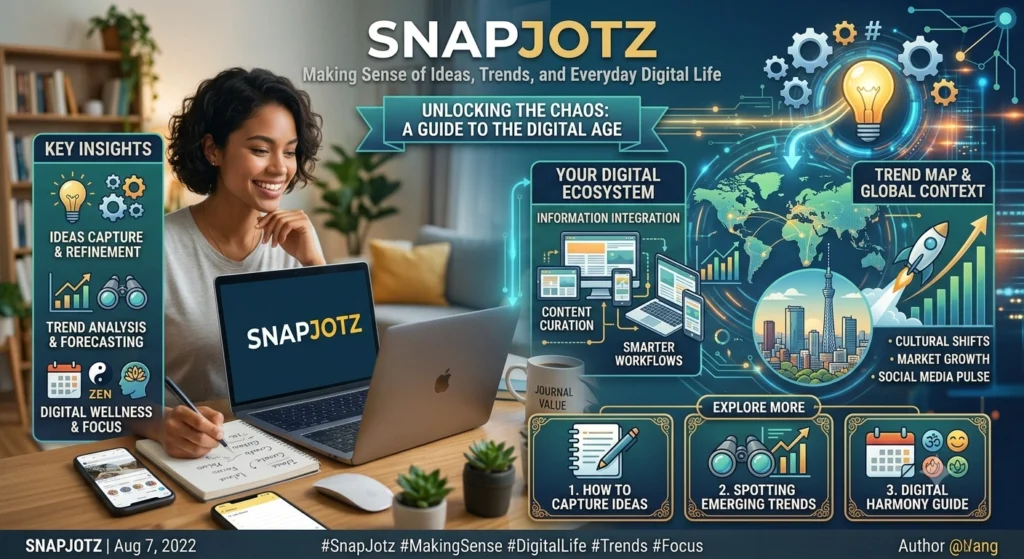
SnapJotz Making Sense of Ideas, Trends, and Everyday Digital Life.
Introduction
The digital world has changed how people discover information. A question that once required a book, newspaper, or conversation can now be answered within seconds through a search engine, social platform, website, or digital assistant.
But fast access to information also creates a challenge: how do people identify what is useful?
Every day brings new technologies, social trends, lifestyle ideas, online conversations, and digital tools. Readers need content that doesn’t simply repeat information but helps them understand it.
SnapJotz represents a modern digital content concept focused on useful discoveries, technology, lifestyle, productivity, online culture, and emerging trends.
The idea is to turn interesting subjects into clear, accessible stories that readers can understand and potentially apply in everyday life.
What Is SnapJotz?
SnapJotz can be viewed as a digital publishing concept centered around discovering, explaining, and sharing useful ideas.
A publication built around the SnapJotz concept could cover:
- Technology
- Artificial intelligence
- Digital tools
- Lifestyle
- Productivity
- Social media
- Online culture
- Entertainment
- Travel
- Consumer trends
- Everyday solutions
- Emerging ideas
The focus isn’t necessarily on one narrow subject.
Instead, it is about helping readers discover something useful across different areas of modern life.
Why Digital Discovery Has Changed
Information discovery used to be more linear.
People might read a newspaper, watch a television program, visit a library, or ask someone they knew.
Today, discovery can happen through:
- Search engines
- Social media
- Short-form videos
- Newsletters
- Podcasts
- Blogs
- Online communities
- Digital recommendations
A person can encounter a subject almost anywhere and then investigate it further.
This has made digital content an important part of everyday decision-making.
The Problem With Too Much Content
More information doesn’t automatically mean better information.
Readers may find:
- Duplicate articles
- Outdated information
- Clickbait
- Unsupported claims
- Generic advice
- Poorly organized explanations
This makes content quality and clarity increasingly important.
A useful digital publication should help readers move from curiosity to understanding.
What Makes an Article Worth Reading?
A strong article should provide a clear benefit.
It can:
- Answer a specific question.
- Explain an unfamiliar concept.
- Solve a practical problem.
- Analyze an emerging trend.
- Compare different approaches.
- Introduce a useful tool.
- Provide context around a subject.
The reader should leave with a clearer understanding of the topic.
SnapJotz and Everyday Discoveries
Some of the most useful content starts with ordinary experiences.
1. Common Questions Can Become Useful Stories
For example:
- How can I organize my digital files?
- Why is a particular app becoming popular?
- How can I reduce distractions?
- What should beginners know about AI?
- Why has an online trend suddenly appeared?
These questions represent real information needs.
2. Small Ideas Can Have Practical Value
Useful content doesn’t always require a complicated solution.
Simple ideas such as:
- Creating a daily priority list
- Organizing frequently used files
- Turning off unnecessary notifications
- Planning tasks ahead
- Setting aside focused work periods
can make digital routines easier to manage.
The important part is explaining how the idea can actually be used.
SnapJotz and Technology
Technology continues to reshape everyday experiences.
3. Technology Is Part of Daily Life
People use digital technology for:
- Communication
- Education
- Work
- Shopping
- Banking
- Entertainment
- Travel
- Personal organization
This means technology articles should not be written only for experts.
Clear explanations can help beginners understand why a development matters.
4. Artificial Intelligence Is Expanding Its Role
AI has become a major part of the digital conversation.
Topics include:
- Generative AI
- AI assistants
- AI search
- Automation
- AI productivity tools
- AI-powered applications
- AI in education
- AI in business
Rather than focusing only on technical features, useful content should explain the practical impact.
5. A Simple Framework for Explaining Technology
A technology article can answer five questions:
What is it?
Define the technology simply.
How does it work?
Explain the basic process.
Who can use it?
Identify relevant users.
What can it do?
Provide realistic examples.
What are its limitations?
Explain where expectations should be kept realistic.
This structure helps readers understand new technology without unnecessary complexity.
SnapJotz and Lifestyle
Technology isn’t the only area where people look for practical information.
Lifestyle content can address everyday needs.
6. Useful Lifestyle Topics
Potential subjects include:
- Organization
- Productivity
- Time management
- Travel
- Food
- Entertainment
- Home routines
- Hobbies
- Personal planning
- Digital habits
These subjects become stronger when they address specific problems.
7. Make Advice Actionable
Instead of:
“Get organized.”
A more useful recommendation might be:
“Create one location for frequently used digital documents and review it once a week.”
The second version gives readers an action they can understand and test.
SnapJotz and Online Trends
Online trends can develop extremely quickly.
8. Look Behind the Trend
A useful trend article can examine:
- Where the trend started
- Why it gained attention
- Who participates
- How it spread
- Why people find it interesting
- Whether it may continue
This gives readers more than a simple description of what is popular.
9. Trends Can Reveal Changing Habits
Online trends may indicate broader shifts in:
- Consumer behavior
- Communication
- Entertainment
- Technology adoption
- Work culture
- Lifestyle preferences
The trend itself may be temporary, but the behavior behind it can be meaningful.
SnapJotz and Social Media
Social media has become one of the most important ways people discover content.
10. Discovery Often Begins With a Short Post
A reader may first encounter a subject through:
- A video
- An image
- A short post
- A recommendation
- A comment
- A shared article
That initial discovery can lead to longer-form content that provides deeper context.
11. Turn One Idea Into Multiple Formats
A detailed article can be adapted into:
| Original Content | New Format |
|---|---|
| Guide | Short video |
| Research | Infographic |
| FAQ | Social post |
| Interview | Quote card |
| Tutorial | Video walkthrough |
| Trend analysis | Newsletter |
This gives publishers more ways to reach audiences.
Search Intent and SnapJotz
Understanding search intent helps content creators answer the right question.
12. Informational Intent
Example:
“What is digital media?”
The reader wants an explanation.
13. How-To Intent
Example:
“How to organize a digital workspace?”
The reader wants practical instructions.
14. Comparison Intent
Example:
“Best ways to manage digital tasks”
The reader wants to compare different methods.
15. Discovery Intent
Example:
“Emerging digital trends”
The reader wants to explore new developments.
Matching content to search intent improves relevance and user satisfaction.
Building Topic Clusters
Related content can be connected into topic clusters.
For example, a productivity cluster might include:
- How to Organize Your Workday
- Digital Task Management Explained
- Ways to Reduce Online Distractions
- Simple Planning Methods
- Digital Tools for Productivity
- Building Sustainable Work Habits
This gives readers multiple entry points into the same subject.
SnapJotz and Visual Storytelling
Visuals can make digital information easier to understand.
16. Images Should Support the Story
Relevant images can help explain:
- Products
- Places
- Technology
- People
- Events
- Processes
- Concepts
A visual should have a purpose rather than simply decorate the page.
17. Infographics Can Present Complex Information
Infographics work well for:
- Statistics
- Comparisons
- Timelines
- Processes
- Trend summaries
They allow readers to scan structured information quickly.
18. Video Can Show Processes
Video can be particularly useful for:
- Tutorials
- Demonstrations
- Interviews
- Walkthroughs
- Educational explainers
The best format depends on the information being communicated.
Accuracy and Trust
Digital publishing moves quickly, but accuracy remains essential.
19. Verify Important Claims
Before publishing factual information, ask:
- Is the source reliable?
- Is the information current?
- Can the claim be verified?
- Is additional context necessary?
- Could the information have changed?
This process helps protect reader trust.
20. Keep Time-Sensitive Content Updated
Information about these areas can change rapidly:
- Technology
- Software
- Business
- Social media
- Travel
- Digital services
Content should be reviewed when important changes occur.
21. Distinguish Facts From Opinions
Readers should be able to recognize whether information is:
Fact: Independently verifiable information.
Analysis: Interpretation of information.
Opinion: A specific viewpoint.
Prediction: An expectation about a future development.
This distinction makes digital content more transparent.
SnapJotz and AI-Assisted Publishing
AI is becoming increasingly common in content workflows.
22. AI Can Support Content Creation
AI tools can assist with:
- Brainstorming
- Outlining
- Summarization
- Translation
- Content organization
- Repurposing
- Workflow automation
These capabilities can reduce repetitive work.
23. Human Review Is Essential
AI-generated content can sometimes contain:
- Incorrect facts
- Outdated information
- Missing context
- Repetitive wording
- Unsupported claims
Human review helps ensure the final content is accurate and useful.
24. Original Value Matters More Than Volume
Producing more content doesn’t automatically make a publication more valuable.
Strong content can differentiate itself through:
- Original examples
- Useful research
- Clear explanations
- Fresh perspectives
- Practical recommendations
- Audience-specific insights
The objective should be to add value, not simply increase the number of pages.
A Practical SnapJotz Publishing Process
Step 1: Identify an Idea
Look for questions, problems, trends, and interesting observations.
Step 2: Define the Reader
Determine who would benefit from the topic.
Step 3: Understand Search Intent
Identify what the reader actually wants.
Step 4: Research
Gather reliable and relevant information.
Step 5: Create an Outline
Arrange the information logically.
Step 6: Answer the Main Question
Give readers the essential information early.
Step 7: Add Context
Explain why the subject matters.
Step 8: Include Examples
Make the topic practical and relatable.
Step 9: Verify Details
Check important facts, dates, names, and claims.
Step 10: Update
Refresh useful articles when information changes.
Content Categories for SnapJotz
| Category | Example Focus |
|---|---|
| Technology | AI, apps, software, digital tools |
| Lifestyle | Habits, routines, everyday ideas |
| Productivity | Organization, planning, focus |
| Digital Culture | Online communities and behavior |
| Trends | Emerging interests and developments |
| Entertainment | Digital entertainment and popular culture |
| Travel | Destinations and planning |
| How-To | Practical tutorials and guides |
This combination allows the publication to serve readers with different interests.
Common Digital Content Mistakes
Chasing Every Trend
Not every viral subject is relevant to every audience.
Using Clickbait
A headline should attract attention without creating a false expectation.
Writing Without a Clear Purpose
Every article should answer a real information need.
Repeating Existing Content
Add context, examples, research, or a distinct perspective.
Ignoring Accuracy
Unverified information can damage credibility.
Forgetting Existing Articles
Older useful content can often be improved and updated.
10 Principles for Better Digital Content
- Start with a real reader question.
- Understand the target audience.
- Match content to search intent.
- Answer the main question early.
- Add useful context.
- Use practical examples.
- Verify important information.
- Make content easy to scan.
- Use visuals when they improve understanding.
- Focus on usefulness rather than volume.
Frequently Asked Questions
What is SnapJotz?
SnapJotz can be viewed as a digital content concept focused on useful discoveries, technology, lifestyle, productivity, online trends, and everyday ideas.
What topics can SnapJotz cover?
Potential topics include technology, AI, lifestyle, productivity, entertainment, travel, social media, digital culture, emerging trends, and practical everyday subjects.
Why is digital content important?
Digital content helps people discover information, learn new skills, solve problems, follow developments, and make informed decisions.
What makes an article useful?
A useful article answers a genuine question, provides accurate information, adds context, uses practical examples, and gives readers clear takeaways.
Can AI be used in content publishing?
Yes. AI can support brainstorming, outlining, summarization, translation, organization, and content repurposing, while human review remains important.
What is evergreen content?
Evergreen content addresses recurring questions and remains useful over time, such as tutorials, guides, definitions, and practical resources.
Conclusion
SnapJotz represents a modern approach to digital discovery—bringing together useful ideas, technology, lifestyle, productivity, online trends, and everyday experiences.
The internet gives people access to more information than ever before, but access alone isn’t enough.
Readers need information that is understandable.
They need context that helps them interpret new developments.
They need practical ideas they can apply.
And they need content they can trust.
A SnapJotz-style publication can address these needs by turning interesting questions and emerging subjects into clear, useful digital stories.
Technology will continue to evolve. Social platforms will change. New trends will appear. Content formats will develop.
But the basic purpose of useful publishing will remain the same: help people discover something meaningful and understand what to do with it.
By combining research, clear writing, practical examples, visual storytelling, and responsible editorial practices, SnapJotz can create content that goes beyond attracting attention.
It can create content that readers remember and return to.
In a crowded digital environment, the best discovery is not simply something new—it is something genuinely useful.