
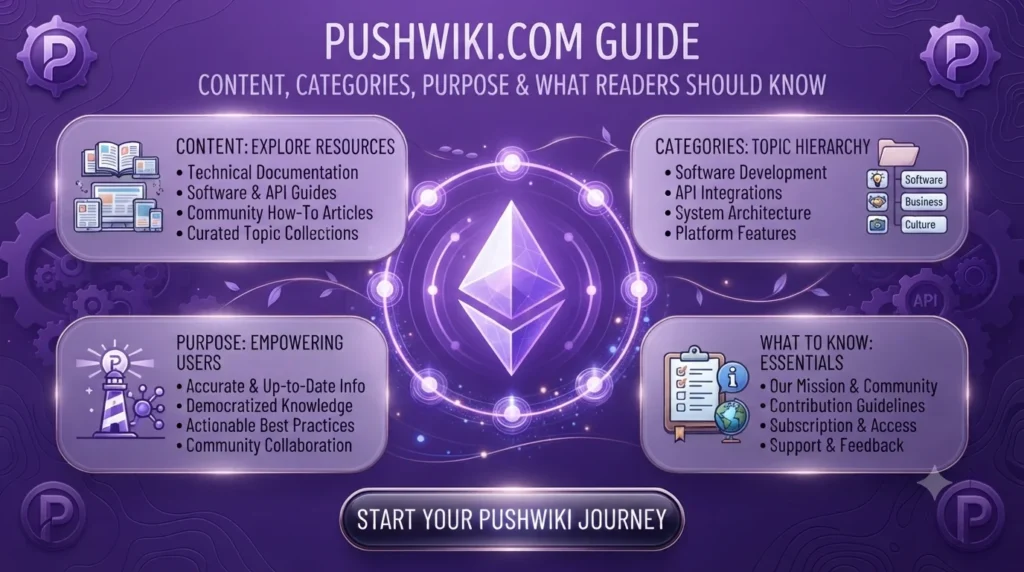
Pushwiki.com Guide: Content, Categories, Purpose and What Readers Should Know.
Introduction
Pushwiki.com is a multi-topic online publishing website that covers subjects such as business, technology, finance, education, health, law, lifestyle, and other areas of general interest. Its current pages show a mixture of guides, explainers, reviews, news-style articles, and practical informational content.
The name “Pushwiki” can be slightly confusing because the website does not operate like a traditional community-edited wiki. Instead, visitors encounter individual articles organized into categories, with publication dates and author names displayed on many pages.
Current content ranges from business and finance articles to technology guides, educational resources, health-related subjects, and practical how-to material. The website also publishes articles about other online platforms and digital trends.
This guide explains what Pushwiki.com is, what type of content it publishes, how its categories work, how readers can evaluate its information, and what to consider before relying on an article for an important decision.
Quick Answer: What Is Pushwiki.com?
Pushwiki.com is a broad online publication that provides articles and guides across multiple subject areas.
Its current website includes categories such as Business, Technology, Finance, Education, Health, Law, and Blog content. Recent posts cover subjects ranging from business trends and digital publishing to AI, personal finance, educational technology, and practical online questions.
Rather than functioning as an open encyclopedia, Pushwiki.com uses a conventional content-publishing structure. Articles appear under categories, include publication information, and are generally written as standalone pieces.
Pushwiki.com at a Glance
| Factor | Details |
|---|---|
| Website | Pushwiki.com |
| Website type | Multi-topic online publication |
| Main purpose | Publishing informational and practical articles |
| Content areas | Business, technology, finance, education, health, law and more |
| Article formats | Guides, explainers, reviews, informational articles and news-style content |
| Audience | General online readers |
| Publishing model | Category-based article publication |
| Main benefit | Broad range of topics in one place |
| Important consideration | Individual articles should be evaluated for accuracy and freshness |
The exact content mix can change as new articles are published. Checking the current category pages provides the clearest picture of what the website covers at a particular time.
What Is Pushwiki.com?
Pushwiki.com is an online content publication that brings together articles from several different categories.
A visitor can find business information in one section and technology content in another. Finance, education, health, law, and general blog content also appear across the site’s current structure.
The site’s publishing approach resembles a general-interest blog network more than a specialist publication. Readers can therefore use it to explore a wide range of subjects without visiting a separate website for every basic question.
Current examples show how broad the editorial mix can be. Pushwiki.com has published material about SoSoActive, hyperconverged infrastructure, AI chatbots, personal finance, educational technology, health-related subjects, and other topics.
That variety is one of the site’s defining characteristics.
How Does Pushwiki.com Work?
Pushwiki.com organizes information through categories and individual article pages.
Most articles have a visible title, publication date, author attribution, and category association. The category pages then collect related articles in one location.
For example, the current Technology section contains articles about MetaPress, AI chatbots, Instagram privacy tools, smartphone functions, network security, and other technology subjects.
The Business section follows a similar structure. Current posts cover topics such as entrepreneurship, IT infrastructure, business services, shipping, and other commercial subjects.
Readers can therefore approach the website in two ways:
- Search for a specific topic.
- Browse a category and discover related articles.
This structure is common among modern content websites because it supports both search traffic and casual browsing.
What Topics Does Pushwiki.com Cover?
Pushwiki.com has a broad editorial scope.
The current site contains dedicated sections or content relating to:
- Business
- Technology
- Finance
- Education
- Health
- Law
- Lifestyle
- General blog topics
- Digital platforms
- Online services
- Practical guides
- Current or trending subjects
The categories are not limited to one professional industry. Instead, Pushwiki combines informational material from different parts of everyday digital life.
Such a structure can make the site useful for readers who have varied interests.
Business Content on Pushwiki
Business is one of the prominent areas within Pushwiki.com’s current content structure.
Recent business articles cover entrepreneurship, business technology, infrastructure, services, and practical commercial questions. The category includes both broad explanatory content and more specific articles aimed at people researching particular business issues.
One recent example discusses SoSoActive and its business, finance, entrepreneurship, marketing, e-commerce, and IT categories. Another article explores hyperconverged infrastructure deployment.
Business readers may therefore encounter:
- Entrepreneurship topics
- Business software
- Digital marketing
- IT infrastructure
- E-commerce
- Business services
- Workplace questions
- Practical business guides
The usefulness of any individual article depends on its research quality and relevance to the reader’s situation.
For decisions involving contracts, investments, legal obligations, or major financial commitments, readers should verify important information with authoritative sources.
Technology and AI Content
Technology is another major part of the Pushwiki.com content mix.
The current Technology category includes articles about AI chatbots, digital publishing platforms, smartphone functions, online privacy, network security, and other technology-related subjects.
Some articles are designed for beginners. A technology guide may explain a concept in straightforward language before moving into practical details.
Other posts focus on specific products, platforms, or current developments. Such articles can become outdated more quickly because technology changes frequently.
A useful way to read technology content is to check:
- The publication date.
- Whether the article has been updated.
- Whether product specifications are supported by official documentation.
- Whether pricing information is still current.
- Whether the recommended process matches the latest software version.
Technology readers should be especially careful with older tutorials. Interfaces, features, pricing, and service policies can change after an article is published.
Finance and Personal Finance Topics
Finance is another category represented on Pushwiki.com.
Current finance content includes subjects such as banking rules, stock-related discussions, personal budgeting, cryptocurrency, and other financial topics.
Personal finance articles can be helpful when someone wants a basic explanation of budgeting, financial terminology, or general concepts.
Investment-related content requires a different level of caution.
A blog article should not automatically be treated as personalized financial advice. Market conditions can change, and investment decisions depend on an individual’s financial circumstances, risk tolerance, objectives, and applicable regulations.
Anyone making a significant financial decision should verify important information through appropriate primary sources, financial institutions, regulators, or qualified professionals.
Education and Career Topics
Pushwiki.com also publishes educational content.
The Education category currently includes website-building guidance, augmented and virtual reality in education, certification courses, EdTech tools, and other learning-related topics.
Students can use introductory articles to understand unfamiliar subjects. Teachers, parents, and professionals may also find practical ideas for learning and technology use.
Educational content becomes more useful when readers treat it as a starting point rather than an automatic replacement for formal academic resources.
For research papers or professional work, primary documents, academic publications, institutional websites, and official educational sources may provide stronger evidence.
Health and Wellness Content
Health is another subject represented on the website.
Current Pushwiki health content includes topics involving medical technology, AI in healthcare, wellness, beauty-related supplies, and general health information.
General health articles can help readers understand terminology or discover questions they may want to discuss with a professional.
Medical decisions require greater caution.
Symptoms, diagnoses, medications, treatments, and urgent health concerns should be evaluated using appropriate medical sources and professional advice. An online article can provide background information, but it should not be treated as a substitute for a qualified healthcare professional.
The publication date also matters because medical guidance and technology can change.
Law and Practical Information
Pushwiki.com also has a Law category.
Current articles include subjects such as commercial litigation and child-support modification.
Legal topics can be useful for general education, particularly when a reader wants to understand terminology or identify questions to ask a professional.
Legal rules vary by jurisdiction, however.
A general online article may not account for a person’s location, specific circumstances, recent legislative changes, or court decisions. Anyone facing an important legal matter should therefore consult applicable official sources or a qualified legal professional.
Guides and How-To Articles
Practical guides are another important part of Pushwiki.com’s content.
One example is its guide to building a first website. The article covers subjects such as choosing a domain, selecting hosting, planning website structure, choosing a theme, creating pages, adding media, and installing plugins.
This type of article can be particularly useful for beginners.
Step-by-step content works best when instructions remain current and easy to follow. Website-building technology changes frequently, so readers should confirm current hosting options, software interfaces, domain services, and plugin requirements before following older instructions.
A practical guide can also provide a useful learning framework even when some individual steps require updating.
Is Pushwiki.com a Traditional Wiki?
No. Pushwiki.com is better described as an online publishing website than as a conventional collaborative wiki.
A traditional wiki generally allows users to create or edit pages through a collaborative knowledge-management system. Wikipedia is the most familiar example of this model.
Pushwiki.com instead presents individual articles through a category-based publishing structure. Its current pages show article titles, dates, authors, and category relationships.
The name “Pushwiki” should therefore not be taken as evidence that the site uses a Wikipedia-style editing model.
For readers, the practical distinction is straightforward: evaluate Pushwiki articles as online editorial content rather than assuming that they represent collaboratively maintained encyclopedia entries.
Is Pushwiki.com Useful for Research?
Pushwiki.com can be useful for initial research, topic discovery, and general explanations.
A reader who encounters an unfamiliar term can use a relevant article to establish basic context. The article may also introduce related companies, technologies, concepts, or questions that deserve further investigation.
Research quality improves when readers use a two-stage process.
Stage One: Discover
Use the article to understand the topic and identify the main concepts.
Stage Two: Verify
Check important claims against primary or authoritative sources.
For example, an article about software can introduce a product, while the official software documentation can confirm its current features.
Likewise, a finance article can explain a concept, while a regulator, financial institution, company filing, or other primary source can provide authoritative information.
This approach prevents a secondary article from becoming the only evidence behind an important decision.
How to Evaluate a Pushwiki Article
The quality of an article should be assessed independently from the website’s overall appearance.
Check the Author
Look at the displayed author name and consider whether the topic requires specialist expertise.
Check the Date
A recent publication may be more useful for rapidly changing subjects, although recency alone does not guarantee accuracy.
Review the Evidence
Important factual claims should have reasonable support. Links to official sources can strengthen an article’s usefulness.
Compare Primary Sources
Company announcements, government websites, official documentation, academic publications, and regulatory information can provide stronger evidence for specific claims.
Watch for Opinions
A writer’s interpretation should not automatically be treated as an established fact.
Consider the Subject
The verification standard should be higher for health, finance, law, cybersecurity, and other high-consequence topics.
What Are the Limitations of Pushwiki.com?
Broad coverage provides convenience, but it also creates some limitations.
Multiple Niches
A website that covers many industries cannot necessarily provide the same depth as a specialist publication focused on one subject.
Changing Information
Technology, financial information, product availability, regulations, and online services can change after publication.
Article-by-Article Differences
Different authors and subjects can produce differences in writing style, research depth, and source quality.
Secondary-Source Dependence
Some articles may be better suited for general understanding than for authoritative research.
Similar Website Names
Readers should make sure they are researching pushwiki.com rather than another domain with a similar name.
These points do not automatically make Pushwiki.com unreliable. They simply show why individual articles should be evaluated according to their topic and evidence.
Pushwiki.com and Content Discovery
Pushwiki.com can also be viewed as a content-discovery platform.
A reader might arrive through a search query about a specific technology question and then find related business or education content. Another visitor could enter through a finance article and explore other categories afterward.
This broad structure gives the website a varied reading experience.
Current category pages show that the site publishes both evergreen educational pieces and articles connected with contemporary subjects.
For SEO professionals and content researchers, the site can also provide examples of how broad informational websites organize content around multiple search intents.
That does not mean every article should be treated as an authoritative source. Search visibility, article usefulness, and factual authority are separate concepts.
Safety and Trust Considerations
Browsing a website and trusting every claim published there are two different things.
Pushwiki.com provides publicly accessible content, but readers should still apply normal online safety practices.
For Financial Information
Verify investment, banking, cryptocurrency, and other financial claims through appropriate authoritative sources.
For Health Information
Use qualified medical professionals and recognized medical resources when decisions involve symptoms, diagnosis, medication, or treatment.
For Legal Information
Check applicable laws and consult a qualified legal professional when the issue has significant consequences.
For Technology
Confirm software features, prices, compatibility, and security instructions through official documentation where possible.
For Online Services
Check the official service website before providing payment details, downloading software, or creating an account.
These practices help readers distinguish useful background information from information that requires independent confirmation.
Who May Find Pushwiki.com Useful?
Pushwiki.com may be useful for several types of readers.
General readers can browse articles across multiple subjects.
Students may use educational articles to gain introductory context.
Digital users can explore technology, software, AI, and online-service topics.
Business readers may find articles covering entrepreneurship, infrastructure, marketing, and related subjects.
Content researchers can use the site to discover topics and identify questions for deeper research.
The usefulness of a particular article will always depend on its subject, publication date, evidence, and intended purpose.
Pushwiki.com vs. a Specialist Website
The difference between a broad publication and a specialist website is worth understanding.
| Pushwiki.com | Specialist Website |
|---|---|
| Covers multiple topics | Focuses on a narrower subject |
| General audience | Often targets a specialist audience |
| Offers topic discovery | Usually provides deeper topical coverage |
| Includes different article formats | Often maintains a consistent subject focus |
| Useful for introductory research | May be more suitable for specialist research |
| Article quality can vary by topic | Expertise may be concentrated in one field |
Neither format serves every purpose equally.
A general publication can be convenient when someone wants a quick explanation. Specialist or primary sources become more important when the subject involves professional, financial, medical, legal, or technical decisions.
Final Takeaway
Pushwiki.com is a broad online publishing website rather than a traditional collaborative wiki. Its current content spans business, technology, finance, education, health, law, and other subjects, giving readers a single place to explore different types of informational content.
The site’s broad coverage makes it useful for topic discovery and introductory reading. Practical guides can also help beginners understand unfamiliar subjects or complete common online tasks.
At the same time, readers should avoid treating every article as a final authority. Publication dates, authorship, supporting evidence, and the importance of the subject all affect how an article should be used.
A sensible approach is simple: use Pushwiki.com to discover and understand information, then verify important claims through authoritative sources before making significant decisions.
That method is especially important for financial, medical, legal, security, and other high-consequence topics.
What is Pushwiki.com?
Pushwiki.com is a multi-topic online publication that publishes informational articles, guides, reviews, and other content across subjects including business, technology, finance, education, health, law, and general-interest topics.
What topics does Pushwiki.com cover?
The current website covers business, technology, finance, education, health, law, and other general-interest subjects. Its technology section includes AI and digital topics, while its finance and education sections contain their own specialized articles.
Can Pushwiki.com be used for research?
Yes. It can be useful for discovering topics and understanding basic concepts. Important claims should still be checked against primary or authoritative sources.
Does Pushwiki.com have educational content?
Yes. Its Education category includes topics such as website creation, AR and VR in education, certification courses, EdTech tools, and other learning-related subjects.
Should Pushwiki.com articles be treated as authoritative?
The answer depends on the individual article and subject. Readers should examine the author, date, evidence, sources, and topic before relying on important information. High-stakes claims deserve independent verification.