
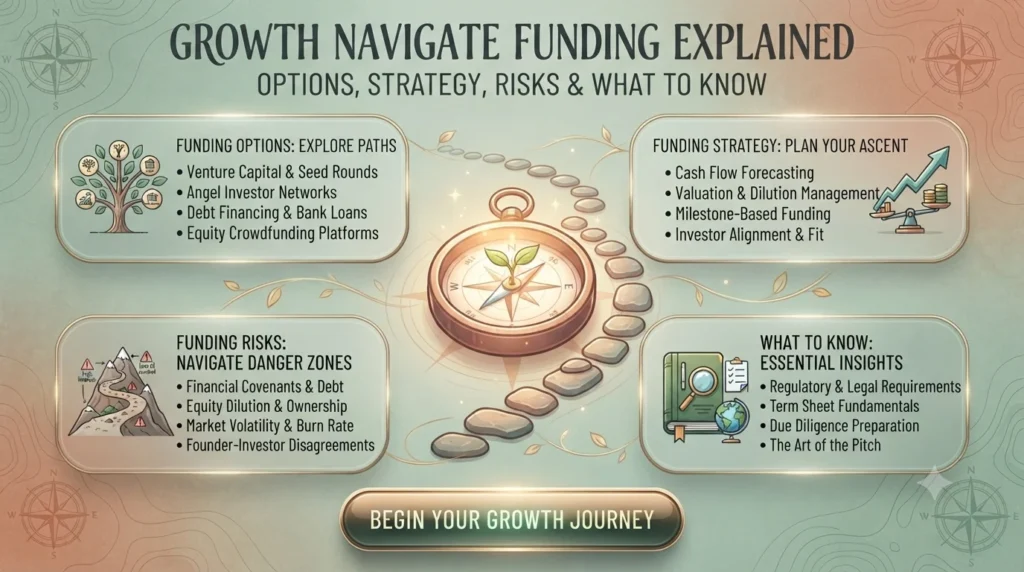
Growth Navigate Funding Explained: Options, Strategy, Risks and What to Know.
Introduction
Finding funding is one challenge. Knowing how much to raise, when to raise it, which financing method to choose, and how to use the capital can be much more complicated.
That is the basic idea behind growth navigate funding . The phrase is commonly used to describe a strategic approach to financing business expansion. Instead of treating funding as simply “getting money,” the approach connects capital decisions with specific growth objectives, financial requirements, timing, and risk.
The term can also create confusion because several websites use the Growth Navigate name for business, startup, or funding-related services. Those websites should not automatically be assumed to be operated by the same organization.
For founders, small-business owners, and entrepreneurs researching this topic, that distinction matters. A funding strategy is different from a commercial advisory service, and neither should be confused with a government grant or guaranteed funding program.
This guide explains what growth navigate funding means, the major financing options available to businesses, how to prepare for a funding process, common mistakes to avoid, and what to check before working with any funding provider or advisory company.
Quick Answer: What Is Growth Navigate Funding?
Growth navigate funding refers to the process of matching business-growth objectives with appropriate sources of capital. It can involve bootstrapping, business loans, investors, grants, crowdfunding, revenue-based financing, or other financing structures.
The phrase is not best treated as the name of a universally recognized financial product. Online sources use it in different ways, including as a general funding strategy and as part of the branding of separate business-advisory websites.
A practical growth funding plan should answer five questions:
- Why does the business need capital?
- How much money is actually required?
- When will the capital be needed?
- Which funding structure fits the business?
- What financial or ownership costs come with the funding?
Growth Navigate Funding at a Glance
| Factor | What It Means |
|---|---|
| Main purpose | Finance business expansion or specific growth objectives |
| Funding need | Hiring, inventory, equipment, marketing, product development, expansion or working capital |
| Common sources | Revenue, loans, investors, grants, crowdfunding and other financing |
| Key decision | Match the funding structure to the business’s stage and cash flow |
| Main risk | Taking unsuitable financing or raising more capital than the business can effectively use |
| Equity consideration | Investor funding may involve giving up part of business ownership |
| Debt consideration | Loans normally create repayment obligations and interest costs |
| Due diligence | Important before accepting funding or signing an advisory agreement |
| Is it a guaranteed program? | No general evidence establishes “Growth Navigate Funding” as a universal guaranteed funding program |
| Best approach | Connect funding to measurable business milestones |
What Does Growth Navigate Funding Mean?
Growth navigate funding can be understood as a framework for planning business capital around growth requirements.
A company may need money to hire employees, purchase equipment, develop a product, increase inventory, launch a marketing campaign, enter another market, or support working capital. Each objective creates different financial requirements.
For example, a company with predictable revenue might consider debt because it can potentially service regular repayments. A young startup without predictable cash flow may instead explore equity investment, grants, or other forms of startup financing.
The important principle is not simply finding available money.
The objective is to find capital that matches the business’s ability, timing, and growth plan.
Is Growth Navigate Funding an Official Financial Product?
There is no clear evidence that the phrase represents one universally recognized government or financial-industry funding product.
Instead, online sources use the term in several contexts. Some articles describe it as a general strategy for planning growth capital. Other websites use Growth Navigate branding for advisory or funding-related services.
That distinction should remain clear when researching offers online.
A website using the phrase does not automatically represent a government-backed program, bank, investment fund, or regulated financial institution.
Why Funding Strategy Matters
Capital can accelerate growth, but the wrong financing structure can also create financial pressure.
Suppose a business takes on a large loan to finance an expansion before it has predictable cash flow. Monthly repayments could become a significant operating burden.
Equity financing creates a different consideration. The business may receive capital without traditional loan repayments, but founders can give up part of their ownership and potentially some control.
Grants may avoid both debt and equity dilution, but eligibility can be restrictive and application processes may be competitive.
The right decision therefore depends on the company’s circumstances.
Funding Should Have a Purpose
A strong funding plan connects money to a specific objective.
Examples include:
- Hiring a sales team
- Developing a new software product
- Purchasing manufacturing equipment
- Increasing inventory
- Opening a new location
- Entering a new geographic market
- Expanding marketing
- Building technology infrastructure
- Refinancing existing obligations
- Supporting working capital
A vague objective such as “grow the company” is difficult to measure.
A clearer objective might be “fund six months of product development and customer acquisition.”
That difference makes financial planning more practical.
Growth Navigate Funding vs. a Funding Provider
Another source of confusion is the relationship between the phrase and companies using similar branding.
Some websites currently use Growth Navigate or Growth Navigate Funding in connection with fundraising advice, financial planning, investor introductions, pitch decks, or business-growth information.
Those businesses should be evaluated individually.
A brand name alone does not establish:
- Corporate ownership
- Regulatory status
- Investor relationships
- Funding success rates
- Government affiliation
- Guaranteed financing
- Licensing
- Financial performance
Businesses considering an advisory service should verify those details directly through reliable documentation.
Main Types of Business Funding
There is no single funding source suitable for every business.
1. Bootstrapping
Bootstrapping means financing growth through founder capital and business-generated revenue.
This approach can preserve ownership because outside investors are not necessarily involved.
The limitation is scale. Internal cash may not be enough for large investments, rapid hiring, or capital-intensive expansion.
2. Business Loans
Loans provide capital that generally must be repaid according to agreed terms.
Depending on the lender and product, businesses may encounter interest charges, fees, collateral requirements, guarantees, and repayment schedules.
Debt can be useful when the company has sufficiently predictable cash flow to manage those obligations.
Before accepting a loan, calculate the total repayment cost rather than looking only at the amount received.
3. Angel Investment
Angel investors provide capital to startups or growing companies, typically in exchange for an ownership interest or another investment structure.
Some angels also provide industry knowledge, contacts, mentorship, or strategic support.
Founder ownership is an important consideration. Receiving capital can help a company grow, but the ownership percentage given to investors affects future control and economics.
4. Venture Capital
Venture capital is generally associated with businesses that have the potential for substantial growth.
VC financing can provide significant capital and access to investors with experience in particular industries.
The trade-off can include dilution, investor expectations, governance considerations, and pressure to achieve ambitious growth milestones.
Not every profitable small business is an appropriate venture-capital candidate.
5. Grants
Grants can provide funding without the same repayment or ownership structure associated with conventional debt or equity.
Government agencies, foundations, research organizations, and other institutions may offer grants for specific purposes.
Eligibility can depend on geography, industry, business size, research activity, social objectives, or other criteria.
Businesses should verify grant opportunities through official sources instead of relying solely on third-party websites claiming to provide access.
6. Crowdfunding
Crowdfunding allows businesses or projects to raise money from a larger number of contributors.
Different models exist, including reward-based, donation-based, debt-based, and investment-based crowdfunding.
The appropriate model depends on the project and applicable legal requirements.
Crowdfunding also requires marketing effort. Having a platform available does not automatically mean that a campaign will reach its financial target.
7. Revenue-Based Financing
Revenue-based financing links repayments to business revenue under the terms of the financing arrangement.
This structure can be attractive to some businesses with recurring revenue because repayment may be connected to performance.
The total cost and contractual terms need careful review, however. A flexible repayment mechanism does not automatically mean inexpensive financing.
How to Choose the Right Funding Option
A useful funding decision starts with the business rather than the funding provider.
Step 1: Define the Growth Objective
Write down exactly what the money will accomplish.
For example:
“We need $250,000 to hire four employees, increase production, and finance six months of expansion.”
That statement is more useful than simply saying:
“We need funding to grow.”
Step 2: Calculate the Funding Requirement
Estimate the cost of the project and include a reasonable cash buffer.
Review:
- Current cash
- Monthly operating expenses
- Existing debt
- Expected revenue
- Payroll
- Inventory requirements
- Marketing expenses
- Capital expenditures
- Tax obligations
- Emergency reserves
The resulting number becomes a starting point rather than an automatic fundraising target.
Step 3: Consider the Cost of Capital
Funding has a cost even when that cost is not an obvious interest payment.
Debt can create:
- Interest
- Fees
- Repayment obligations
- Collateral requirements
Equity can create:
- Ownership dilution
- Investor rights
- Governance considerations
- Future fundraising implications
A complete analysis should consider all of these factors.
Step 4: Match Funding to Timing
A business may need money today, but the underlying project may not generate returns for several months.
The financing structure should account for that timing difference.
Short-term borrowing for a long-term project can create unnecessary pressure. Similarly, selling significant equity to solve a relatively small temporary cash problem may not fit the company’s objectives.
Funding According to Business Stage
Idea Stage
At the idea stage, founders may rely heavily on personal savings, friends and family, grants, incubators, accelerators, or early-stage investors.
The main objective is usually validation.
Evidence of customer demand can become more valuable than a polished funding presentation alone.
Pre-Seed Stage
Pre-seed businesses often use capital to develop an MVP, conduct customer research, hire initial employees, and validate the business model.
The funding requirement is usually linked to proving specific assumptions.
Seed Stage
Seed funding may support product development, early sales, customer acquisition, and team expansion.
Investors may look more closely at traction, market opportunity, business economics, and evidence that the product can scale.
Growth Stage
A growing business may require larger amounts of capital for expansion, acquisitions, international markets, hiring, infrastructure, or working capital.
At this stage, financial reporting and operational discipline become increasingly important.
How to Prepare for Funding
Preparation can determine how quickly a business can respond when an opportunity appears.
Build a Clear Business Plan
A funding plan should explain:
- What the company sells
- Who the customers are
- How the company makes money
- What problem it solves
- Market opportunity
- Competitive environment
- Current traction
- Growth strategy
- Funding requirement
- Planned use of funds
Organize Financial Records
Keep financial documents accurate and accessible.
Depending on the funding type, these may include:
- Income statements
- Balance sheets
- Cash-flow statements
- Bank statements
- Tax records
- Revenue reports
- Debt schedules
- Accounts receivable
- Accounts payable
Prepare a Funding Presentation
Startups seeking investors often use pitch decks.
A useful presentation normally explains the problem, solution, market, business model, traction, team, competition, financial outlook, funding requirement, and use of funds.
The goal is clarity rather than excessive design.
What Investors and Lenders May Examine
Different capital providers look at different factors.
Investors may consider:
- Market size
- Product differentiation
- Founder and management team
- Revenue growth
- Customer retention
- Unit economics
- Competitive position
- Scalability
- Future financing requirements
Lenders may focus more heavily on:
- Cash flow
- Credit history
- Assets
- Existing debt
- Repayment ability
- Business history
- Guarantees or collateral
A company should therefore tailor its funding materials to the type of capital it is pursuing.
How Much Funding Should a Business Raise?
There is no universal funding amount.
The appropriate figure depends on the company’s operating expenses, growth plans, current revenue, cash position, timing, and expected milestones.
A practical method is to calculate the amount required to reach the next meaningful business milestone.
For a startup, that could mean reaching product-market validation or a particular revenue level.
For an established company, the milestone might involve opening a location, purchasing equipment, or reaching a new market.
Avoid Raising Without a Spending Plan
More capital is not automatically better.
Excess funding can encourage inefficient spending, unnecessary hiring, or premature expansion.
The better question is:
What specific result should this capital help the company achieve?
That question creates a direct connection between financing and business performance.
Common Growth Funding Mistakes
Raising Too Late
Waiting until the bank account is almost empty can weaken negotiating power.
Fundraising takes time. Investors and lenders may request documentation, financial information, due diligence, and multiple meetings.
Choosing Capital Based Only on Speed
Fast funding can be attractive when cash is tight.
Yet expensive financing can create a larger problem later. Review the total cost, repayment terms, ownership impact, and contractual obligations before accepting an offer.
Ignoring Dilution
Founders sometimes focus heavily on the amount raised and overlook the percentage of ownership being transferred.
Equity decisions can affect future fundraising and control.
Using Long-Term Funding for Short-Term Problems
A financing structure should match the purpose of the money.
Temporary working-capital needs and long-term expansion projects may require very different solutions.
Assuming Every Funding Claim Is Verified
A website may advertise impressive capital figures, investor networks, or success percentages.
Those numbers should be treated as company-reported claims unless independent evidence supports them.
Risks and Red Flags
Anyone researching growth navigate funding should watch for warning signs.
Guaranteed Funding Promises
Legitimate financing normally depends on eligibility, underwriting, investor interest, business quality, or other conditions.
A promise that every applicant will receive funding deserves careful scrutiny.
Upfront Payment for Guaranteed Loans
Be cautious when a company demands money upfront while guaranteeing a loan or investor connection.
Verify the provider, contractual terms, licensing where applicable, and the exact service being purchased before sending money.
Pressure to Act Immediately
A legitimate financial decision should allow enough time to review the agreement.
High-pressure sales tactics can make it easier to overlook fees, repayment obligations, ownership terms, or cancellation conditions.
Unclear Company Identity
Check:
- Legal business name
- Physical business information
- Terms and privacy policies
- Contact information
- Regulatory disclosures where applicable
- Independent business records
- Professional credentials
- Contract terms
Similar names across multiple websites should not be assumed to indicate common ownership.
How to Evaluate a Growth Navigate Funding Advisory Service
If you encounter a website offering funding assistance under the Growth Navigate name, evaluate that specific organization.
Verify Its Identity
Look for a clearly stated legal entity and consistent contact information.
Understand What It Actually Sells
An advisory firm may offer pitch-deck preparation, financial modeling, fundraising strategy, investor introductions, or general business consulting.
Those services are different from providing capital directly.
Ask How Fees Work
Find out whether charges are:
- Fixed
- Hourly
- Monthly
- Retainer-based
- Success-based
- A combination of structures
Get the arrangement in writing.
Examine Claims Carefully
Marketing claims such as “capital secured,” “funding success rate,” or “investor network” should not automatically be interpreted as independently verified performance data.
Ask what the numbers mean and whether supporting evidence is available.
A Practical Growth Navigate Funding Process
A simple process can make funding decisions more structured.
1. Define the Milestone
Identify the specific business result the capital should support.
2. Calculate the Cash Requirement
Estimate expenses, timing, existing cash, and contingency needs.
3. Compare Funding Structures
Consider debt, equity, grants, revenue-based financing, crowdfunding, and internal cash where appropriate.
4. Prepare Documentation
Organize financial records, business information, forecasts, ownership documents, and other relevant materials.
5. Research Providers
Do not rely on one website’s marketing claims. Compare providers and investigate their credentials.
6. Review the Terms
Examine interest, fees, repayment, dilution, investor rights, collateral, termination clauses, and other obligations.
7. Connect Capital to Milestones
Once funding is secured, monitor how the money is being used and whether the expected business results are developing.
8. Review the Strategy Regularly
Business conditions change.
Revenue can grow faster than expected, a product launch can be delayed, or market conditions can shift. Funding plans should therefore be reviewed as the company evolves.
Who Can Benefit From a Growth Navigate Funding Strategy?
Startup Founders
Founders can use the framework to connect fundraising with product, customer, and revenue milestones.
Small Businesses
Established small companies may use funding strategically for equipment, inventory, hiring, expansion, or working capital.
Growing Companies
Businesses entering a new stage of expansion can compare debt and equity options before committing to a financing structure.
Entrepreneurs With Limited Capital
A structured approach can help prioritize the projects that genuinely require outside financing.
Business Advisors
Consultants can use a milestone-based funding framework to help clients evaluate financing needs before approaching lenders or investors.
Final Takeaway
Growth navigate funding is best understood as a strategic approach to matching capital with business growth requirements. The concept is broader than any single loan, grant, investor, or advisory company.
Successful funding decisions begin with the business objective. Once the purpose is clear, a company can calculate its actual capital requirement, compare financing structures, evaluate costs, and select an option that fits its financial position.
The phrase itself requires some caution because several websites use similar Growth Navigate branding. A business should verify the identity and claims of any specific funding provider rather than assuming that similarly named websites are connected.
For founders and business owners, the most useful principle is straightforward: raise or borrow capital for a defined purpose, understand the full cost, and connect spending to measurable growth milestones.
Is Growth Navigate Funding a real funding program?
The phrase is used online in multiple ways. It is commonly used as a general description of strategic business funding, while separate websites use Growth Navigate branding for business or fundraising services. There is no basis for treating the phrase itself as a universal government funding program.
Is Growth Navigate Funding a loan?
Not necessarily. “Growth navigate funding” can refer broadly to different financing methods, including loans, equity investment, grants, crowdfunding, and internally generated cash.
Can startups use growth navigate funding?
Yes. Startups can apply the underlying funding-planning approach when deciding how much capital they need, what milestone they want to achieve, and which financing structure fits their stage.
Does funding always require giving up equity?
No. Loans and many grants do not require conventional ownership dilution. Equity investment, by definition, involves an ownership interest or similar investment rights.
How much funding should a startup raise?
There is no universal amount. The target should generally be connected to the company’s expected expenses and the milestone it intends to reach before needing additional capital.