
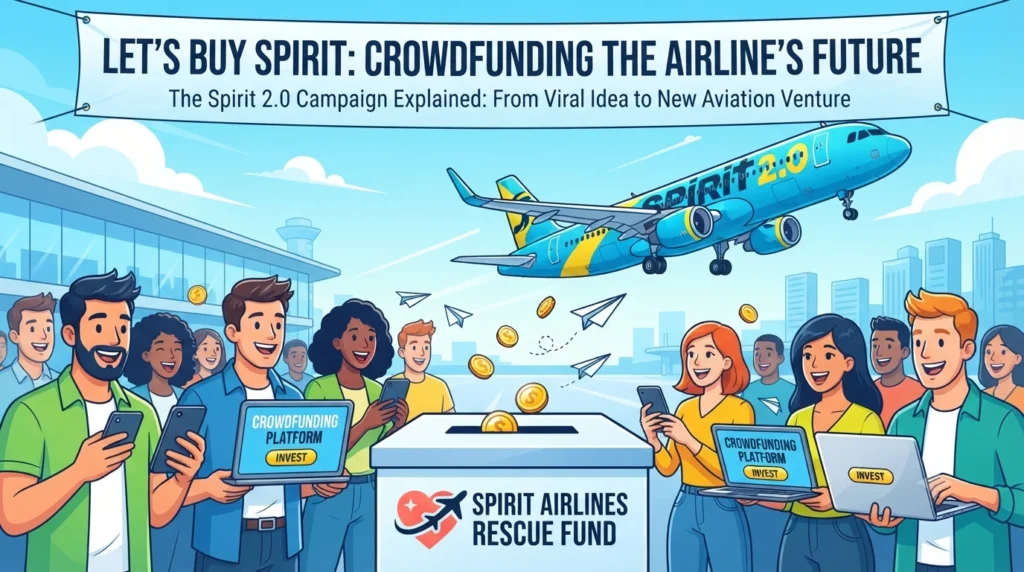
Let’s Buy Spirit Explained: From Viral Airline Rescue Idea to a New Aviation Venture.
Introduction
Let’s Buy Spirit became one of the most unusual airline stories of 2026. Shortly after Spirit Airlines announced an immediate shutdown of its operations on May 2, content creator and voice actor Hunter Peterson launched a grassroots campaign asking whether ordinary travelers could collectively help bring the airline back. The idea quickly spread online under the name Spirit 2.0, attracting hundreds of thousands of public pledges and significant media attention.
The original concept was straightforward in principle but extremely ambitious in practice: instead of allowing Spirit to simply disappear, a large community of passengers, employees and supporters could potentially help acquire its assets and create a more community-oriented airline.
However, the story did not end with the proposed purchase. By June 2026, the campaign had changed direction after its team decided not to continue pursuing the acquisition. The project subsequently shifted toward creating a completely new airline rather than buying the original Spirit.
This article explains what Let’s Buy Spirit was, why it attracted so much attention, how the pledge campaign worked, what happened to the acquisition plan and what the project became afterward.
Quick Answer: What Was Let’s Buy Spirit?
Let’s Buy Spirit was a grassroots campaign launched after Spirit Airlines ceased operations in May 2026, proposing that a large community of supporters could help acquire and revive the airline.
The campaign was led by Hunter Peterson and initially operated around the concept of “Spirit 2.0: Owned by the People.”
It was not a conventional airline acquisition backed by an established airline company or major private-equity firm. The initial public commitments were also non-binding pledges rather than completed payments. TechCrunch reported that tens of thousands of people had pledged nearly $23 million during the campaign’s first days, while the actual acquisition and relaunch of an airline would require substantially more capital and regulatory work.
The project’s later development is equally important: the team eventually abandoned the attempt to purchase Spirit’s remaining assets and began exploring the creation of a new airline from the ground up.
What Happened to Spirit Airlines?
Understanding the Let’s Buy Spirit movement requires understanding why it started.
On May 2, 2026, Spirit Aviation Holdings announced that Spirit Airlines had begun an orderly wind-down of operations. The company cancelled all flights and instructed customers not to go to airports for their scheduled Spirit flights.
Spirit said that its financial outlook had been severely affected by higher oil prices and other pressures, while the company did not have additional funding available to continue operating.
The shutdown ended more than three decades of Spirit’s operations as an airline.
Spirit had become particularly recognizable in the U.S. aviation market through its ultra-low-cost model, where passengers could purchase relatively low base fares and pay separately for various optional services.
Its disappearance therefore created a noticeable gap for travelers who relied on low-cost air travel.
Who Started Let’s Buy Spirit?
The campaign was launched by Hunter Peterson, a content creator and voice actor who had previously flown Spirit and was familiar with the airline as a customer.
After Spirit’s shutdown, Peterson proposed the idea of collectively buying the airline.
What initially appeared to be a social-media thought experiment rapidly attracted public attention. Within a short period, the campaign’s website was receiving enough traffic to experience technical problems, while thousands of people registered their interest.
Peterson’s proposal drew inspiration from community-owned organizations, particularly the ownership structure associated with the Green Bay Packers.
The broader idea was to explore whether passengers and employees could have a meaningful ownership role in an airline instead of leaving control entirely to conventional corporate owners.
How Did the Spirit 2.0 Campaign Work?
The campaign went through several stages.
Stage 1: Public pledges
The initial campaign asked supporters to express their willingness to contribute toward the effort.
These were not equivalent to completed investments.
That distinction matters because online coverage sometimes described the rapidly increasing figures as money “raised,” while reports also clarified that the early numbers represented non-binding pledges or expressions of intent rather than money already collected.
Stage 2: Building a community
The campaign then developed a broader network of supporters.
The idea was not simply to find one wealthy buyer. Instead, organizers attempted to demonstrate that a large community of travelers could potentially support a different airline ownership structure.
This community-building aspect became one of the defining characteristics of Spirit 2.0.
Stage 3: Seeking serious financing
As the project developed, the team moved beyond public pledges and explored investment structures that could potentially support an actual acquisition.
By June, the campaign was seeking accredited investors as it considered making a bid for Spirit-related assets. TravelPulse reported that the campaign had raised millions in investment commitments during this phase but ultimately did not reach the required $5 million target before the relevant deadline.
Stage 4: Changing direction
The acquisition strategy eventually ended.
Peterson announced that the group would stop fundraising for the purchase and instead explore building an entirely new airline.
That became the next chapter of the movement.
How Much Money Did Let’s Buy Spirit Raise?
This question requires careful wording because the campaign reported several different types of financial figures at different stages.
During the early public-pledge phase, media reports documented rapidly increasing pledged amounts.
For example, TechCrunch reported approximately $23 million in non-binding pledges from around 36,000 people shortly after the campaign launched.
Other reports later documented much larger pledge totals as more people joined the campaign. One May 2026 report cited more than $214 million in pledged support from the movement.
Those figures should not be interpreted as equivalent to cash sitting in an acquisition account.
A pledge indicates an expression of financial intent. It does not necessarily mean the money was transferred, invested or available for purchasing an airline.
Later, the campaign moved toward a formal investment phase involving accredited investors. TravelPulse reported that the team had collected about $2.2 million from 433 investments at one point while pursuing an initial $5 million fundraising target.
The difference between pledges, investments and actual acquisition capital is therefore essential when discussing the campaign’s financial progress.
Why Was Buying Spirit Airlines So Difficult?
Buying or restarting an airline is substantially more complicated than purchasing an ordinary company.
An airline involves:
- Aircraft
- Airport facilities
- Routes and slots
- Employees
- Maintenance arrangements
- Technology systems
- Brand and intellectual property
- Financing
- Insurance
- Regulatory approvals
- Safety requirements
- Operating authority
- Aircraft leases or ownership
- Customer-service infrastructure
Even if an investor group could obtain aircraft or other assets, it would still need the appropriate regulatory framework and operational infrastructure to fly passengers.
The financial challenge is also significant.
A viral crowdfunding campaign can demonstrate public interest, but interest alone does not create the capital, regulatory approvals or operating systems required to run an airline.
What Made the Idea So Popular?
Several factors helped the campaign spread quickly.
1. Spirit had a recognizable brand
Spirit was already familiar to millions of travelers.
Its bright-yellow aircraft, low base fares and controversial fee structure made it one of the most recognizable ultra-low-cost airlines in the United States.
2. The shutdown happened suddenly
Spirit announced its operational wind-down on May 2, leaving customers and employees dealing with an abrupt end to the airline’s operations.
That created an immediate emotional and practical reaction among passengers.
3. The ownership concept was unusual
The idea of an airline owned by a large community of customers was different from the traditional airline ownership model.
Peterson compared the concept to community ownership structures such as the Green Bay Packers model.
4. Social media accelerated participation
The campaign grew primarily through social platforms.
Instead of beginning with a traditional investment bank, airline executive team or established aviation company, the initial proposal spread through online videos and social communities.
That helped the idea reach a large audience extremely quickly.
What Was “Spirit 2.0”?
Spirit 2.0 was the name associated with the proposed revival of Spirit Airlines under a new ownership concept.
The phrase suggested that the goal was not merely to restart the old airline exactly as it had operated.
Instead, Peterson and supporters discussed creating an airline with greater community participation and a different relationship between passengers, employees and ownership.
The concept emphasized ideas such as:
- Community ownership
- Passenger participation
- Employee involvement
- Affordable air travel
- A different corporate structure
However, these ideas represented the campaign’s proposed model rather than an established operating airline.
Did Let’s Buy Spirit Actually Buy Spirit Airlines?
No.
The Let’s Buy Spirit campaign did not complete an acquisition of Spirit Airlines.
Spirit itself began an orderly wind-down on May 2, 2026.
The Spirit 2.0 team later pursued the possibility of acquiring assets but stopped that effort after failing to reach its fundraising target and reassessing the situation. TravelPulse reported on June 19 that the campaign had decided not to continue the fundraising for the acquisition and would instead explore building a new airline.
By August, reporting described the initiative as having shifted to a “Let’s Build An Airline” concept rather than purchasing Spirit itself.
This is one of the most important facts to understand when researching Let’s Buy Spirit today.
What Happened to the Original Spirit Assets?
Spirit’s liquidation process continued separately from the Let’s Buy Spirit movement.
Some Spirit assets were sold or transferred to other parties.
For example, later reporting said JetBlue acquired Spirit’s LaGuardia Airport slots for approximately $58 million, while other Spirit-related assets were also sold.
That made the original objective increasingly difficult: even if the Let’s Buy Spirit group had raised sufficient capital, it could not simply assume that the entire former airline remained available as one package.
The liquidation process and bankruptcy proceedings determined how different assets would be handled.
Why Did the Campaign Stop Trying to Buy Spirit?
According to reporting about Peterson’s June update, the campaign did not meet its $5 million target for the acquisition effort before the relevant deadline.
Peterson said that developments in Spirit’s bankruptcy and proposed changes to the fundraising process led the team to conclude that continuing the fundraising was not in the best interests of the organization or investors.
The team therefore changed its strategy.
Instead of trying to purchase Spirit’s existing assets, it began considering the more fundamental question:
What if the community built a new airline instead?
That question became the foundation for the project’s next phase.
What Is the New “Let’s Build An Airline” Direction?
By August 2026, reporting described the former Let’s Buy Spirit initiative as moving toward a new airline project.
One reported concept involved a membership-based airline model, described as something similar to a “Costco of airlines,” where members could receive access to discounted fares while non-members could potentially book flights under different pricing arrangements.
The project also began appearing under new branding associated with First Jet Air.
A current First Jet Air profile describes the venture as evolving from the original attempt to buy Spirit into an effort to build an airline from the ground up, with a community-oriented ownership concept.
This represents a significant change from the original campaign.
The objective is no longer simply:
Buy Spirit.
It has become:
Build a new airline around the community that formed around the Spirit 2.0 idea.
Let’s Buy Spirit vs. the New Airline Concept
| Aspect | Original Let’s Buy Spirit | Later Direction |
|---|---|---|
| Main idea | Acquire and revive Spirit | Build a new airline |
| Spirit assets | Central to the plan | No longer the primary objective |
| Community involvement | Core concept | Remains important |
| Funding | Public pledges, later investor fundraising | New financing structure required |
| Airline | Spirit 2.0 concept | New airline project |
| Brand direction | Spirit 2.0 | Let’s Build An Airline / First Jet Air |
| Status | Acquisition effort ended | New-airline development |
The table shows why simply describing the project as a “crowdfunding campaign to buy Spirit” is now incomplete.
Is Let’s Buy Spirit a Crowdfunding Investment?
The answer depends on which phase of the project is being discussed.
The original public campaign used non-binding pledges to measure support.
Later, the organization moved toward actual investment fundraising and restricted participation to eligible investors during that stage. TravelPulse reported that the campaign was seeking accredited investors while considering an acquisition bid.
Therefore, readers should not assume that entering a pledge automatically meant buying an ownership share of Spirit Airlines.
Likewise, people considering any current investment opportunity connected with a new airline should review the actual offering documents, legal entity, securities structure, risks and regulatory disclosures rather than relying on social-media posts or headlines.
What Can We Learn From the Let’s Buy Spirit Story?
The campaign provides an interesting example of how social media can influence business formation and entrepreneurship.
A community can form before a company exists
The campaign attracted a large audience before there was an operating airline behind the idea.
That demonstrates the ability of social platforms to gather potential customers, supporters and investors around an emerging business concept.
Viral attention is not the same as operating capital
Large pledge numbers can demonstrate interest, but an airline requires substantial committed capital.
It also requires regulatory approval, aircraft, personnel, infrastructure and operational expertise.
Aviation is heavily regulated
An airline cannot simply be launched after purchasing aircraft.
Passenger aviation involves extensive regulatory and safety requirements.
Business plans can change
The Let’s Buy Spirit project demonstrates how a startup concept can evolve after market, legal, financial and operational constraints become clearer.
The original goal was acquisition.
The later goal became new-airline development.
Is Spirit Airlines Coming Back?
The original Spirit Airlines did not return to normal passenger operations after its May 2, 2026 wind-down.
The official Spirit restructuring website states that Spirit began an orderly wind-down of operations on May 2 and that all flights were cancelled.
The later Let’s Buy Spirit movement should therefore not be confused with Spirit Airlines restarting under its original corporate structure.
The current story is about a separate effort to create a new airline inspired in part by the community that formed around Spirit 2.0.
Frequently Asked Questions About Let’s Buy Spirit
What is Let’s Buy Spirit?
Let’s Buy Spirit was a grassroots campaign launched after Spirit Airlines shut down in May 2026. It initially proposed collectively acquiring and reviving Spirit under a community-oriented ownership model.
Who started Let’s Buy Spirit?
The campaign was started by Hunter Peterson, a content creator and voice actor who became the public face of the Spirit 2.0 movement.
Did Let’s Buy Spirit purchase Spirit Airlines?
No. The campaign did not complete the purchase of Spirit Airlines.
How much money was pledged?
The reported pledge amount grew rapidly during the campaign. Early coverage reported nearly $23 million from approximately 36,000 pledges, while later reports cited more than $200 million in pledges. These were not equivalent to completed acquisition funding.
What is Spirit 2.0?
Spirit 2.0 was the campaign’s proposed concept for rebuilding Spirit around community ownership and participation.
Why did the acquisition plan end?
The team did not reach its fundraising target for the acquisition phase and subsequently decided to stop pursuing the purchase of Spirit assets.
What happened after Let’s Buy Spirit?
The movement shifted toward building an entirely new airline rather than purchasing the former Spirit operation. Later reporting connected the effort with a “Let’s Build An Airline” direction and First Jet Air.
Is the new airline already operating flights?
The available information indicates that the project is in the development and fundraising stage rather than operating a normal scheduled passenger airline. Readers should check the project’s current official communications for any changes in operating status.
Final Thoughts
Let’s Buy Spirit was more than a viral slogan; it became an unusual experiment in community-driven aviation entrepreneurship.
The movement began almost immediately after Spirit Airlines announced its shutdown on May 2, 2026. Hunter Peterson’s proposal attracted an unexpectedly large online audience, with supporters making millions of dollars’ worth of non-binding pledges toward the idea of collectively acquiring the airline.
The original acquisition plan ultimately did not happen. By June, the organizers had stopped pursuing the purchase and began considering the creation of a new airline instead. Later reporting showed the project evolving toward a new-airline concept rather than a direct Spirit revival.
That makes the current meaning of “Let’s Buy Spirit” somewhat different from what it meant when the campaign first went viral. It is now best understood as the origin story of a broader attempt to create a community-oriented airline from the ground up.
For readers following the project, the most important distinction is between Spirit Airlines itself, the original Spirit 2.0 acquisition campaign, and the newer airline venture that emerged after the acquisition plan ended.