
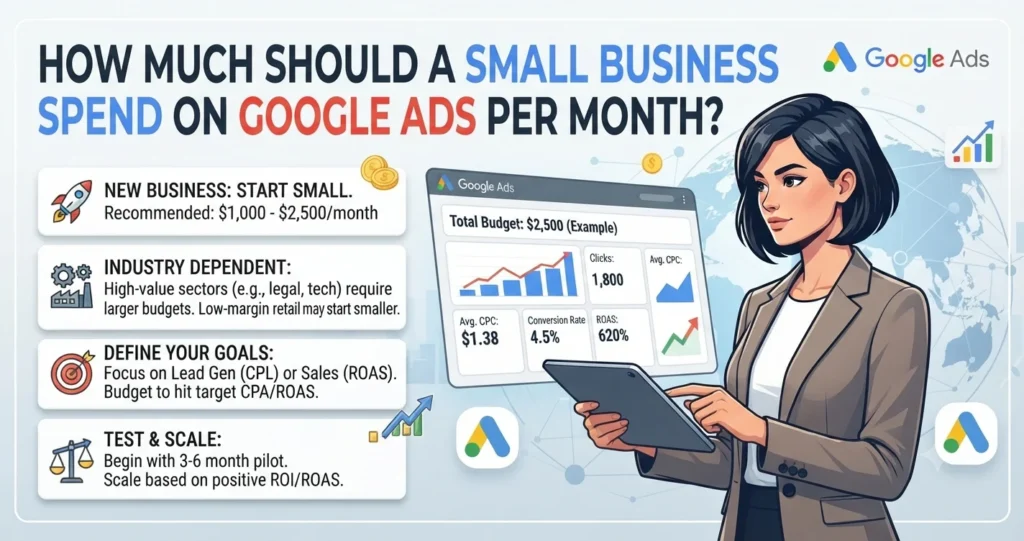
How Much Should a Small Business Spend on Google Ads Per Month?
Introduction
How much should a small business spend on Google Ads per month? For an Australian business starting with paid search, a monthly advertising budget of A$500–A$1,500 may be a reasonable testing range, while businesses targeting competitive keywords or seeking a more consistent flow of enquiries may need A$1,500–A$3,000 or more. These are suggested planning ranges, not official Google recommendations or guaranteed performance levels.
The right budget depends on your industry, average cost per click (CPC), target audience, conversion rate and the value of each new customer. A business that earns A$2,000 in gross profit from a new customer can justify a different advertising cost from one that earns A$100.
Rather than choosing a number based on what competitors spend, calculate how many clicks you need, how many of those clicks could become customers and what you can afford to pay for each acquisition.
A Google Ads CPC Calculator can help estimate traffic from a proposed budget, while Google’s Keyword Planner can provide keyword and bid estimates relevant to your market.
In this guide, we explain how to choose a monthly Google Ads budget, compare different spending levels, calculate potential returns and avoid wasting money. We also cover when professional campaign management from a provider such as Scalvia may be worth considering.
Quick Answer: How Much Should You Spend on Google Ads?
There is no universal minimum monthly spend for standard Google Ads campaigns. You choose your budget according to your objectives and financial capacity, and Google provides tools to help estimate and manage spending. Google’s official budget guidance.
For planning purposes, the following ranges can help Australian small businesses decide where to begin.
| Monthly advertising spend | Potential use |
|---|---|
| A$300–A$500 | A tightly focused, small-scale test |
| A$500–A$1,500 | Testing local services or a limited group of keywords |
| A$1,500–A$3,000 | Developing a more consistent lead-generation campaign |
| A$3,000–A$5,000 | Expanding into additional services, locations or keyword groups |
| A$5,000+ | Scaling campaigns with evidence of profitable performance |
These ranges represent illustrative planning scenarios, not industry-wide spending averages. A competitive market may require a different budget, while a business targeting a small local area may be able to start with less.
Important: These amounts refer to advertising spend paid to Google, not the total cost of running a campaign. Management fees, landing-page development, tracking and other services may cost extra.
1. What Determines Your Google Ads Budget?
Your ideal monthly budget depends on several connected factors. Understanding them helps you set a realistic spending limit rather than relying on a generic recommendation.
Industry and keyword competition
Different industries have different advertising costs. A retailer advertising affordable accessories may face different CPCs from a solicitor, specialist medical practice or emergency plumber.
Competitive keywords can consume a limited budget quickly. Before launching a campaign, research the searches your potential customers use and examine estimated bids through Google Keyword Planner.
Your target location
A business serving one suburb has a different advertising opportunity from a company targeting customers across Australia.
For example, a local electrician might focus on searches in the suburbs where the business can respond quickly. A national ecommerce store may need a broader strategy covering multiple product categories and customer segments.
Start with the locations that are most commercially valuable instead of spreading your budget too thinly.
Your business goals
Your budget should reflect what you want Google Ads to achieve.
- Brand awareness: You may focus on reaching a relevant audience.
- Lead generation: You need enough clicks to produce enquiries at an acceptable cost.
- Online sales: Your budget should account for conversion rate, order value and profit margin.
- Local bookings: You may prioritise phone calls, appointment requests and completed bookings.
A campaign designed to generate sales should be evaluated using business outcomes, not clicks alone.
Your conversion rate
Conversion rate is the percentage of ad clicks that result in a desired action, such as a purchase or enquiry.
Suppose two businesses each spend A$1,000 and receive 250 clicks.
- Business A converts 2% of clicks, generating five enquiries.
- Business B converts 6% of clicks, generating 15 enquiries.
Business A pays A$200 per enquiry, while Business B pays approximately A$66.67 per enquiry.
Both businesses spend the same amount, but the second generates three times as many enquiries. This is why improving landing pages and tracking can be as important as increasing the advertising budget.
2. How to Calculate Your Monthly Google Ads Budget
The most useful starting point is to work backwards from your desired business results.
Instead of asking, “How much do other businesses spend?”, ask, “How many new customers do I need, and how much can I afford to spend to acquire them?”
Step 1: Decide how many customers you need
Suppose a local service business wants to acquire 10 new customers each month through paid search.
Step 2: Estimate the leads required
If 25% of qualified leads become paying customers, the business needs approximately 40 qualified leads to generate 10 customers.
Formula:
Required leads = Target customers ÷ Lead-to-customer conversion rate
In this example:
10 ÷ 0.25 = 40 leads.
Step 3: Estimate the cost per lead
Assume your campaign can generate qualified leads at A$60 each. This is an example assumption, not a market benchmark or guaranteed result.
Your estimated monthly advertising budget would be:
40 leads × A$60 = A$2,400.
Step 4: Check whether the budget is affordable
If your gross profit per new customer is A$500, acquiring 10 customers generates A$5,000 in gross profit before advertising and other operating costs.
After A$2,400 in ad spend, A$2,600 remains before management fees and other expenses.
This gives you a starting point for assessing whether the campaign is commercially viable.
| Budgeting metric | Example |
|---|---|
| Target new customers | 10 |
| Lead-to-customer conversion rate | 25% |
| Required qualified leads | 40 |
| Assumed cost per lead | A$60 |
| Estimated monthly ad spend | A$2,400 |
The calculation is only as reliable as its assumptions. Use actual campaign results to update the lead conversion rate and cost per lead once data becomes available.
3. How Much Should You Spend Based on Business Type?
Different businesses require different approaches to budgeting. The following examples illustrate how to think about your starting investment.
Local service businesses
Electricians, plumbers, cleaners and other local service providers may benefit from targeting searches that show a clear intention to hire.
A tightly targeted test budget of A$500–A$1,500 could be a starting point where keyword costs and local competition permit. A larger budget may be needed for emergency services or competitive metropolitan markets.
Prioritise relevant service keywords, accurate location targeting and landing pages that make it easy to call or request a quote.
Ecommerce businesses
Online retailers should consider product margins, average order value, repeat purchases and the cost of acquiring a customer.
A store with a healthy margin may be able to invest more per sale than one selling low-margin products. Start by testing products or categories with clear demand and track the profitability of sales attributed to advertising.
Product campaigns may require a different budget allocation from Search campaigns, so avoid assuming that every campaign type will produce the same results.
Professional services
Accountants, consultants and legal practices should focus on the value of qualified enquiries rather than the volume of website traffic.
If each new client generates substantial gross profit, a higher cost per lead may be acceptable. However, a high-value service does not automatically make an expensive campaign profitable.
Track lead quality and the percentage of enquiries that become paying clients.
Startups and new businesses
New businesses often lack reliable conversion data. Begin with a controlled budget that you can afford to test without jeopardising cash flow.
Use the first phase to understand which keywords generate relevant visits, whether the landing page converts and how much qualified leads cost. Increase spending only when the evidence supports it.
4. How to Use a Google Ads CPC Calculator
A Google Ads CPC Calculator helps you estimate how many clicks your budget may generate. A Cost Per Click Calculator can also help you compare different spending scenarios before you launch or expand a campaign.
The core formulas are straightforward.
Estimated clicks = Monthly advertising budget ÷ Average CPC
Average CPC = Advertising spend ÷ Total clicks
For example, a monthly budget of A$1,200 at an assumed average CPC of A$4 would generate approximately 300 clicks.
Example Google Ads budget calculator
| Monthly budget | Assumed average CPC | Estimated clicks |
|---|---|---|
| A$500 | A$2 | 250 |
| A$1,000 | A$4 | 250 |
| A$1,500 | A$5 | 300 |
| A$2,000 | A$8 | 250 |
| A$3,000 | A$6 | 500 |
These calculations assume the entire budget is spent at the selected average CPC. Actual clicks may differ because CPCs, search volume and auction conditions change. The figures exclude management fees and other campaign expenses.
How to use the calculator effectively
- Choose a monthly budget you can afford.
- Research relevant keywords using Google’s Keyword Planner.
- Estimate a realistic average CPC for your campaign.
- Calculate the number of clicks your budget could support.
- Apply an estimated conversion rate to forecast leads or sales.
- Compare the results with your target cost per acquisition.
For example, 300 clicks at a 5% conversion rate would produce 15 conversions. If those conversions are qualified enquiries, your budget and sales process should be assessed using the cost and quality of those leads.
A Google CPC Calculator is a planning tool, not a prediction of guaranteed performance. Use actual Google Ads data to refine the estimates as your campaign develops.
5. Google Ads Budget vs Management Fees
One common budgeting mistake is treating the advertising budget as the entire cost of Google Ads.
There are usually two separate expenses when you hire an agency or marketing provider.
Advertising spend: The amount allocated to showing ads through Google.
Management fees: The cost of services such as keyword research, campaign setup, optimisation, conversion tracking and reporting, depending on the agreement.
Some providers also charge setup fees or additional costs for landing pages and creative work.
Example of a complete monthly budget
Suppose your business allocates A$1,500 to Google Ads and pays a hypothetical A$800 monthly management fee.
| Expense | Amount |
|---|---|
| Google Ads spend | A$1,500 |
| Management fee | A$800 |
| Total before applicable taxes and extras | A$2,300 |
This example illustrates the difference between media spend and service costs; it is not a quoted market rate.
Before signing an agreement, confirm whether the fee includes campaign setup, reporting, tracking, landing-page improvements and GST. Ask who owns the advertising account and how you will access performance data.
6. How to Make a Small Google Ads Budget Work
A limited budget can still provide useful results if it is focused on the right opportunities.
Focus on high-intent keywords
Choose searches that indicate a customer is ready to enquire or purchase. Highly broad keywords can attract visitors who are researching rather than buying.
Use search-term reports to identify irrelevant queries and add negative keywords where appropriate.
Limit unnecessary geographic reach
Advertise where you can serve customers effectively. A local business should not pay for enquiries from locations outside its service area unless it has a commercial reason to do so.
Review location settings and actual geographic performance regularly.
Improve the landing page
A relevant landing page should match the ad’s promise, explain the service clearly and offer a straightforward next step.
Make sure contact forms work, phone numbers are easy to find and the page performs well on mobile devices.
Measure conversions accurately
Track meaningful actions such as completed forms, qualified calls, purchases and bookings.
Without reliable conversion tracking, it is difficult to tell whether your campaign is generating business or merely attracting traffic.
Avoid spreading the budget too thinly
Launching many campaigns with a very small budget can limit the data available to evaluate each one. Start with the most commercially valuable opportunities and expand when performance justifies it.
Review performance before scaling
Evaluate CPC, conversion rate, cost per lead and customer acquisition cost. Increase the budget gradually when your results and available search volume support expansion.
7. Common Google Ads Budgeting Mistakes to Avoid
Small businesses can lose money when their budget is not connected to a clear strategy.
- Choosing a budget based only on competitors: Your margins, market and customer value may be completely different.
- Expecting immediate profitability: A new campaign needs careful monitoring, and results are not guaranteed.
- Ignoring management fees: The true marketing cost can be higher than the amount paid directly to Google.
- Using CPC as the only success metric: Cheap clicks do not necessarily become customers.
- Failing to track lead quality: A high volume of irrelevant enquiries can make a campaign appear more successful than it is.
- Increasing spending too quickly: More budget can amplify poor targeting or a weak landing page.
- Ignoring cash flow: Set a spending ceiling that your business can sustain even if early results are disappointing.
A practical budget should include enough flexibility to test and improve the campaign while protecting the business from excessive financial risk.
8. Is Google Ads Worth It for a Small Business?
Google Ads can be a useful marketing channel when your customers actively search for the products or services you provide, your offer is competitive and you can measure the results.
It may be less suitable when search demand is very limited, margins are too low to support acquisition costs or your website is not ready to convert visitors.
Consider this example:
A business spends A$2,000 on ads and receives 20 qualified leads. Its cost per lead is A$100. If four leads become customers, its advertising cost per customer is A$500.
If each new customer generates A$900 in gross profit before advertising and other acquisition expenses, the campaign may have room to work financially. If each customer generates only A$300, the campaign is unlikely to be sustainable at those figures.
This is why your budget should be determined by customer economics rather than an arbitrary monthly amount.
Google Ads can also complement SEO. Paid search provides advertising visibility while the campaign runs, whereas SEO focuses on earning organic search visibility over time. The appropriate balance depends on your goals, resources and timeline.
9. How Scalvia Can Help With Google Ads
Choosing a budget is only one part of running a successful campaign. Keyword selection, targeting, landing-page quality, conversion tracking and ongoing optimisation all influence how effectively the money is used.
For businesses that want professional support, Scalvia provides Google Ads services that small businesses can consider when planning and managing paid advertising.
Before engaging Scalvia or another provider, discuss your target customers, service locations, monthly ad spend and expected outcomes. Request a clear explanation of the work included, management fees, reporting process and how campaign success will be measured.
A useful first step is to establish an affordable budget, calculate the cost per lead your business can sustain and identify the keywords most likely to attract relevant customers.
Professional support can help organise these activities, but it cannot guarantee a particular number of leads, sales or return on advertising spend. Performance depends on the market, campaign execution, offer and customer experience.
Conclusion: Set a Google Ads Budget That Supports Growth
The right monthly Google Ads budget is the amount your business can afford to invest while pursuing a realistic, measurable commercial goal. For some Australian small businesses, A$500–A$1,500 may be a sensible testing range. Others may need A$1,500–A$3,000 or more to compete effectively and generate sufficient qualified leads.
Start with your target number of customers, estimate the required leads, research keyword costs and calculate the cost per acquisition you can afford. Use a Google Ads CPC Calculator to model potential traffic, then compare those estimates with actual campaign performance.
Remember to separate advertising spend from management fees and other expenses. If you need professional support, Scalvia provides Google Ads services that you can evaluate against your goals and budget.
The objective is not to spend as much as possible or simply buy the cheapest clicks. It is to invest an amount that can be measured, improved and sustained while contributing to profitable business growth.
How much should a small business spend on Google Ads per month?
A small business might begin testing with A$500–A$1,500 per month, while competitive or growth-focused campaigns may need A$1,500–A$3,000 or more. The right amount depends on CPC, conversion rate, customer value and the business’s available budget.
Is A$500 a month enough for Google Ads?
A$500 can be enough to test a narrowly targeted campaign in some markets. However, expensive keywords or low conversion rates may produce too little data to judge performance reliably. Research your CPC before deciding whether this budget is suitable.
What is the minimum Google Ads budget?
Google Ads does not have a universal minimum monthly spend for standard campaigns. Advertisers set their budgets, although the amount required to generate useful traffic varies by industry, competition and campaign goals.