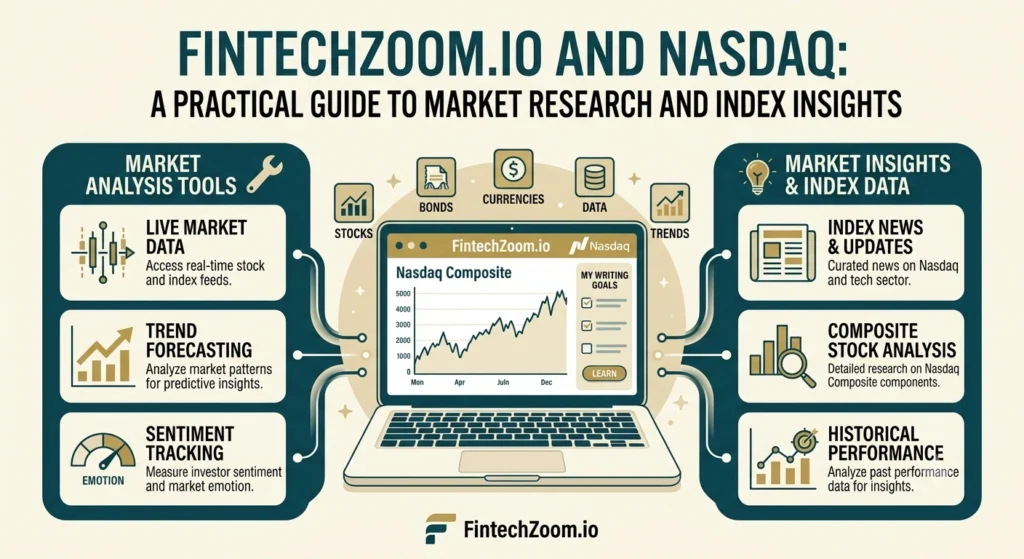
FintechZoom.io and Nasdaq: A Practical Guide to Market Research and Index Insights.
Introduction
The Nasdaq is one of the world’s most closely followed financial markets, particularly among investors interested in technology, growth companies, and innovation-driven businesses. At the same time, websites such as FintechZoom.io have emerged as online resources for people looking for market commentary, stock information, charts, and financial education.
Searching for “FintechZoom.io Nasdaq” can therefore lead to two related but different subjects: the information FintechZoom.io publishes about Nasdaq and the Nasdaq market itself.
Understanding that distinction is important.
FintechZoom.io is an independent financial website that publishes stock-market and financial content. Nasdaq, meanwhile, operates a major securities exchange and provides official indexes and market data.
This guide explains how the two fit together, what the Nasdaq Composite represents, how FintechZoom.io approaches Nasdaq-related content, and how readers can verify important market information before making financial decisions.
What Is FintechZoom.io?
FintechZoom.io is a financial information website covering subjects such as stocks, cryptocurrencies, market investing, and financial education.
Its website includes sections dedicated to stocks and crypto, along with courses covering financial literacy, stock-market trading, and stock-market investing.
The site describes itself as a resource for people interested in analyzing financial markets and says it covers markets including stocks, Nasdaq, Dow Jones, cryptocurrencies, gold, and silver.
Its stock section contains articles covering individual companies, market indexes, commodities, and broader investment themes.
For someone searching for Nasdaq information, FintechZoom.io can therefore be viewed as a third-party financial content resource, rather than the official Nasdaq exchange.
That distinction should remain clear whenever financial information is being researched.
What Does “FintechZoom.io Nasdaq” Mean?
The phrase FintechZoom.io Nasdaq generally refers to Nasdaq-related market information published or discussed on FintechZoom.io.
FintechZoom.io has a dedicated article titled “Nasdaq FintechZoom – Navigating The Past, Present & Future Charts.” The article discusses Nasdaq, market charts, historical performance, and technical information.
However, “FintechZoom.io Nasdaq” is not the name of a separate stock or financial index.
This is an important distinction for new investors.
FintechZoom.io is a website.
Nasdaq is the name associated with a major securities marketplace and a family of financial indexes.
The Nasdaq Composite is one of the major indexes associated with the Nasdaq Stock Market.
What Is the Nasdaq?
The Nasdaq Stock Market is a major electronic securities marketplace.
Nasdaq has operated for decades and is closely associated with technology, innovation, and growth-oriented companies.
However, Nasdaq is more than just a technology market.
The Nasdaq Composite includes companies from multiple industries and is designed to represent the performance of securities listed on the Nasdaq Stock Market. Nasdaq’s official description says the index includes domestic and international common-type stocks listed on the exchange.
The exchange itself also provides financial technology, market infrastructure, listings, data, and other services.
Understanding the Nasdaq Composite
When people casually say “the Nasdaq”, they may be referring to the Nasdaq Composite Index.
The Nasdaq Composite is a broad market index containing thousands of Nasdaq-listed securities.
Nasdaq describes it as a market-capitalization-weighted index. This means companies with larger market values generally have a greater influence on the index’s movements.
The index was launched in 1971, making it one of the long-established benchmarks for tracking Nasdaq-listed companies.
Its technology exposure is substantial, but the index is not limited to technology companies.
It includes companies across areas such as:
- Technology
- Consumer sectors
- Health care
- Financials
- Industrials
- Other industries
That broader composition is one reason the Nasdaq Composite should not simply be described as a “technology index.”
Nasdaq Composite vs. Nasdaq-100
One of the most common sources of confusion is the difference between the Nasdaq Composite and Nasdaq-100.
They are not the same index.
| Feature | Nasdaq Composite | Nasdaq-100 |
|---|---|---|
| Coverage | Broad Nasdaq-listed market | 100 large non-financial Nasdaq-listed companies |
| Number of constituents | More than 2,500 | 100 |
| Financial companies | Can be included | Excluded under index rules |
| Weighting | Market capitalization based | Modified methodology |
| Purpose | Broad Nasdaq market benchmark | Large-company growth-oriented benchmark |
Nasdaq’s current explanation confirms that the Composite covers more than 3,000 securities broadly, while the Nasdaq-100 consists of 100 of the largest non-financial companies listed on Nasdaq.
Because the two indexes have different construction rules, their performance can differ.
Why Is Nasdaq So Closely Associated With Technology?
Technology has historically played a major role in the Nasdaq ecosystem.
Large technology and innovation-focused companies have become important components of the market.
That association means Nasdaq is often used by investors as an indicator of sentiment toward:
- Technology
- Artificial intelligence
- Software
- Semiconductors
- Internet businesses
- Cloud computing
- Digital services
Nevertheless, investors should avoid assuming that every Nasdaq-listed company is a technology company.
The Nasdaq Composite is considerably broader.
Nasdaq itself currently describes the Composite as covering companies across all 11 ICB industry groups.
How FintechZoom.io Covers Nasdaq
FintechZoom.io has published dedicated Nasdaq-related content covering topics such as market charts, historical movements, technical analysis, and the broader role of Nasdaq in financial markets.
The site’s broader stock section also includes Nasdaq alongside other market topics such as the S&P 500, Dow Jones, FTSE 100, individual stocks, commodities, and cryptocurrencies.
This gives readers a wider context.
Instead of looking at Nasdaq in isolation, readers can compare its market behavior with other major benchmarks and asset classes.
However, third-party commentary should still be distinguished from official index data.
FintechZoom.io vs. Official Nasdaq Information
The difference between the two sources is straightforward.
FintechZoom.io
Provides:
- Financial articles
- Market commentary
- Educational material
- Stock-related content
- Investment-oriented discussions
- Cryptocurrency information
Nasdaq
Provides:
- Official index information
- Index methodologies
- Market data
- Listings information
- Exchange information
- Financial technology services
- Official index statistics
For example, Nasdaq’s official index page provides current Nasdaq Composite data and methodology information.
Therefore, if you see a Nasdaq figure on a third-party website, it is sensible to compare it with the official Nasdaq source before using the number for an important decision.
Why Official Data Matters
Financial markets move continuously during trading sessions.
A number published several hours ago may no longer represent the current market.
Even historical figures can be misinterpreted if the date or calculation method is unclear.
For that reason, investors should distinguish between:
Market commentary and official market data.
A financial article may explain why an index moved.
The official exchange or index provider is generally the better place to verify the actual index level, methodology, constituent rules, and official historical data.
Nasdaq provides dedicated index pages and methodology documents for this purpose.
What Can Cause the Nasdaq to Move?
The Nasdaq Composite can move because of many factors.
Technology Earnings
Large technology companies can have a substantial effect on market sentiment.
Strong earnings may encourage investors to expect continued growth.
Weak results can have the opposite effect.
Interest Rates
Growth-oriented companies can be particularly sensitive to changes in interest-rate expectations.
When investors change their expectations for future rates, valuations can move.
Inflation
Inflation affects consumer spending, business costs, monetary policy, and interest-rate expectations.
Those factors can influence equity valuations.
Economic Data
Employment, economic growth, consumer activity, and other economic indicators can affect investor expectations.
Geopolitical Developments
Major geopolitical events can increase uncertainty and change risk appetite across global markets.
Why Nasdaq Charts Matter
Charts can help investors visualize market movements.
A Nasdaq chart may show:
- Daily movement
- Weekly performance
- Monthly trends
- Longer-term performance
- Support and resistance levels
- Trading volume
- Historical highs and lows
FintechZoom.io’s Nasdaq-related content discusses charts and technical information as part of its market coverage.
However, a chart should be treated as a tool rather than a prediction machine.
Past price patterns do not guarantee future results.
Technical Analysis and Nasdaq
Technical analysis involves studying market prices, trading volume, trends, and other market data.
Common concepts include:
- Moving averages
- Support
- Resistance
- Momentum
- Relative strength
- Trend lines
- Volume
These tools can help traders organize market information.
However, technical indicators are not guarantees.
Two investors can look at the same chart and reach different conclusions.
That is why technical analysis is generally more useful when combined with broader market research and risk management.
Fundamental Factors Behind Nasdaq Performance
Charts are only one part of market analysis.
Fundamental analysis looks at the underlying businesses and economic conditions.
For individual companies, investors may consider:
- Revenue
- Earnings
- Profit margins
- Cash flow
- Debt
- Valuation
- Competitive position
- Growth expectations
For an index such as the Nasdaq Composite, investors can also examine broader factors such as earnings trends, sector performance, monetary policy, and economic conditions.
Using multiple forms of analysis can provide a more complete picture.
Nasdaq and Artificial Intelligence
Artificial intelligence has become an important investment theme across technology markets.
Companies involved in:
- AI infrastructure
- Semiconductors
- Cloud computing
- Data centers
- Enterprise software
- Cybersecurity
- Automation
can influence investor expectations about technology-sector growth.
Because Nasdaq includes many companies involved in technology and innovation, AI developments can have an important effect on market sentiment.
Still, investors should distinguish between an industry’s growth potential and an individual company’s investment prospects.
A growing industry does not automatically mean every company in that industry will outperform.
How Beginners Can Use FintechZoom.io for Nasdaq Research
A beginner can use third-party financial content as an educational starting point.
A sensible workflow is:
Step 1: Learn the Basic Terms
Understand the difference between:
- Nasdaq Stock Market
- Nasdaq Composite
- Nasdaq-100
- Individual Nasdaq-listed stocks
Step 2: Read Market Commentary
Use financial websites to understand what analysts and writers are discussing.
Step 3: Verify the Data
Check important figures against official Nasdaq information.
Step 4: Research Individual Companies
If an article discusses a particular stock, examine the company’s official filings and investor-relations information.
Step 5: Consider Risk
Never assume that an article’s positive outlook guarantees an investment return.
How Investors Can Verify Nasdaq Information
Before relying on a Nasdaq-related claim, ask five questions:
- What date does the information refer to?
- Is the figure live, delayed, or historical?
- Which Nasdaq index is being discussed?
- Does the official Nasdaq source confirm it?
- Is the statement fact, analysis, or opinion?
This simple checklist can prevent many misunderstandings.
It is especially useful when articles use phrases such as “Nasdaq,” because that word may refer to different indexes or the exchange itself.
Common Mistakes When Searching “FintechZoom.io Nasdaq”
Mistake 1: Treating FintechZoom.io as Nasdaq
FintechZoom.io is an independent website.
It is not the Nasdaq exchange.
Mistake 2: Assuming Nasdaq Means Nasdaq Composite
“Nasdaq” can refer to the exchange, the Composite, or another Nasdaq index depending on context.
Mistake 3: Confusing Nasdaq Composite With Nasdaq-100
The two indexes have different rules and constituents.
Mistake 4: Using Old Market Data
Always check the date.
Mistake 5: Treating Commentary as Investment Advice
Market commentary represents analysis, not certainty.
Mistake 6: Assuming Technology Is the Entire Nasdaq
Technology is highly important, but the Nasdaq Composite covers multiple industries.
Is FintechZoom.io an Official Nasdaq Website?
No. FintechZoom.io and Nasdaq are separate websites and organizations.
FintechZoom.io publishes financial content and market-related information. Nasdaq operates the Nasdaq Stock Market and provides official market and index information.
This distinction is important when evaluating financial information online.
For official Nasdaq index values, methodologies, and exchange information, readers should consult Nasdaq’s own resources.
Should Investors Rely on FintechZoom.io Alone?
No single financial website should be the only source used for an important investment decision.
FintechZoom.io can be useful for discovering market topics, reading commentary, and understanding different investment themes.
However, investors should also consider:
- Official company filings
- Official exchange information
- Regulatory disclosures
- Company investor-relations pages
- Multiple independent research sources
- Current market data
A diversified research process is generally more reliable than relying on one article or one website.
A Simple Research Framework for Nasdaq Investors
A practical research process can be divided into four stages.
Stage 1: Market
Ask what is happening with the broader Nasdaq market.
Stage 2: Sector
Identify which industries are driving or weakening performance.
Stage 3: Company
If considering an individual stock, examine its business fundamentals.
Stage 4: Risk
Consider valuation, volatility, diversification, and your own investment objectives.
This framework helps prevent investors from jumping directly from a headline to an investment decision.
E-E-A-T Considerations for Financial Content
Financial content requires particularly careful sourcing.
Readers should look for:
- Identifiable authors
- Clear publication dates
- Primary sources
- Transparent methodology
- Distinction between facts and opinions
- Appropriate risk disclosures
- Links to official information
FintechZoom.io identifies authors on its published articles, while Nasdaq provides official index methodologies and market documentation.
For high-stakes financial decisions, readers should prioritize primary and authoritative sources.
This is especially important when an article makes specific claims about prices, forecasts, returns, or investment opportunities.
FintechZoom.io Nasdaq: Key Takeaways
The phrase FintechZoom.io Nasdaq is best understood as a search topic connecting FintechZoom.io’s financial content with Nasdaq-related market information.
The most important points are:
- FintechZoom.io is a financial information website.
- Nasdaq is a major securities marketplace and financial technology company.
- The Nasdaq Composite tracks a broad group of Nasdaq-listed securities.
- The Nasdaq-100 is a separate index containing 100 large non-financial Nasdaq-listed companies.
- FintechZoom.io is not the official Nasdaq website.
- Official Nasdaq data should be checked when accuracy matters.
- Market commentary should not automatically be treated as investment advice.
Understanding these distinctions makes Nasdaq research much easier.
Frequently Asked Questions About FintechZoom.io Nasdaq
What is FintechZoom.io Nasdaq?
FintechZoom.io Nasdaq refers to Nasdaq-related financial content published or discussed on FintechZoom.io. It is not the name of a separate stock, ticker, or Nasdaq index. FintechZoom.io provides financial articles and market resources, while Nasdaq provides the official exchange and index information.
Is FintechZoom.io the official Nasdaq website?
No, FintechZoom.io is not the official Nasdaq website. It is an independent financial information website, whereas Nasdaq operates the Nasdaq Stock Market and publishes official index and market information.
What is the Nasdaq Composite?
The Nasdaq Composite is a broad market-capitalization-weighted index covering Nasdaq-listed securities. Nasdaq says the index includes thousands of securities across multiple industries and is widely used as a benchmark for the Nasdaq-listed market.
Is the Nasdaq Composite the same as the Nasdaq-100?
No, the Nasdaq Composite and Nasdaq-100 are different indexes. The Composite provides broad coverage of Nasdaq-listed securities, while the Nasdaq-100 tracks 100 of the largest non-financial companies listed on Nasdaq.
Why is Nasdaq associated with technology stocks?
Nasdaq has a substantial concentration of technology and innovation-oriented companies, although its broad Composite index includes many other industries. Nasdaq’s current information describes the Composite as covering all 11 ICB industry groups, so it should not be treated as a pure technology index.
Can FintechZoom.io be used for Nasdaq research?
Yes, FintechZoom.io can be used as a source of market commentary and educational information about Nasdaq. However, important figures and investment-related claims should be independently verified with official Nasdaq information and other authoritative financial sources.
Conclusion
FintechZoom.io and Nasdaq occupy different positions in the financial-information ecosystem.
FintechZoom.io provides financial content, market commentary, educational resources, and articles covering stocks, indexes, and other markets. Nasdaq, meanwhile, operates a major securities marketplace and provides official indexes, market data, methodologies, and financial-market technology.
For readers searching for FintechZoom.io Nasdaq, understanding this distinction is the first step.
The Nasdaq Composite is a broad index representing Nasdaq-listed securities, while the Nasdaq-100 is a separate benchmark focused on 100 large non-financial Nasdaq-listed companies.
FintechZoom.io can be useful for discovering market discussions and learning about financial topics. Nevertheless, investors should verify important data against primary sources and avoid treating forecasts or commentary as guaranteed outcomes.
The best financial research combines accessible analysis with authoritative data.
For Nasdaq-related decisions, that means using third-party analysis for context while turning to official Nasdaq and company sources when accuracy, methodology, or current market information matters.