
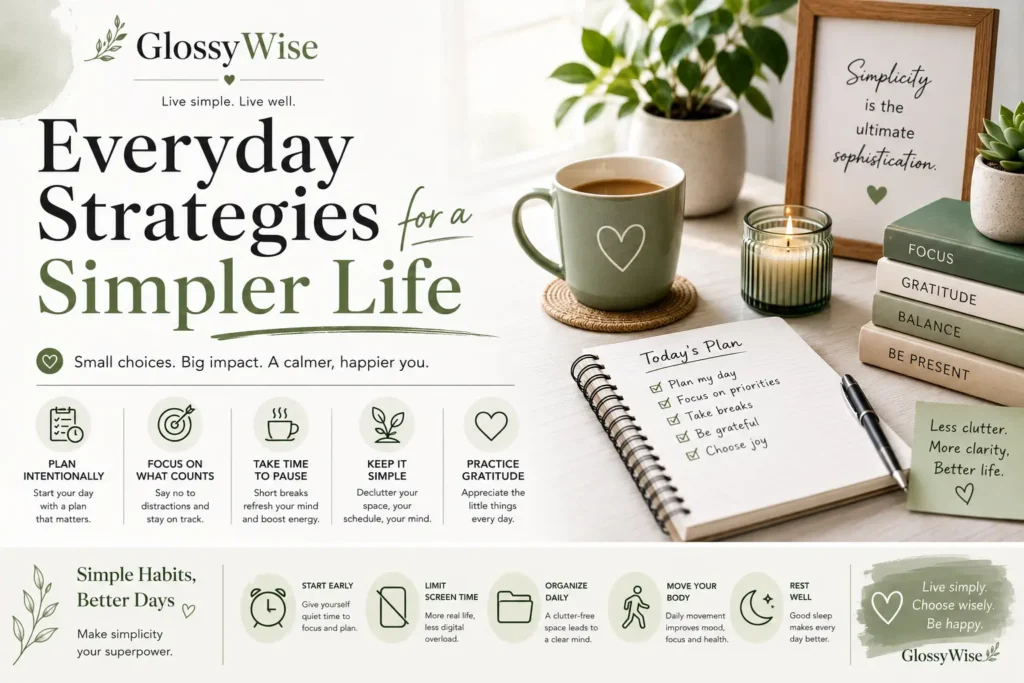
GlossyWise: Everyday Strategies for a Simpler Life.
Introduction
A simpler life does not necessarily mean doing less. It can mean making everyday activities easier to understand, easier to organize, and less demanding than they need to be.
That is where the GlossyWise approach can be useful. Instead of searching for complicated solutions, it focuses on practical improvements that fit naturally into ordinary routines. From deciding what deserves your attention to organizing your personal space and making better use of your time, small changes can make daily responsibilities feel more manageable.
This guide explores practical strategies for creating a smoother everyday lifestyle. You will find ideas for planning, organization, digital habits, decision-making, personal time, and maintaining routines without turning your schedule into a rigid checklist.
What Is a GlossyWise Lifestyle?
A GlossyWise lifestyle can be understood as a practical approach to everyday improvement.
It focuses on asking useful questions:
- What can be simplified?
- What regularly wastes my time?
- Which tasks deserve my attention first?
- What can I organize once and maintain easily?
- Which habits genuinely improve my day?
- What can I stop doing?
The goal is not to create a flawless lifestyle.
Instead, it is about making small, sensible improvements that fit real circumstances.
A system is useful when it continues to work even when you are busy, tired, traveling, or dealing with unexpected responsibilities.
1. Find Your Biggest Everyday Time-Wasters
Before changing your routine, identify where your time actually goes.
Think about activities that repeatedly take longer than necessary.
Perhaps you:
- Search for misplaced items
- Repeatedly check messages
- Spend too long deciding what to do first
- Look through poorly organized files
- Repeat the same small tasks unnecessarily
- Start several activities without finishing important ones
Choose one recurring problem.
Improving one major source of friction can be more useful than making ten minor changes simultaneously.
2. Plan Tomorrow Before Today Ends
You do not need an elaborate planning system.
Spend a few minutes identifying what tomorrow requires.
Write down:
- The most important task
- Other necessary responsibilities
- Anything you need to prepare
- One personal activity you would like to make time for
This creates a starting point for the next day.
You can still change the plan when circumstances change. The purpose is simply to avoid beginning every morning without direction.
3. Design Your Home Around Convenience
Organization becomes more useful when it reflects how you actually live.
If you use something every day, keeping it difficult to reach does not make much sense.
Consider where you naturally use different items and organize accordingly.
For example:
- Keep everyday kitchen items accessible.
- Store frequently used work materials near your workspace.
- Place keys in one consistent location.
- Keep essential chargers together.
- Store rarely used items away from everyday areas.
Good organization is not about making every shelf look perfect.
It is about making ordinary actions easier.
4. Use the “One Home” Rule
One simple organizational principle is to give frequently used items a predictable location.
If everything has a home, putting things away becomes easier.
This can work for:
- Keys
- Wallets
- Important paperwork
- School supplies
- Work equipment
- Cables
- Household tools
- Digital documents
The fewer places an item could be, the easier it is to find.
This small habit can save repeated searching over time.
5. Create a Personal Information System
Important information often ends up scattered across notebooks, phone notes, emails, screenshots, and messaging apps.
Instead of remembering where everything is, create a simple place for important information.
You could maintain sections for:
Personal
Important personal notes and information.
Work or study
Projects, deadlines, ideas, and reference material.
Ideas
Things you want to explore later.
Tasks
Actions that need to be completed.
Reference
Information you may need again.
The exact system does not matter as much as consistency.
6. Reduce Digital Interruptions
Digital tools are useful, but constant interruptions can make it difficult to concentrate.
Take a look at the notifications you receive.
Ask:
Does this notification require immediate attention?
If not, consider whether you need it at all.
You can review:
- Social media notifications
- Shopping alerts
- Promotional emails
- App notifications
- Group messages
- News alerts
Keeping only useful alerts can make your devices feel less demanding.
7. Use Short Lists Instead of Endless Lists
Long to-do lists can create the impression that everything must happen immediately.
Try dividing tasks into three groups:
Today
Things that genuinely need attention today.
Later
Tasks that can wait.
Someday
Ideas or optional activities that are not currently important.
This allows you to separate immediate responsibilities from things that simply happen to be on your mind.
8. Create Better Defaults
Repeated decisions can take unnecessary mental effort.
You can simplify them by establishing default choices.
For example:
- A regular day for household errands
- A standard place for important documents
- A basic morning routine
- A short list of reliable meals
- A consistent time for weekly planning
- A preferred location for commonly used items
Defaults do not remove choice.
They simply mean you do not have to reconsider the same small decision every time.
9. Make Space for Unplanned Time
A completely packed schedule leaves little room for unexpected events.
Instead of filling every available period, leave some flexibility.
This can help when:
- A task takes longer than expected
- Someone needs your attention
- Travel takes extra time
- You need a genuine break
- An interesting opportunity appears
A practical schedule should have some breathing room.
10. Separate Important Work From Maintenance Tasks
Not every task requires the same kind of attention.
Some activities create progress, while others simply keep things running.
Progress tasks
Examples include:
- Completing a project
- Studying an important topic
- Developing a skill
- Working toward a personal goal
Maintenance tasks
Examples include:
- Cleaning
- Sorting files
- Answering routine messages
- Basic household organization
Both matter, but mixing them together can make it difficult to see whether you are actually moving forward.
Give important work dedicated attention when possible.
11. Protect Your Personal Time
A simpler lifestyle should not become a productivity project.
Personal time deserves space too.
Consider what you enjoy outside responsibilities.
It could be:
- Cricket or another sport
- Reading
- Music
- Walking
- Cooking
- Gaming
- Art
- Photography
- Travel
- Socializing
You do not have to justify every minute of free time by making it productive.
Sometimes the point of an activity is simply that you enjoy it.
12. Build a Routine That Can Survive Busy Days
Your routine should have a backup version.
For example:
Normal day:
Complete your full planned routine.
Busy day:
Complete the most important part.
Very busy day:
Do the minimum necessary and return to your normal routine when possible.
This avoids an all-or-nothing mindset.
A missed routine does not mean you need to abandon the system entirely.
GlossyWise Strategy Table
| Area | Practical Strategy |
|---|---|
| Planning | Choose a few meaningful priorities |
| Home | Keep frequently used items accessible |
| Organization | Give important items consistent locations |
| Digital life | Remove unnecessary notifications |
| Information | Use one reliable system for important notes |
| Decisions | Establish useful defaults |
| Work | Separate progress from maintenance tasks |
| Time | Leave room for unexpected events |
| Personal life | Protect time for enjoyable activities |
| Habits | Create flexible versions for busy days |
A Simple GlossyWise Weekly Reset
You can use a short weekly review to prepare for the days ahead.
Review your schedule
Look at upcoming appointments, deadlines, events, and commitments.
Check your priorities
Identify what genuinely deserves attention.
Organize one area
Choose a desk, drawer, folder, inbox, or another small area.
Look at unfinished tasks
Decide whether each one should be completed, postponed, delegated, or removed.
Plan personal time
Identify opportunities for hobbies, exercise, friends, family, or simply relaxing.
The goal is clarity—not an elaborate weekly planning ceremony.
How to Avoid Making Your Lifestyle Too Complicated
Ironically, trying too hard to simplify life can sometimes make it more complicated.
Watch for these signs:
You keep adding new systems
If you need several apps to manage your productivity system, consider whether the system itself has become the problem.
Your routine takes too long to maintain
A routine should save effort rather than consume all of it.
You feel guilty when you miss a habit
Flexibility is important. Real life does not always follow a schedule.
You are organizing instead of acting
Organization is useful when it supports action. Constantly rearranging lists and folders is not necessarily progress.
You are copying someone else’s lifestyle
Use ideas as inspiration, but adapt them to your own responsibilities and preferences.
A GlossyWise Example for a Busy Week
Imagine someone has work, household responsibilities, personal commitments, and limited free time.
Instead of creating an elaborate schedule, they might:
Sunday:
Review the upcoming week.
Each evening:
Identify tomorrow’s most important tasks.
Morning:
Begin with the highest-priority responsibility.
During work:
Limit unnecessary interruptions during focused tasks.
After work:
Complete essential household responsibilities.
Evening:
Keep some time for a personal interest.
Weekend:
Reset one area of the home and prepare for the next week.
This system is intentionally uncomplicated.
Its purpose is to create a little more clarity without trying to control every moment.
Practical GlossyWise Checklist
Before changing your routine, ask yourself:
- What is currently making my day harder?
- Can I remove the problem instead of managing it?
- Can I create a simple default?
- Can I organize this once and maintain it?
- Does this new habit save more effort than it requires?
- Will this still work when I have a busy day?
- Am I leaving enough time for things I enjoy?
These questions can help you decide whether a new lifestyle idea is genuinely useful.
FAQ About GlossyWise
What is GlossyWise?
GlossyWise is a practical lifestyle concept centered on making everyday routines, organization, decisions, and personal habits simpler and more manageable. It emphasizes useful changes that can fit naturally into everyday life.
How can GlossyWise make everyday life easier?
GlossyWise can help by encouraging simple systems for planning, organization, digital management, and daily routines. The focus is on reducing unnecessary effort rather than adding more complicated rules.
What is the easiest GlossyWise habit to start with?
One of the easiest places to begin is choosing a small number of priorities for the next day. This gives you a clear starting point without requiring a complicated planning system.
Can GlossyWise help with time management?
Yes, GlossyWise principles can support time management by helping you identify priorities, reduce unnecessary decisions, protect focused time, and leave room for unexpected responsibilities.
Should a GlossyWise routine be strict?
No, a useful routine should be flexible enough to handle busy or unpredictable days. Creating a simpler backup version of important habits can make a routine easier to maintain.
Is GlossyWise only about productivity?
No, GlossyWise can include productivity, but it also covers organization, personal time, digital habits, decision-making, home routines, and everyday balance. The broader goal is to make daily life more practical and manageable.
Conclusion
GlossyWise is less about creating the perfect lifestyle and more about finding practical ways to make your existing life work better.
Start with one recurring problem. Simplify it, create a system that is easy to repeat, and keep it only if it genuinely helps.
Whether you are organizing your workspace, reducing digital distractions, planning your week, or making more room for a favorite hobby, the same principle applies: simple systems are valuable when they make real life easier.
Choose one idea from this guide and try it this week. Once it becomes natural, you can decide what deserves your next improvement.