
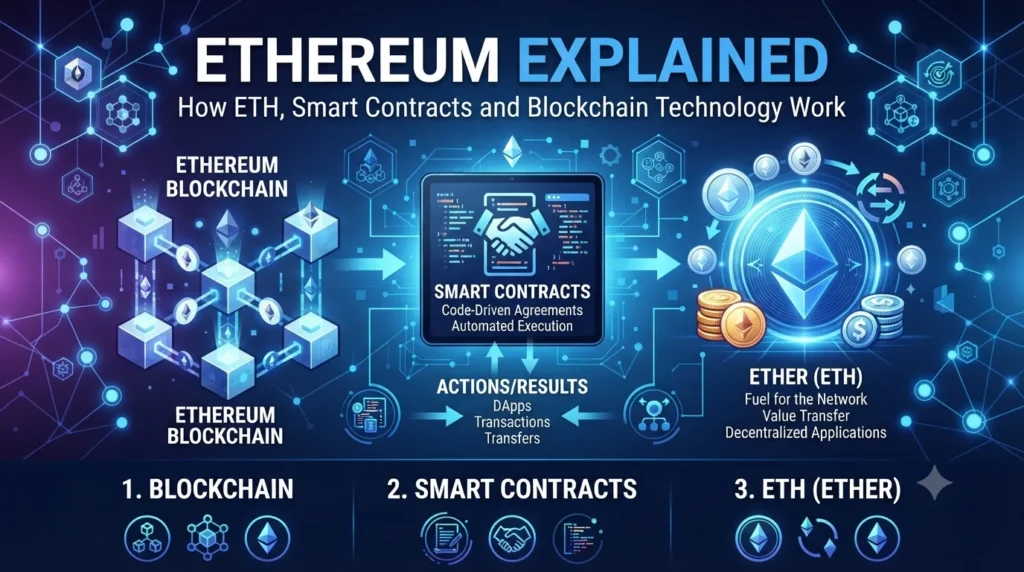
Ethereum Explained: How ETH, Smart Contracts and Blockchain Technology Work.
Introduction
Ethereum is a decentralised blockchain network that allows people to transfer digital assets, run applications and execute agreements through code. Unlike a blockchain designed primarily for payments, Ethereum also provides a programmable environment where developers can build financial services, digital marketplaces, games and other applications.
Its native cryptocurrency is called Ether (ETH). People use ETH to pay transaction fees, participate in network staking and transfer value. It also plays an important role in applications built across the Ethereum ecosystem.
One of Ethereum’s defining features is its support for smart contracts. These programs execute on the blockchain when their specified conditions are met, allowing applications to operate without relying entirely on a central company to manage every transaction.
Ethereum is not the same thing as ETH. The network provides the infrastructure, while ETH is the native digital asset used within that system.
Understanding this distinction makes it easier to explore Ethereum’s technology, its practical applications, its limitations and the risks associated with cryptocurrency.
Ethereum at a Glance
| Feature | Explanation |
|---|---|
| Network | Ethereum |
| Native cryptocurrency | Ether (ETH) |
| Technology | Public blockchain |
| Main capability | Programmable decentralised applications |
| Smart contracts | Programs executed by the network |
| Consensus mechanism | Proof of Stake |
| Transaction fees | Paid in ETH |
| Network participants | Users, validators, developers and node operators |
| Scaling approach | Ethereum mainnet and Layer 2 networks |
| Common applications | Decentralised finance, NFTs, digital assets and blockchain-based services |
| Original network launch | 2015 |
| Main development focus | Scalability, security, decentralisation and usability |
Ethereum’s protocol evolves through community-driven development. Features, upgrade schedules and technical priorities can change as research and testing progress.
How Does Ethereum Work?
Ethereum combines a blockchain, a network of computers and a shared system for executing transactions and smart contracts.
A blockchain records transactions in an ordered sequence of blocks. Participants can independently verify the network’s records using compatible software, helping maintain a common view of its state without depending on one central database administrator.
When someone sends ETH or interacts with a decentralised application, the transaction is submitted to the network. Validators participate in confirming and proposing blocks under Ethereum’s consensus rules, while execution clients check that transactions follow the protocol.
Once transactions are included and the network reaches the required consensus, the resulting state changes become part of Ethereum’s shared record.
The Main Components
Blockchain: Ethereum’s distributed record of transactions and state changes.
Nodes: Computers running Ethereum software to verify data and participate in the network’s operation. Different node configurations perform different roles.
Validators: Participants who stake ETH and help secure the network through proof of stake.
Smart contracts: Programs that carry out defined operations on Ethereum.
ETH: The native asset used for payments, transaction fees, staking and other network activities.
These components work together to create a programmable blockchain that can support many applications rather than one single service.
What Is ETH Used For?
ETH is Ethereum’s native cryptocurrency, but its role extends beyond transferring money between accounts.
Paying Transaction Fees
Users generally pay gas fees in ETH when executing transactions on Ethereum. A transaction could involve sending ETH, interacting with a smart contract or using a decentralised application.
The fee compensates for the computational and network resources required to process the operation.
Staking
ETH can be staked to participate in Ethereum’s proof-of-stake consensus mechanism. Validators help secure the network and may receive rewards for performing their duties correctly.
Staking also introduces risks, including penalties for certain validator misbehaviour and potential losses from third-party services.
Transferring Value
People can send ETH between compatible cryptocurrency addresses without requiring a traditional bank to process the blockchain transfer.
However, this does not mean every transaction is free or reversible. Network fees apply, and a confirmed transfer to the wrong address can be difficult or impossible to recover.
Supporting Blockchain Applications
ETH is used throughout the Ethereum ecosystem. Applications may require it for transactions, collateral, payments or other activities depending on their design.
The specific function of ETH varies between applications, so users should understand the rules of a service before depositing funds.
What Are Ethereum Smart Contracts?
Smart contracts are programs stored and executed on a blockchain. They follow coded rules to process transactions and update application data.
For example, a decentralised exchange can use smart contracts to facilitate token swaps. A lending application can use them to manage deposits, collateral and repayments according to its programmed conditions.
These operations can occur without a traditional intermediary manually approving every individual action.
Common Smart Contract Applications
- Decentralised finance (DeFi): Lending, borrowing, trading and other financial services.
- NFTs: Systems for creating, transferring and managing blockchain-based tokens representing digital or other assets.
- Decentralised applications: Services that use blockchain-based logic alongside other software components.
- Token issuance: Creating tokens that follow established standards.
- On-chain governance: Systems that let eligible participants vote on proposals or protocol-related decisions.
Smart contracts are not automatically trustworthy simply because they run on a blockchain. Coding errors, poorly designed economic incentives, compromised administrative keys and external data dependencies can still create vulnerabilities.
Before using an application, examine its documentation, security reviews and relevant risk disclosures.
What Is Proof of Stake?
Ethereum uses Proof of Stake (PoS) to coordinate agreement on the blockchain’s valid state.
Under this system, validators stake ETH and participate in proposing and attesting to blocks. Their activity helps the network reach consensus about which transactions should be accepted and the order in which they are recorded.
Ethereum completed its transition from proof of work to proof of stake on 15 September 2022 in an upgrade known as The Merge.
Why Ethereum Changed Its Consensus Mechanism
The transition removed Ethereum’s reliance on energy-intensive mining for consensus. It also established staking as the basis for validator participation.
Proof of stake introduces its own technical and economic considerations. Validators must follow protocol rules, maintain reliable infrastructure and protect their keys.
Dishonest behaviour or specific forms of protocol violations can lead to penalties, including the loss of some staked ETH.
The system is designed to make attacking the network economically costly, although no technology can eliminate every operational, software or governance risk.
How Ethereum Gas Fees Work
Gas measures the computational work required to process transactions and execute smart-contract operations on Ethereum.
A straightforward ETH transfer generally requires less gas than a complicated contract interaction. More complex operations can consume substantially more computational resources.
The total fee depends on the gas consumed and the applicable price per unit of gas.
A simplified calculation is:
Transaction fee = Gas used × Effective gas price
Ethereum’s fee mechanism includes a base fee and, under the standard transaction model, an optional priority fee. The base fee is determined by network conditions and is burned, while the priority fee can incentivise validators to include a transaction.
Why Do Fees Change?
Transaction fees can rise when demand for block space increases. During periods of heavy activity, users may need to pay more to have transactions included promptly.
The cost also depends on the operation being performed. Sending ETH is not necessarily as expensive as interacting with a contract that executes many instructions.
How Can Users Manage Gas Costs?
- Check the estimated fee before approving a transaction.
- Avoid rushing transactions when timing is not important.
- Compare the costs of Ethereum mainnet and suitable Layer 2 networks.
- Confirm that the wallet displays the correct network.
- Be careful when using applications that request additional contract permissions.
A low fee should not be the only factor in choosing a network. Security assumptions, withdrawal conditions, liquidity and compatibility matter as well.
Ethereum Layer 1 and Layer 2
Ethereum mainnet is commonly described as Layer 1 (L1). It provides the base blockchain, its consensus mechanism and the underlying security rules.
Layer 2 (L2) networks are designed to handle transactions and computation away from the main chain while using Ethereum for important aspects of settlement or security, depending on the design.
Rollups are a major part of this scaling approach. They process transactions outside the main Ethereum execution environment and publish transaction data or proofs to Ethereum according to their architecture.
Optimistic Rollups
Optimistic rollups generally assume submitted transaction results are valid unless a challenge process demonstrates otherwise. Their security depends on the design of the challenge mechanism and its supporting infrastructure.
Zero-Knowledge Rollups
Zero-knowledge rollups use cryptographic proofs to demonstrate that state transitions satisfy specified rules. The exact proof systems and security properties vary by implementation.
Why Layer 2 Matters
Moving some activity to Layer 2 can reduce costs and increase transaction capacity for users. It also allows different networks to experiment with features and user experiences.
Nevertheless, not every L2 has identical security properties. Users should check withdrawal arrangements, bridge risks, upgrade controls and the degree of decentralisation before moving assets.
What Can You Do With Ethereum?
Ethereum supports a wide range of blockchain-based activities.
Decentralised Finance
DeFi applications allow users to interact with lending markets, exchanges, liquidity pools and other financial protocols. These services can operate through smart contracts rather than relying exclusively on conventional financial intermediaries.
Potential benefits include programmable financial tools and open access. Risks include contract exploits, liquidation, market volatility and flawed protocol design.
NFTs and Digital Ownership
Ethereum supports tokens used for digital collectibles, artwork, memberships and other applications. An NFT can record ownership of a particular token, but it does not automatically transfer copyright or unrestricted rights to the associated content.
The legal and practical rights depend on the relevant terms and applicable law.
Decentralised Autonomous Organisations
Some organisations use blockchain-based governance to coordinate proposals, voting and treasury decisions. Their structures differ, and voting power may be concentrated among a small number of participants.
Stablecoins and Payments
Many stablecoins operate on Ethereum or compatible networks. They aim to maintain a reference value, often against a currency such as the US dollar.
Their stability depends on the issuer, reserves, redemption arrangements, market liquidity and other factors. A stablecoin is not automatically risk-free.
Digital Identity and Other Applications
Developers also explore identity tools, digital credentials, gaming assets, supply-chain systems and public-goods funding.
The practicality of each use case depends on more than blockchain technology alone. User experience, privacy, regulation, costs and adoption all influence whether an application is useful.
Ethereum and Bitcoin: Key Differences
Ethereum and Bitcoin are both prominent blockchain networks, but they have different design priorities.
| Feature | Ethereum | Bitcoin |
|---|---|---|
| Native asset | ETH | BTC |
| Consensus mechanism | Proof of Stake | Proof of Work |
| Main design emphasis | Programmable blockchain applications | Peer-to-peer digital money and monetary settlement |
| Smart contracts | General-purpose programmable execution | More constrained scripting model |
| Network participation | Validators and nodes | Miners and nodes |
| Common use cases | DeFi, tokens, NFTs and decentralised applications | Value transfer, savings narratives and settlement |
| Supply design | No fixed maximum supply encoded in the same way as Bitcoin’s 21-million cap | Maximum supply of 21 million BTC |
Neither network is suitable for every purpose. Ethereum provides a broader programmable application environment, whereas Bitcoin places greater emphasis on its monetary design and proof-of-work security model.
Both assets can experience significant price volatility. Comparing their technology does not establish which asset will perform better financially.
What Is Ethereum Staking?
Ethereum staking involves committing ETH to support the network’s proof-of-stake system.
A solo validator traditionally requires 32 ETH to activate a validator through the protocol. Other participation methods, including pooled staking and liquid staking services, may allow people to participate with different amounts, but these options introduce additional service-specific risks.
Solo Staking
Solo stakers operate their own validator infrastructure and retain direct responsibility for maintaining their setup. This approach offers greater operational control but requires technical knowledge, reliable equipment and key management.
Pooled Staking
Pooling services combine funds or coordinate participation for users who do not want to operate a validator independently. The provider’s fee structure, custody arrangements and operational practices can affect the experience.
Liquid Staking
Some services issue a token representing a staking position. Such tokens may be transferable or usable in DeFi, but their market price can differ from the value of the underlying ETH.
Staking is not a guaranteed-income product. Rewards fluctuate, and penalties, service failures, liquidity constraints and smart-contract vulnerabilities can create losses.
Ethereum’s Roadmap in 2026
Ethereum development continues through community research, implementation, testing and network upgrades. The roadmap aims to improve scalability, security, decentralisation and usability without relying on a single change to solve every challenge.
Several major upgrades have already occurred:
- The Merge — 15 September 2022: Ethereum transitioned to proof of stake.
- Shapella — 12 April 2023: Staking withdrawals became available.
- Dencun — 13 March 2024: The upgrade introduced changes that included blob transactions designed to support Layer 2 scaling.
- Pectra — 7 May 2025: The network received execution- and consensus-layer improvements.
- Fusaka — 3 December 2025: Further changes advanced Ethereum’s scaling work.
What Is Glamsterdam?
As of October 2026, Glamsterdam is an upcoming Ethereum mainnet upgrade targeted for the fourth quarter of 2026, with the precise mainnet activation date not yet confirmed in the official roadmap.
The upgrade is being developed to improve Layer 1 capacity and the way Ethereum processes transactions and manages blockchain data. Key planned changes include enshrined proposer-builder separation (ePBS) and block-level access lists (BALs).
These changes are intended to support more efficient block production, parallel processing and future scaling. Gas repricing proposals are also part of the planned upgrade scope.
Glamsterdam’s features and timing remain subject to implementation and testing. A planned improvement should not be presented as a fully deployed mainnet feature until activation is confirmed.
What Comes After Glamsterdam?
Hegotá is the next named upgrade on Ethereum’s published roadmap, with 2027 shown as its target year. Its scope and timing can change as research and development continue.
Readers can follow the official Ethereum roadmap and protocol announcements for current upgrade status rather than relying on outdated timelines or social-media speculation.
Is Ethereum Safe?
Ethereum’s protocol is maintained through open-source development, independent node operation, cryptographic verification and consensus rules. These mechanisms provide important security properties, but they do not make every activity on the network safe.
Security depends on several layers.
Protocol security: The blockchain’s consensus and execution rules must operate as intended.
Wallet security: Users need to protect recovery phrases, private keys and signing devices.
Smart-contract security: Applications may contain vulnerabilities even when the underlying blockchain functions correctly.
Bridge security: Moving assets between networks can introduce additional technical and operational risks.
Human behaviour: Phishing messages, impersonation, malicious approvals and fraudulent investment schemes remain common threats across cryptocurrency markets.
For everyday users, protecting wallet credentials and verifying transaction details are essential habits. Never disclose a recovery phrase to someone claiming to offer support, and do not trust a website merely because it uses Ethereum branding.
What Are the Risks of Ethereum?
Ethereum has technical uses, but participation involves meaningful risks.
Price Volatility
ETH’s market price can rise or fall sharply. Demand, market conditions, regulation, competition and broader economic developments can influence valuations.
Transaction Errors
Blockchain transactions are often difficult to reverse after confirmation. Sending assets to an incorrect address or using an incompatible network can result in permanent loss.
Smart-Contract Exploits
A decentralised application can contain bugs or design weaknesses. An exploit may allow attackers to drain funds or disrupt a service.
Scams and Phishing
Fraudulent websites and messages may impersonate wallets, exchanges, developers or well-known projects. Some scams promise guaranteed returns or falsely claim that users must migrate or upgrade their ETH.
Regulatory Uncertainty
Rules governing cryptocurrency, exchanges, taxation and digital assets differ across countries and can change over time.
Staking and Liquidity Risks
Staking arrangements may involve penalties, lock-up or withdrawal delays, third-party dependencies and market-price differences.
Anyone considering a financial commitment should research the relevant risks and avoid treating historical performance or technology adoption as a guarantee of future returns.
How to Get Started With Ethereum
A beginner can explore Ethereum without immediately purchasing cryptocurrency.
1. Learn the Basics
Understand the differences between Ethereum, ETH, wallets, smart contracts, gas fees and Layer 2 networks.
2. Explore Official Documentation
Start with Ethereum’s official educational resources and developer documentation. These explain how the protocol works and provide updates about network development.
3. Choose a Wallet Carefully
A wallet helps you manage keys and interact with blockchain applications. Evaluate its security model, recovery process, supported networks and reputation before using it.
4. Verify the Network
Ethereum mainnet and Layer 2 networks are not interchangeable in every context. Confirm the destination network and address before transferring assets.
5. Start With Low-Risk Exploration
Educational resources and public blockchain explorers can help you understand transactions without making a financial commitment. If you choose to transact, use only amounts you can afford to lose and verify every detail.
6. Keep Records and Protect Access
Store recovery information securely and maintain records relevant to your transactions and local tax obligations. Never share private keys or recovery phrases with another person.
Final Takeaway
Ethereum is more than a cryptocurrency. It is a programmable blockchain designed to support digital payments, smart contracts, decentralised finance, token systems and a wide range of applications.
ETH provides the network’s native asset for transaction fees, staking and transfers. Meanwhile, proof of stake allows validators to participate in securing the blockchain without the energy-intensive mining model used by proof-of-work networks.
Scaling remains an important part of Ethereum’s development. Layer 2 networks help expand transaction capacity, while protocol upgrades aim to improve the main network’s efficiency, security and usability.
The roadmap continues to evolve, with Glamsterdam targeted for late 2026 and Hegotá planned afterward. These dates and features should be checked against official announcements because development schedules can change.
For anyone researching Ethereum, the most useful approach is to understand both its capabilities and its limitations. Smart contracts can enable new services, but they can also contain vulnerabilities. Staking may provide rewards, yet it involves operational and financial risks. Likewise, ETH’s usefulness does not eliminate market volatility.
Ultimately, Ethereum is best understood as an evolving blockchain infrastructure whose value depends on its technology, security, ecosystem adoption and the risks users are willing to accept—not as a guaranteed route to financial returns.
What is Ethereum in simple words?
Ethereum is a decentralised blockchain that supports digital transactions and programmable applications. Its native cryptocurrency is called Ether, or ETH.
How does Ethereum make money?
Ethereum is a decentralised protocol, not a single company with one central revenue model. Validators may receive rewards and transaction tips, while ETH holders and application developers participate in different economic activities. The network also burns base fees under its fee mechanism.
Is Ethereum the same as ETH?
No. Ethereum is the blockchain network and its broader technology ecosystem. ETH is the network’s native cryptocurrency, used for transaction fees, staking and transferring value.
Does Ethereum use mining?
Ethereum no longer uses proof-of-work mining for consensus. It transitioned to proof of stake in September 2022, when validators began securing the network through staked ETH.
Why are Ethereum gas fees sometimes expensive?
Fees can rise when demand for transaction processing is high. Complex smart-contract operations may also require more gas than simple ETH transfers.