
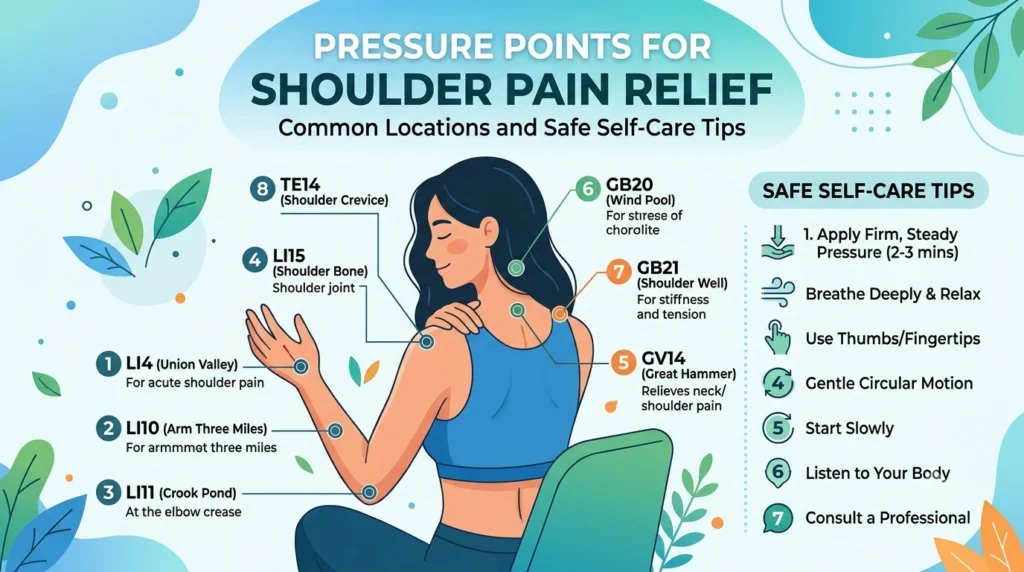
Pressure Points for Shoulder Pain Relief: Common Locations and Safe Self-Care Tips.
Introduction
Shoulder discomfort can affect everyday activities, from working at a computer and carrying shopping bags to exercising, driving and sleeping comfortably. Sometimes the problem feels like tightness across the upper shoulders. In other cases, it appears as an ache around the shoulder blade or discomfort when lifting the arm.
Long periods of sitting, repetitive movements, exercise, muscle strain and certain shoulder conditions can contribute to these symptoms. When discomfort develops, people often look for simple ways to relax the surrounding muscles without immediately relying on medication.
One approach that attracts interest is acupressure, which involves applying gentle pressure to selected areas of the body. Traditional Chinese medicine describes several points around the shoulder, upper back and neck that are commonly associated with tension and discomfort.
However, it is important to understand the difference between traditional pressure-point practices and clinically established shoulder treatments. Acupressure may feel relaxing for some people, but evidence that pressing specific points reliably treats the underlying causes of shoulder pain remains limited.
This guide explains commonly discussed shoulder pressure points, how to approach gentle self-massage, which areas require extra caution, and other self-care options that may support shoulder comfort. It also discusses how physical-stimulation products, including Japanese press-needle patches, differ from ordinary acupressure.
Quick Answer: Which Pressure Points Are Commonly Used for Shoulder Pain?
Traditional acupressure and acupuncture systems describe several points around the shoulders and upper back. The following locations are commonly discussed:
| Traditional point or area | General location | Traditional association |
|---|---|---|
| LI15 (Jianyu) | Outer shoulder, near the shoulder joint | Shoulder discomfort and restricted movement |
| SJ14 (Jianliao) | Outer-back portion of the shoulder | Shoulder tension and discomfort |
| SI11 (Tianzong) | Muscular area around the shoulder blade | Upper-back and shoulder discomfort |
| GB21 (Jianjing) | Upper trapezius, between the neck and shoulder | Neck and shoulder tension |
| Upper trapezius muscle area | Top of the shoulder, between neck and shoulder joint | General muscle tightness |
| Posterior shoulder muscle area | Back of the shoulder, around the rear deltoid | Local muscle tension |
Important: These are traditional point descriptions, not proven treatment targets. Their locations can vary slightly between anatomical references and practitioners. Avoid deep pressure around the neck, front of the shoulder or any area where you feel unusual pain, tingling or numbness.
For uncomplicated muscle tightness, gentle massage may provide temporary comfort. Persistent or severe shoulder pain needs appropriate assessment rather than repeated pressure-point treatment.
1. What Are Pressure Points for Shoulder Pain Relief?
Pressure points are specific locations described in traditional practices such as acupressure and acupuncture. In acupressure, a person uses their fingers, thumbs or a suitable tool to apply pressure to selected areas. Acupuncture involves inserting fine needles into the skin and should be performed by an appropriately qualified practitioner.
Traditional Chinese medicine associates certain points with pathways known as meridians. These concepts form part of the traditional framework, but meridians are not established anatomical structures in modern medicine.
From a practical self-care perspective, gentle pressure or massage may help some people relax tense muscles and become more aware of areas that feel uncomfortable. However, it is not possible to assume that pressing a traditional point will correct a tendon problem, joint condition, nerve irritation or shoulder injury.
Why do people try shoulder acupressure?
People commonly explore pressure-point techniques because they are:
- Non-invasive when performed gently with the fingers.
- Convenient to practise at home.
- Easy to combine with relaxation and breathing exercises.
- A way to apply gentle Japanese Muscle Pain Relief Patch .
- An alternative self-care approach for people who prefer not to use topical products.
These potential benefits should not be confused with proof that acupressure can treat every type of shoulder pain.
2. Common Pressure Points for Shoulder Pain Relief
The following locations are commonly mentioned in traditional acupressure references. They are included to explain the terminology and help readers understand the practice. They should not be treated as a diagnosis or a prescription for treating a shoulder condition.
A. LI15 (Jianyu): Outer Shoulder Area
<text> </text>
<AsyncImage query=”medical anatomical illustration outer shoulder deltoid muscle acupressure LI15 Jianyu point labelled” aspectRatio=”16:9″ width=”100%” />
LI15, traditionally called Jianyu, is described near the outer shoulder, around the region where the upper arm meets the shoulder.
This point is commonly discussed in traditional practices involving shoulder stiffness and difficulty moving the arm.
How to approach the area safely:
- Keep your shoulder relaxed.
- Use the fingertips to make gentle contact with the surrounding muscle.
- Avoid pressing directly into the joint or forcing the arm into an uncomfortable position.
- Stop if you experience sharp pain, tingling or unusual sensations.
Do not use forceful pressure in an attempt to improve shoulder movement. If raising your arm is difficult, a healthcare professional should assess the reason.
B. SJ14 (Jianliao): Outer-Back Shoulder Area
<AsyncImage query=”anatomical illustration posterior lateral shoulder deltoid acupressure SJ14 Jianliao labelled” aspectRatio=”16:9″ width=”100%” />
SJ14, also known as Jianliao, is traditionally located around the outer-back portion of the shoulder.
This area is associated in traditional acupressure descriptions with shoulder discomfort and restricted movement.
Gentle self-care approach:
- Relax your arm and let it rest comfortably.
- Use the opposite hand to touch the surrounding muscle.
- Apply light, comfortable pressure rather than digging into the area.
- Release the pressure if the shoulder becomes more uncomfortable.
The rear shoulder contains several muscles and structures. Avoid assuming that tenderness at one location identifies the cause of your pain.
C. SI11 (Tianzong): Shoulder Blade Area
<AsyncImage query=”anatomical illustration upper back scapula shoulder blade SI11 Tianzong point labelled” aspectRatio=”16:9″ width=”100%” />
SI11, traditionally called Tianzong, is described in the muscular area around the shoulder blade.
People may explore gentle massage around this region when they experience upper-back tightness or discomfort between the shoulder blade and spine.
Safe self-care approach:
- Sit in a comfortable position.
- Relax your shoulders and breathe normally.
- Use your opposite hand to massage accessible muscles around the shoulder blade.
- Keep pressure light and avoid pressing directly on the spine or bony areas.
If you cannot comfortably reach the area, do not twist your body or use a hard object to force pressure into it.
D. GB21 (Jianjing): Upper Trapezius Area
<AsyncImage query=”medical anatomical illustration upper trapezius muscle neck shoulder GB21 Jianjing point labelled” aspectRatio=”16:9″ width=”100%” />
GB21, traditionally known as Jianjing, is described on the upper trapezius muscle between the base of the neck and the outer shoulder.
This region is commonly associated with neck and shoulder tightness, particularly among people who spend extended periods sitting or working at a desk.
However, this area requires particular caution. Important anatomical structures are present around the neck and upper shoulder. Avoid deep pressure, pinching or forceful manipulation.
A safer alternative:
- Rest your hand gently on the upper shoulder muscle.
- Use a light, broad massage rather than concentrated thumb pressure.
- Keep your head in a comfortable, neutral position.
- Stop if you feel dizziness, tingling, numbness or pain travelling down your arm.
Traditional references also advise against using GB21 during pregnancy. Pregnant people should avoid experimenting with pressure-point treatments and seek advice from a qualified healthcare professional.
E. Upper Trapezius Muscle Area
<AsyncImage query=”human shoulder upper trapezius muscle anatomy posterior view highlighted” aspectRatio=”16:9″ width=”100%” />
The upper trapezius is a large muscle extending across the upper back and neck to the shoulders. It helps support and move the shoulder blades and neck.
Tightness in this region may occur after prolonged desk work, repetitive activity or exercise.
Unlike a traditional acupressure point, the upper trapezius is an identifiable anatomical muscle. Gentle massage around the muscle may feel comfortable for some people.
Try this:
- Sit upright without forcing your shoulders backwards.
- Let your arms rest naturally.
- Use the opposite hand to gently massage the top of the shoulder.
- Avoid squeezing the neck or applying pressure over the collarbone.
- Continue only while the pressure feels comfortable.
This is a general relaxation technique, not a treatment for an underlying shoulder injury.
3. How to Apply Gentle Pressure Safely at Home
If your discomfort appears mild and there are no warning signs of injury or illness, gentle self-massage may be a reasonable comfort measure.
The aim is to relax the surrounding muscles, not to force a particular point to respond.
Step 1: Choose a comfortable position
Sit in a chair with your back supported. Keep your feet on the floor and allow your shoulders to rest naturally.
Avoid holding your arm in a raised or twisted position while trying to reach a pressure point.
Step 2: Identify the general muscle area
Choose an accessible muscle area around the upper shoulder or shoulder blade. Avoid the front and side of the neck, the throat, the collarbone and any area that feels swollen or unusually tender.
Step 3: Start with light contact
Place your fingertips on the muscle and apply gentle pressure. Do not dig your thumb into the tissue or attempt to reproduce intense pain.
A comfortable massage should not cause sharp, burning or electric-like sensations.
Step 4: Keep the pressure brief
Start with a short period of gentle contact. If it feels comfortable, you may continue with slow, small movements.
There is no established universal pressure duration or number of repetitions that guarantees shoulder pain relief. Avoid following rigid online routines that encourage increasingly strong pressure.
Step 5: Breathe normally
Keep your breathing relaxed. Do not hold your breath or tense your neck while applying pressure.
Step 6: Stop if symptoms change
Stop immediately if you experience:
- Sharp or increasing pain.
- Tingling or numbness.
- Pain travelling down the arm.
- Dizziness or nausea.
- New weakness or unusual sensations.
If symptoms continue after stopping, seek medical advice.
4. Pressure Points vs Acupressure vs Acupuncture: What Is the Difference?
These terms are sometimes used interchangeably online, but they describe different approaches.
| Approach | What it involves | Important distinction |
|---|---|---|
| Acupressure | Applying pressure with fingers or another suitable tool | Does not normally break the skin |
| Acupuncture | Inserting fine needles at selected locations | Should be performed by a qualified practitioner |
| Massage | Working on muscles and soft tissues using touch and movement | Does not require traditional pressure-point locations |
| Press-needle patches | Small devices that provide local physical stimulation through the skin | Product design and precautions vary |
What about Japanese press-needle patches?
Japanese press-needle patches are a type of physical-stimulation product. Unlike a conventional medicated patch, they are designed to provide local stimulation rather than deliver a topical pain-relieving medicine.
SPOLBAN is one example of this category. Its design and application instructions are specific to the product.
It is important not to assume that a press-needle patch works in exactly the same way as finger-based acupressure or professional acupuncture. These methods differ in how stimulation is delivered.
A 2024 randomised controlled trial examined self-treatment using press needles in 50 people with chronic neck pain over three weeks. The study did not find a statistically significant difference in its primary pain-intensity measure compared with placebo, although one movement-related pain measure favoured the press-needle group.
This study concerned chronic neck pain, not every type of shoulder pain or every press-needle product. Its findings should therefore be interpreted cautiously.
5. Can Pressure-Point Patches Help With Shoulder Discomfort?
Some people interested in pressure-point techniques also explore patches designed for local physical stimulation.
These products may appeal to people who prefer a drug-free option, but their design, application method and evidence vary.
Before considering a press-needle patch, check:
- Whether the product is intended for the area you want to treat.
- Whether its application instructions are clear.
- Whether the adhesive or device materials are suitable for your skin.
- How long it can safely remain in place.
- Whether you have any health conditions or circumstances listed in the manufacturer’s precautions.
SPOLBAN: An example of a Japanese press-needle patch
SPOLBAN is a Japanese press-needle patch manufactured by Yutoku Yakuhin Kogyo Co., Ltd. It is designed for local physical stimulation and is different from a conventional medicated pain-relief patch.
Its official instructions include important precautions:
- Use each patch once; do not reuse it.
- Replace it every two to three days, shifting the application location slightly to help reduce skin irritation.
- Do not use it if you are pregnant.
- Do not use it if you have a metal or acrylic adhesive allergy.
- Do not use it if you have an implanted medical electronic device, such as a pacemaker.
These precautions are specific to SPOLBAN. They should not be assumed to apply identically to every press-needle product.
Important: Do not select a shoulder or neck application point from an online pressure-point diagram and place a press-needle patch there without checking the manufacturer’s instructions. If the recommended location is unclear, consult a qualified healthcare professional.
You can review the official SPOLBAN application instructions and precautions before considering the product.
6. Other Self-Care Tips for Shoulder Pain
Pressure-point massage is only one possible approach to managing mild shoulder discomfort. Other self-care measures may be more useful depending on the cause.
Gentle shoulder movement
Avoid keeping your shoulder completely still for long periods unless a healthcare professional has advised you to do so.
Gentle movement within a comfortable range may help maintain mobility. Start gradually and stop if an exercise causes worsening or new pain.
Use heat or cold appropriately
A wrapped cold pack may be useful after a recent minor injury, while gentle warmth may feel comfortable for muscle tightness.
For general guidance, the NHS suggests using a wrapped cold pack for up to 20 minutes or a wrapped hot-water bottle for up to 20 minutes, depending on the situation. Never place ice or a hot object directly against the skin.
Improve your workstation setup
People who work at desks for extended periods may benefit from simple adjustments:
- Keep the screen at a comfortable viewing height.
- Avoid reaching forward continuously to use a keyboard or mouse.
- Support your arms when practical.
- Take regular movement breaks.
- Avoid holding your shoulders raised while working.
Good ergonomics cannot prevent every shoulder problem, but reducing prolonged awkward positions may help with everyday muscle tension.
Adjust your sleeping position
If one shoulder is uncomfortable, try not to sleep directly on that side. Supporting the affected arm with a pillow may make resting more comfortable.
Choose a sleeping position that does not force the shoulder into an awkward position.
Build strength gradually
Shoulder strength and mobility exercises may be useful for many uncomplicated shoulder problems. However, the right exercises depend on the cause of pain.
A physiotherapist can recommend suitable movements and help you progress gradually without overloading the joint.
7. Common Mistakes to Avoid When Using Shoulder Pressure Points
Applying too much pressure
Strong pressure does not mean better results. Excessive force can irritate muscles and surrounding tissues.
Use gentle contact and stop if discomfort increases.
Pressing directly on bones or joints
Avoid forceful pressure over the collarbone, shoulder joint, spine and other bony areas. Focus on accessible soft tissue only.
Massaging the front or side of the neck
The neck contains important blood vessels, nerves and other structures. Avoid deep pressure, aggressive massage or experimenting with pressure-point techniques in these areas.
Using pressure points to treat an injury
A dislocated shoulder, fracture, tendon injury or other significant condition cannot be diagnosed or corrected by pressing a traditional acupressure point.
Seek medical assessment if the pain began after a fall, accident or sudden injury.
Treating online pressure-point maps as medical instructions
Traditional point charts can help explain where certain points are described, but they are not personalised treatment plans. Anatomical differences, the cause of pain and individual health circumstances matter.
Ignoring symptoms that are getting worse
If pain continues, affects normal movement or repeatedly returns, do not rely on massage or pressure-point techniques alone.
8. When Should You Seek Medical Advice for Shoulder Pain?
Not all shoulder discomfort is caused by muscle tightness. Pain can also involve tendons, joints, nerves, bones or conditions outside the shoulder.
Arrange a medical assessment if:
- Your shoulder pain is worsening or not improving after around two weeks.
- You find it very difficult to move your arm.
- Pain repeatedly interrupts your sleep.
- You experience persistent tingling, numbness or weakness.
- You notice swelling, redness or unusual warmth around the shoulder.
Seek urgent medical care after a significant injury, particularly if the shoulder looks deformed, is badly swollen or you cannot move your arm.
Seek emergency help if shoulder pain occurs with chest pressure or pain, shortness of breath, sweating, dizziness or pain spreading to the jaw or arm. These symptoms can indicate a heart-related emergency and should not be treated with pressure-point massage.
Conclusion
Pressure points for shoulder pain relief are commonly discussed in traditional acupressure practices. Locations such as LI15, SJ14, SI11 and GB21 are associated with shoulder and upper-back discomfort, but their traditional use should not be confused with proven medical treatment.
For mild muscle tightness, gentle massage, comfortable movement, appropriate heat or cold, and better workstation habits may support everyday shoulder comfort. Avoid forceful pressure, particularly around the neck, and do not use pressure-point techniques to manage a suspected injury.
Japanese press-needle patches, including SPOLBAN, offer a different approach to local physical stimulation. Anyone considering these products should review the specific application instructions and safety precautions rather than relying on general acupressure diagrams.
Most importantly, pay attention to persistent, worsening or unusual symptoms. Understanding the possible cause of shoulder pain is more useful than repeatedly pressing the same spot without knowing what is causing the discomfort.