
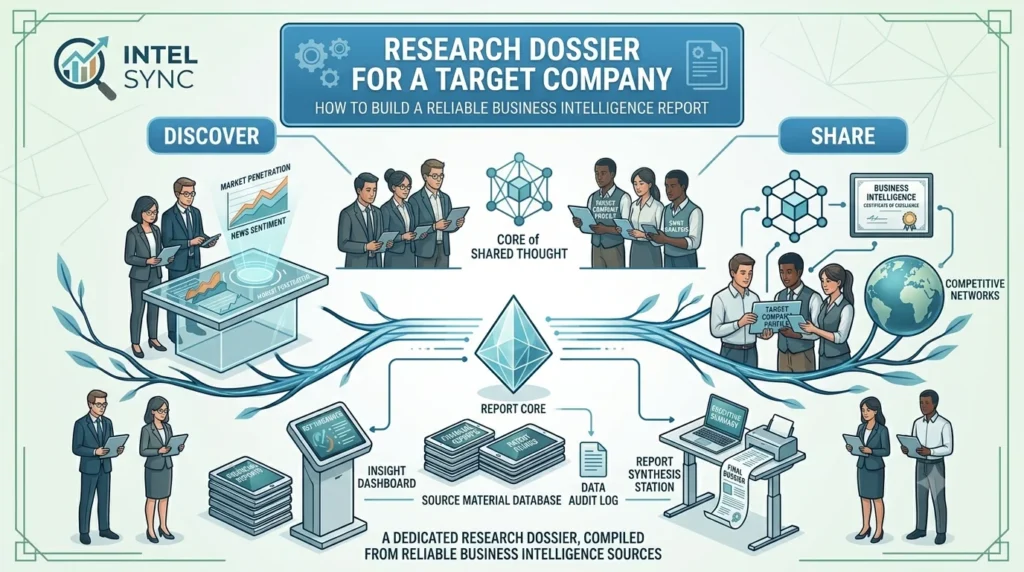
Research Dossier for a Target Company: How to Build a Reliable Business Intelligence Report.
Introduction
A research dossier for a target company is a structured report that brings together relevant business information, supporting evidence and analytical findings about a specific organisation. It helps researchers understand a company’s operations, market position, business model, competitors, leadership, opportunities and potential risks.
Unlike a basic company profile, a dossier does more than describe what a business does. It examines what the available evidence reveals and how that information relates to a particular business decision.
For example, a marketing agency researching a potential client may investigate its services, target audience, online presence, competitors and possible marketing gaps. An investor, on the other hand, may focus on financial performance, ownership, profitability and business risks.
The same research principles apply to both situations, but the information collected should reflect the purpose of the investigation.
A useful dossier also records where information came from, when it was checked and whether a claim is confirmed, estimated or still uncertain. This makes the document easier to review, update and share with decision-makers.
Quick Facts About a Research Dossier
| Topic | Details |
|---|---|
| Definition | A structured collection of company information, evidence and analysis |
| Main purpose | Support research and business decision-making |
| Common uses | Sales prospecting, competitor research, investment analysis and supplier evaluation |
| Key information | Company identity, operations, leadership, finances, market position and risks |
| Primary sources | Official company disclosures, regulatory filings and government records |
| Secondary sources | Industry reports, reputable news coverage and research publications |
| Typical output | A report, document, spreadsheet or internal research file |
| Important principle | Separate verified facts from estimates and interpretations |
Why Is a Company Research Dossier Important?
Business information is available across many sources, including company websites, annual reports, government databases, news articles, industry publications and professional directories.
The challenge is not simply finding information. It is determining which details are relevant, whether they are reliable and what they mean when considered together.
A structured dossier helps solve that problem.
1. It Creates a Central Record
Instead of keeping notes across browser tabs, emails and spreadsheets, researchers can organise key findings in one document.
This central record makes it easier to review company details, identify missing information and share research with colleagues.
2. It Improves Decision-Making
A dossier can help decision-makers assess a potential business relationship, prepare for a sales meeting or investigate a competitor.
For example, a supplier evaluation may reveal that a company operates in several regions but provides limited public information about its ownership. That finding may indicate a need for additional verification before a contract is signed.
3. It Supports Competitive Analysis
Researching competing businesses can reveal differences in their products, pricing, positioning, customer segments and distribution strategies.
These observations can help a business identify market gaps and develop a more informed strategy.
4. It Reduces Avoidable Research Errors
A structured process encourages researchers to check company identities, reporting dates and source quality before recording conclusions.
This is particularly important when several businesses share similar names or when public information refers to a parent company rather than a subsidiary.
5. It Makes Research Reusable
A dossier can become a reference document that is updated as new information becomes available.
Rather than restarting from the beginning before every meeting or project, teams can review existing evidence and focus on what has changed.
What Information Should a Research Dossier Include?
The structure depends on the research objective. However, most comprehensive dossiers benefit from the following sections.
Company Overview
Begin with the company’s basic identity.
Record its official name, website, industry, main products or services, operating locations and relevant business entities.
Where possible, distinguish the legal entity from its consumer-facing brand. This helps prevent confusion when a business operates through subsidiaries or related companies.
Company History and Milestones
A short timeline can explain how the organisation developed.
Relevant events may include its founding, product launches, acquisitions, leadership changes, expansion into new markets and major strategic shifts.
Use reliable sources to confirm dates. Avoid presenting an unverified founding story or corporate milestone as established fact.
Leadership and Ownership
Identify relevant executives, founders, board members or owners when reliable information is available.
The level of detail should reflect the purpose of the research. A sales dossier may need the relevant decision-makers, while an investment review may require a deeper examination of ownership and governance.
Do not assume that a person listed in an old article still holds the same position. Check current company disclosures or official profiles.
Products and Services
Explain what the company offers, who its products serve and how those offerings differ from alternatives.
Where relevant, record product categories, customer segments, distribution channels and publicly documented pricing.
If pricing is not available, mark it as undisclosed rather than inventing a figure.
Business Model
Investigate how the company creates and delivers value.
Depending on the organisation, its business model might involve subscriptions, product sales, professional services, licensing, advertising or several revenue streams.
Distinguish the business’s stated model from assumptions about how much revenue each activity generates.
Financial Performance
For public companies, financial reports and regulatory filings may provide information about revenue, profitability, cash flow, debt and business segments.
Record the relevant reporting period and currency alongside each figure.
Private companies may disclose less information. In those cases, clearly identify unavailable data and label third-party estimates appropriately.
Customers and Target Markets
Examine the audiences and markets the company serves.
Useful details can include customer types, geographic reach, industries served and publicly announced partnerships.
Customer names should only be included when supported by reliable public evidence or information that you are authorised to use.
Competitors and Market Position
Identify businesses that compete for similar customers or solve comparable problems.
Compare their products, pricing where available, target markets, positioning, distribution and differentiating features.
A competitor should not be included merely because it operates in the same broad industry. Explain why it is relevant to the research question.
Risks and Opportunities
Summarise the most important issues identified during research.
Potential risks could include market concentration, regulatory changes, supply-chain dependencies or declining demand. Opportunities might include an underserved market, an emerging product category or a potential partnership.
These findings should be linked to evidence and clearly distinguished from speculation.
How to Build a Research Dossier Step by Step
A repeatable workflow helps researchers avoid unnecessary work and maintain a consistent standard of evidence.
Step 1: Define the Research Objective
Before searching for information, write one sentence explaining what the dossier needs to help you decide.
For example:
“Assess whether this company is a suitable prospect for a digital marketing partnership.”
That objective determines which questions matter most.
A sales team may prioritise the company’s services, customer acquisition channels and business needs. An acquisition team will require substantially more detail about ownership, liabilities, financial performance and legal exposure.
Step 2: Confirm the Correct Company
Verify the organisation’s identity before collecting detailed information.
Check the official name, website, country of operation, industry and, where relevant, registration details or parent company.
This step is particularly important when a company has a common name, multiple brands or a complicated corporate structure.
Step 3: Create a Research Checklist
List the questions your investigation must answer.
Examples include:
- What does the company sell?
- Who are its main customers?
- How does it generate revenue?
- Which markets does it serve?
- Who makes relevant business decisions?
- Which competitors offer similar products?
- What significant developments have occurred recently?
- What risks or unanswered questions deserve further investigation?
A checklist prevents the project from becoming an unstructured collection of interesting facts.
Step 4: Collect Primary Sources First
Start with the company’s official website, regulatory disclosures, annual reports and relevant government records.
These sources can provide direct evidence about corporate identity, reported financial performance, leadership and business activities.
However, a company website is not independent confirmation of every marketing claim. Important information should be cross-checked when the decision requires a high level of confidence.
Step 5: Add Independent Sources
Use reputable news organisations, industry publications, research reports and other credible sources to provide additional context.
Independent coverage can help identify market developments, competitive pressures and questions that company materials may not address.
Check the original publication whenever possible instead of relying on repeated summaries of the same claim.
Step 6: Verify Important Information
Cross-check high-impact facts against additional reliable sources where possible.
For example, an executive appointment may be confirmed through a company announcement, while financial figures can be checked against the relevant official report.
When sources disagree, record the discrepancy and investigate it. Do not silently choose whichever number supports your preferred conclusion.
Step 7: Analyse What the Evidence Means
A dossier should connect information with the research objective.
Suppose a company has announced expansion into a new region. That fact alone does not prove that the expansion will succeed.
A useful analysis would consider the target market, available resources, competitive environment and potential operational challenges.
The purpose is to explain the significance of the evidence without presenting assumptions as facts.
Step 8: Identify Missing Information
Record important questions that remain unanswered.
Missing information might include undisclosed pricing, unclear ownership, unavailable financial statements or limited evidence about a company’s market share.
These gaps are part of the research outcome. A credible dossier makes uncertainty visible instead of filling it with guesses.
Step 9: Write the Executive Summary
Prepare a concise summary of the most important findings, risks and next steps.
Although it appears near the beginning of the finished report, writing it after the research is usually more effective because the conclusions are then supported by the collected evidence.
Step 10: Review and Date the Report
Check names, dates, calculations, links and citations.
Add the research date and the date of the latest review. This allows future readers to understand how current the findings are.
Where to Find Reliable Company Information
The reliability of a dossier depends heavily on the sources used to create it.
Different sources serve different purposes, so researchers should select them according to the question being investigated.
| Source type | Useful for | Important limitation |
|---|---|---|
| Official company website | Products, services and corporate announcements | May present information from the company’s perspective |
| Annual reports and regulatory filings | Reported financial and governance information | Available detail varies by jurisdiction and entity |
| Government business registries | Legal identity and registration information | Records differ between countries |
| Company press releases | Announced launches, appointments and developments | Announcements may describe intentions rather than completed outcomes |
| Reputable news publications | Independent reporting and business context | Check dates and original evidence |
| Industry associations | Industry definitions, standards and sector information | Membership or coverage may be incomplete |
| Job advertisements | Publicly stated hiring needs and role requirements | One vacancy does not prove a company-wide strategy |
| Customer reviews | Reported customer experiences and recurring themes | Reviews can be unrepresentative or difficult to verify |
| Market research reports | Industry trends and market estimates | Methodologies and access conditions vary |
Official Sources
For US-listed companies, the SEC’s EDGAR database provides access to regulatory filings.
In Australia, the ASIC website provides information and services related to companies and business registrations. Availability and access to particular records depend on the relevant service and document.
Other countries have their own corporate registries and financial disclosure systems.
News and Industry Sources
Reputable news outlets can provide context about leadership changes, acquisitions, expansion and regulatory developments.
Where a report makes a significant claim, look for direct statements, official documents or additional credible coverage.
Digital and Marketing Sources
For a marketing-focused dossier, examine the company’s website, search visibility, content, social media presence and publicly accessible advertising activity.
Tools such as Google Trends can help explore search-interest patterns. However, search interest is not the same as actual sales, market share or customer demand.
Similarly, third-party SEO and traffic platforms provide estimates, not necessarily exact business performance figures.
How to Analyse Competitors and Market Position
Competitor research is one of the most useful parts of a target company dossier when the objective involves marketing, sales or strategy.
The goal is to understand how the target company competes and where meaningful differences exist.
Identify Direct and Indirect Competitors
Direct competitors offer similar products or services to comparable customers.
Indirect competitors may solve the same customer problem through a different product, business model or approach.
For example, a project management software company may compete directly with other project management tools while also facing indirect competition from spreadsheets or broader collaboration platforms.
Compare Relevant Factors
Create a consistent comparison framework.
| Factor | Research question |
|---|---|
| Products and services | What does each company offer? |
| Target audience | Which customers does each business serve? |
| Pricing | What public pricing or commercial terms are available? |
| Positioning | What benefits does each company emphasise? |
| Distribution | How do products reach customers? |
| Content and visibility | What information and resources are publicly available? |
| Customer feedback | What recurring themes appear in credible reviews? |
| Differentiation | What meaningful differences can be supported by evidence? |
Use the same criteria for each competitor. Otherwise, the comparison may reflect inconsistent research rather than genuine differences.
Turn Findings Into Insights
A comparison table is only the starting point.
Ask what the findings mean for the original objective. A competitor may have a broader service range but less specialised messaging. Another may publish more educational content but provide limited evidence of its results.
These observations can inform strategy, provided the evidence supports them.
Avoid claiming that one business is better overall simply because it performs well on a single measure.
How to Identify Business Risks and Opportunities
A good dossier considers both potential advantages and possible problems.
The relevant categories depend on the organisation and the intended decision.
Financial Risks
Financial concerns may include debt exposure, inconsistent profitability, cash-flow pressures or dependence on a small number of revenue sources.
For a public company, assess the reported figures over multiple periods instead of relying on a single result.
Operational Risks
Operational issues may involve supplier dependencies, service interruptions, workforce challenges or limited distribution capacity.
Public information may reveal warning signs, but it rarely provides a complete view of internal operations.
Market and Competitive Risks
Changes in customer demand, new competitors, substitute products and changing regulations can affect a company’s position.
Research should distinguish between a confirmed event and a potential future risk.
Reputation Risks
Customer feedback, regulatory announcements and credible news coverage can reveal issues worth investigating.
However, a handful of online reviews should not be treated as definitive proof of widespread customer dissatisfaction.
Growth Opportunities
Potential opportunities may include entering new markets, serving underserved customer groups, improving distribution or developing partnerships.
Label these as opportunities to investigate, not guaranteed outcomes.
A useful risk register records the issue, supporting evidence, potential impact, confidence level and recommended follow-up.
Research Dossier for Sales and Marketing
A sales or marketing dossier has a different emphasis from an investment report.
Its primary goal is to understand the target company’s needs and determine whether a proposed service or partnership is relevant.
Understand the Business
Review its services, target audience, locations, market positioning and publicly stated business priorities.
For a potential digital marketing client, relevant areas might include website structure, organic search visibility, paid advertising, content quality and local search presence.
Identify Evidence-Based Opportunities
Look for specific gaps that can be supported by public information.
For example, a business may have useful service pages but limited supporting educational content. That could indicate a content opportunity, although further research would be needed to assess its commercial importance.
Avoid treating a low search ranking, limited social activity or missing website feature as automatic proof of poor business performance.
Research Relevant Decision-Makers
Use official leadership pages, company announcements and professional profiles to identify people whose roles are relevant to the proposed service.
Record only information needed for a legitimate business purpose, and respect privacy and applicable outreach rules.
Personalise the Business Proposal
Connect your recommendation to the evidence collected.
Instead of sending a generic message about increasing traffic, explain the specific issue you observed and how you would investigate or address it.
A well-researched proposal is more credible when it identifies both the opportunity and the limits of the available evidence.
Research Dossier for Investment and Due Diligence
Investment research and formal due diligence require greater depth than routine prospect research.
A preliminary dossier can help identify questions that need further investigation, but it should not be treated as a substitute for professional financial, legal or tax advice.
Review Financial Information
Examine available financial statements, debt, cash flow, profitability and relevant reporting notes.
Compare figures over time and consider the company’s industry, business model and reporting period.
Investigate Ownership and Corporate Structure
Where relevant, verify the legal entity, parent company, subsidiaries and publicly disclosed ownership information.
Corporate structures can be complex, so do not assume that information about one entity applies automatically to every related company.
Examine Legal and Regulatory Matters
Review relevant official disclosures, regulatory announcements and accessible court records where appropriate.
A reported allegation is not the same as a proven violation. Record the status of the matter and rely on authoritative sources.
Document Uncertainty
Private companies may disclose less information than publicly listed businesses.
Mark missing data clearly and distinguish verified facts from third-party estimates. Where the potential consequences are significant, obtain specialist advice and perform the appropriate formal checks.
Common Research Mistakes to Avoid
Even a detailed report can be misleading if the underlying process is weak.
Using Outdated Information
An old executive profile or historical price list may no longer reflect the current business.
Record publication dates and verify information that can change frequently.
Confusing Estimates With Confirmed Facts
Third-party databases may estimate revenue, traffic, employee counts or market share.
Label these figures as estimates and identify the source. Do not present them as audited or officially confirmed numbers.
Relying Only on the Company Website
Official information is essential, but independent evidence can reveal context and questions that corporate materials do not address.
Use a combination of primary and credible secondary sources.
Collecting Too Much Irrelevant Data
A lengthy report is not necessarily a useful report.
Focus on the evidence needed to answer the research questions. Exclude information that does not support the objective.
Ignoring Conflicting Evidence
Different sources may report different dates, figures or descriptions.
Investigate the reason, check the original records and document any unresolved discrepancies.
Treating Correlation as Causation
Two events occurring together do not prove that one caused the other.
For example, a company’s marketing activity increasing alongside revenue growth does not, by itself, establish that the marketing activity caused the growth.
Failing to Record Sources
Without a source log, readers cannot easily verify the findings or update the report.
Attach a source and date to important claims as you collect them rather than trying to reconstruct the research trail later.
A Practical Research Dossier Template
The following outline can be copied into a document or spreadsheet and adapted for different research objectives.
Section 1: Research Details
- Target company:
- Official website:
- Legal entity, if confirmed:
- Industry:
- Research objective:
- Geographic scope:
- Researcher or team:
- Research date:
- Last updated:
Section 2: Executive Summary
- Company overview:
- Most important findings:
- Key opportunities:
- Main risks:
- Unanswered questions:
- Recommended next steps:
Section 3: Company Profile
- Products and services:
- Target customers:
- Operating locations:
- Business model:
- Company history:
- Relevant subsidiaries or parent company:
Section 4: Leadership and Ownership
- Key executives:
- Board members, where relevant:
- Publicly disclosed ownership information:
- Corporate structure:
- Supporting sources:
Section 5: Financial and Operational Information
- Reported revenue and reporting period:
- Profitability, where available:
- Cash flow and debt, where relevant:
- Workforce information:
- Operational developments:
- Data limitations:
Section 6: Market and Competitor Analysis
- Main competitors:
- Target market:
- Industry developments:
- Product comparisons:
- Public pricing information:
- Competitive advantages and limitations:
Section 7: Risks and Opportunities
- Identified risks:
- Supporting evidence:
- Potential impact:
- Confidence level:
- Opportunities to investigate:
- Recommended follow-up:
Section 8: Source Register
| Field | What to record |
|---|---|
| Source title | Name of the report, page or document |
| Publisher | Organisation responsible for the source |
| URL or reference | Link or document identifier |
| Publication date | When the source was published |
| Access date | When you reviewed it |
| Key finding | Information supported by the source |
| Reliability notes | Limitations, estimates or unresolved questions |
This template should be adjusted to fit the assignment. A short sales dossier may need only a few sections, whereas a formal acquisition investigation requires much more extensive evidence and specialist review.
How to Maintain and Update a Dossier
A research dossier is not necessarily a one-time document. Its value can increase when the information is kept current.
Establish an Update Schedule
Review the report according to the pace of change and the decisions it supports.
A prospecting dossier may need updating before an important sales meeting. Financial research should be reviewed when relevant reports or disclosures become available.
Track Significant Changes
Record meaningful developments such as leadership appointments, product launches, acquisitions, market expansion or new regulatory announcements.
Include the date and source of each change.
Preserve Earlier Findings
When new information replaces an older figure, retain enough history to understand what changed and why.
This is particularly useful when comparing financial performance, market positioning or strategic direction over time.
Assign Responsibility
For team-based research, establish who maintains the dossier and who reviews important findings.
A clear owner helps prevent duplicate work and makes it easier to identify outdated information.
Protect Sensitive Information
Use appropriate access controls for internal reports, commercial research and confidential documents.
Public information can still be subject to copyright or usage restrictions. Private customer information and personal data require additional care.
Final Takeaway
A research dossier for a target company provides a structured way to understand a business using verified information, independent evidence and relevant analysis.
Its value comes from the quality of the research rather than the volume of data collected. Confirming the correct company, defining the objective, selecting reliable sources and recording evidence make the resulting report more useful for decision-makers.
The approach can support many business activities, including sales prospecting, marketing strategy, competitor analysis, supplier evaluation, investment research and partnership planning. Each use case requires a different level of detail, so the dossier should be designed around the decision it needs to support.
Researchers should also make uncertainty visible. Estimates, missing information and conflicting reports must be identified rather than silently treated as facts. For major investments or high-risk commercial decisions, preliminary research should be supplemented by appropriate professional due diligence.
Ultimately, a strong research dossier is more than a company profile. It is an organised, evidence-based decision tool that explains what is known, how it is known, what it means and what needs to be investigated next.
What is a research dossier for a target company?
It is a structured report containing relevant company information, supporting evidence and analysis. It helps researchers understand a business and make informed decisions about sales, competition, investment or partnerships.
What is the difference between a company profile and a research dossier?
A company profile usually summarises basic information about a business. A research dossier goes further by examining evidence, competitors, risks, market position and the implications of the findings.
Who needs a target company research dossier?
Sales teams, marketers, investors, consultants, procurement teams, researchers and business owners may all benefit from one. The structure should reflect the purpose of the investigation.
What should a company research dossier include?
Common sections cover company identity, history, leadership, products, business model, financial information, customers, competitors, risks, opportunities and source references.
How do you find reliable information about a company?
Start with official company materials, regulatory filings and government records. Then use reputable news coverage and industry sources to verify or contextualise important findings.