
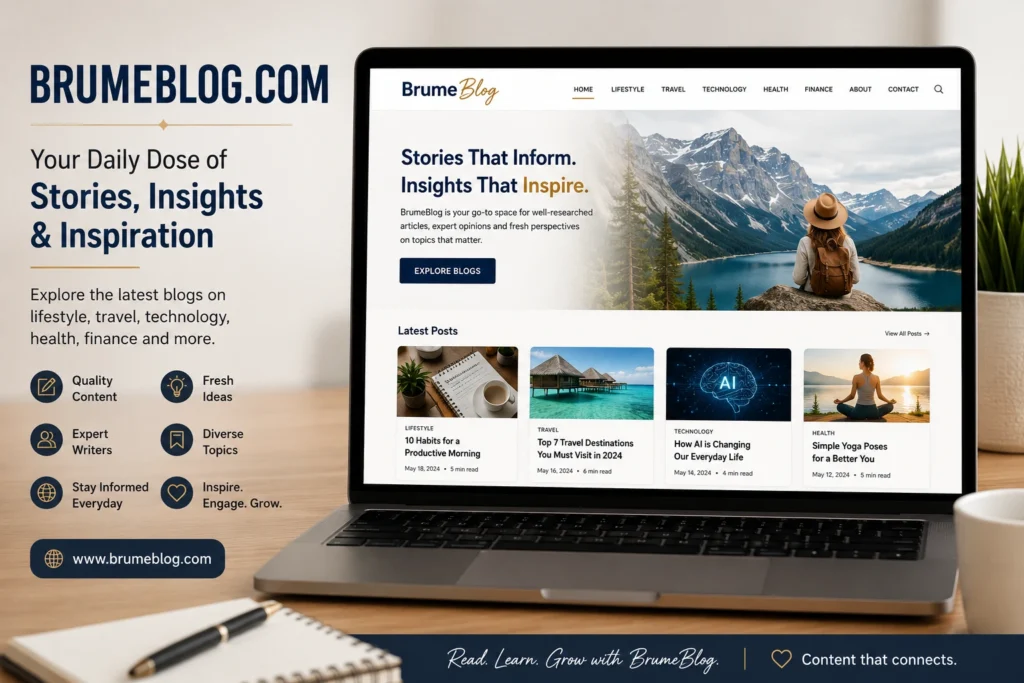
BrumeBlog.com: What Users Should Know Before Trusting the Website
Finding a new website through search can feel effortless. You enter a question, scan the results, click an unfamiliar domain, and start reading. The tricky part comes later: deciding whether the information deserves your confidence. With websites such as BrumeBlog.com, readers should look beyond the domain name and page design and examine the content, authorship, sources, and transparency behind what they publish.
If you’re researching BrumeBlog.com, this guide provides a practical framework for evaluating the website before using its information for research, recommendations, or important decisions.
Quick Summary
- BrumeBlog.com should be evaluated by examining its individual articles and overall publishing practices.
- Author identity and subject expertise can provide useful credibility signals.
- Publication and update dates help determine whether information is current.
- Supporting references make factual claims easier to verify.
- About, contact, privacy, and editorial information improve transparency.
- HTTPS and a clean browsing experience are useful baseline signals.
- Search rankings alone should never be treated as proof of accuracy.
- Important financial, health, legal, or professional claims should be independently verified.
What Is BrumeBlog.com?
BrumeBlog.com appears to be a blog-style online publishing website intended to provide readers with articles and informational material. Like thousands of other content websites, its usefulness ultimately depends on what individual pages contain rather than simply on the site’s existence or visual presentation.
That distinction matters. A website can publish genuinely helpful material in one area and weaker content in another. Readers shouldn’t assume that every page has the same level of research, expertise, or editorial review.
When exploring BrumeBlog.com, start with the actual article you’re interested in. Look at its purpose, author information, evidence, date, and claims. Those details provide much more useful information than a quick glance at the homepage.
For general-interest content, an article may be perfectly adequate as an introduction. For information that could affect money, health, legal rights, or business decisions, the standard should be considerably higher.
Why Should You Check a Website’s Credibility?
The internet has made publishing remarkably easy. A new site can be launched quickly, and content can reach a global audience almost immediately. That is useful for independent publishers, but it also means readers have to distinguish between informed material and unsupported claims.
This is where concepts such as E-E-A-T—Experience, Expertise, Authoritativeness, and Trustworthiness—become useful. They encourage a closer look at who created information, whether they have relevant knowledge, and whether the content gives readers reasons to trust its claims.
Search Visibility Isn’t Enough
A page appearing in search results doesn’t automatically make it authoritative.
Search engines try to surface useful and relevant information, but users should still evaluate the source themselves. This becomes particularly important when an article makes precise claims, recommends products or services, quotes statistics, or gives instructions that could have real consequences.
A good rule is simple: use search engines to find information, then use judgment to evaluate it.
How Should You Evaluate BrumeBlog.com Content?
A useful review starts with the article itself.
Look for Clear Authorship
Check whether the article identifies its writer and provides meaningful information about that person.
Useful author signals may include:
- A named writer
- An author biography
- Relevant professional experience
- Subject-specific knowledge
- Links to other work
An author’s background doesn’t guarantee that every statement is correct. It does, however, give readers context for understanding the perspective and expertise behind the material.
Anonymous content isn’t automatically false, either. But when there is no identifiable author or editorial information, readers have less information with which to assess expertise.
Check When the Article Was Published
Freshness can make a major difference.
A basic historical explanation may remain useful for years. A technology guide, software tutorial, business recommendation, or statistics-heavy article can become outdated much faster.
Before accepting an article’s recommendations, look for its publication or update date. Then ask whether the examples, statistics, tools, and advice still apply.
If an article makes a time-sensitive claim without a date, treat that information cautiously.
Examine the Depth of the Article
Useful content should answer the reader’s actual question instead of simply repeating general statements.
Look for:
- Specific explanations
- Relevant examples
- Supporting evidence
- Clear definitions
- Practical context
- Limitations or exceptions
For example, an article about an online service should ideally explain what the service does, who it is for, potential limitations, and what users should consider before using it.
That is much more useful than a page filled with vague promotional language.
Does BrumeBlog.com Provide Evidence for Its Claims?
Evidence is one of the easiest ways to distinguish research-oriented content from unsupported commentary.
Suppose an article gives a specific statistic. Can you determine where that number came from? If it makes a technical claim, does it point toward official documentation or credible research?
Sources Worth Checking
Depending on the subject, stronger references may include:
- Government websites
- Academic publications
- Official company documentation
- Industry organizations
- Original research
- Reputable news organizations
The right source depends on the claim. Government information may be appropriate for regulations, while an official manufacturer page may be better for product specifications.
Don’t Stop at One Source
Cross-checking is especially important for high-impact information.
If you’re reading about investment decisions, medical issues, legal questions, or professional requirements, compare the information with authoritative sources.
Think of an unfamiliar blog as a starting point rather than the final authority. That small change in mindset can prevent many avoidable mistakes.
What Trust Signals Should You Look For?
Website credibility isn’t determined by article quality alone. The surrounding site can provide additional clues.
Transparency
Check whether BrumeBlog.com clearly provides information such as:
- About information
- Contact details
- Privacy policy
- Terms of use
- Editorial or author information
Transparency gives readers a clearer picture of who is responsible for the website and how it operates.
Security
HTTPS should be considered a basic expectation for modern websites, particularly when users may submit information.
However, a secure connection only protects communication between the browser and website. It does not prove that the site’s content is accurate.
That’s an important distinction. Security and credibility are related but separate questions.
Website Maintenance
A site that is regularly maintained generally provides a better experience.
Check for broken pages, outdated references, unreadable layouts, excessive pop-ups, and confusing navigation. These aren’t definitive proof of poor content, but several problems appearing together can indicate limited editorial maintenance.
What Are Potential Red Flags?
No single warning sign proves that a website is unreliable. Context matters.
Still, readers should slow down when they encounter:
- Dramatic claims without evidence
- Anonymous authors on expert subjects
- Statistics without sources
- Outdated information presented as current
- Excessive promotional language
- Misleading headlines
- Broken or suspicious external links
- Promises that sound too good to be true
A particularly useful test is to ask: Can I independently verify this claim?
If the answer is yes, verification becomes straightforward. If the answer is no, the information deserves more caution.
Key Takeaways
Before relying on information from BrumeBlog.com:
- Identify the author whenever possible.
- Check publication and update dates.
- Look for supporting evidence and references.
- Compare important claims with authoritative sources.
- Review the site’s transparency and contact information.
- Confirm basic website security.
- Watch for exaggerated or unsupported claims.
- Treat unfamiliar websites as research starting points, not automatic authorities.
Frequently Asked Questions
Is BrumeBlog.com trustworthy?
Its trustworthiness should be assessed at the article level by reviewing authorship, sources, dates, transparency, and factual support. Important claims should be independently verified before they influence significant decisions.
What should I check first on BrumeBlog.com?
Start with the article’s author, publication date, and sources. These three checks quickly reveal who created the information, how current it may be, and whether its major claims can be verified.
Can BrumeBlog.com be used for research?
It can potentially be useful for discovering information and understanding a topic, but important facts should be checked against authoritative sources, especially for financial, medical, legal, or professional questions.
Does a professional-looking website mean its content is accurate?
No. Design, branding, and search visibility are not proof of factual accuracy. Reliable evaluation requires looking at authorship, evidence, freshness, transparency, and whether important claims can be independently confirmed.
Conclusion
BrumeBlog.com, like any unfamiliar online publication, is best approached with a balanced mindset. Don’t dismiss a site simply because you haven’t heard of it, but don’t automatically trust it because an article looks polished or appears in search results. Check who wrote the material, when it was published, what evidence supports it, and whether important claims hold up elsewhere. A few minutes of verification can turn casual online reading into much more dependable research.