
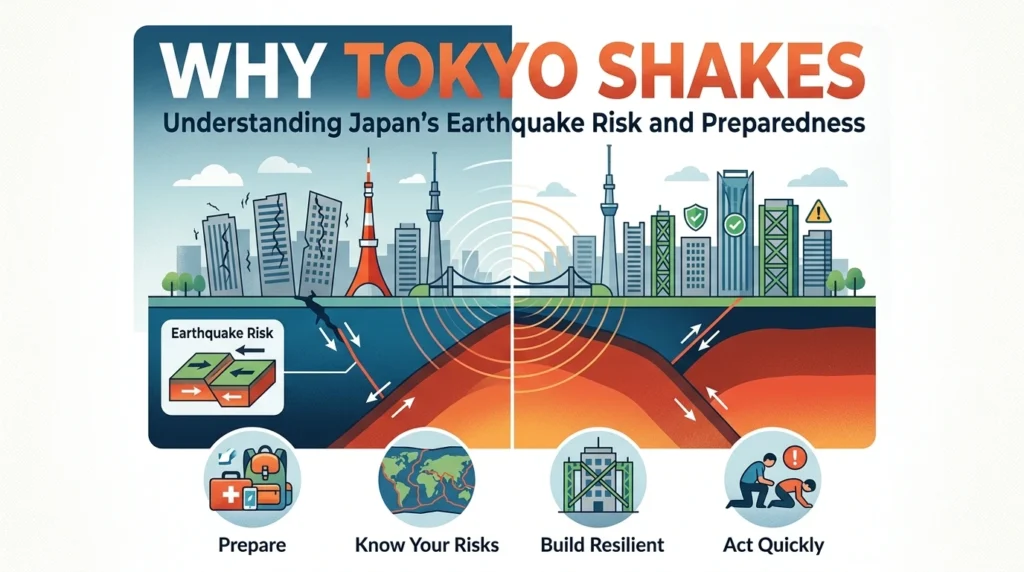
Why Tokyo Shakes: Understanding Japan’s Earthquake Risk and Preparedness.
Introduction
Japan is famous for its advanced infrastructure, dense cities, and rich cultural history—but it is also one of the world’s most seismically active countries.
Among Japan’s major cities, Tokyo receives particular attention because of its location in the earthquake-prone Kanto region. Earthquakes can occur beneath or around the capital, making seismic preparedness an important part of life in the city.
Japan’s Meteorological Agency explains that the country lies in one of the world’s most active seismic and volcanic zones and continuously monitors earthquake activity across Japan.
So, why does Tokyo have so many earthquakes? What makes the region vulnerable? And how prepared is the city for a major earthquake?
Let’s explore the science, risks, history, and preparedness measures behind Tokyo’s earthquake environment.
Why Does Japan Have So Many Earthquakes?
The main reason is plate tectonics.
Japan sits in a region where several tectonic plates interact. These enormous pieces of Earth’s crust are constantly moving, although the movement is usually too slow to notice.
Where plates meet, enormous forces can build up underground.
When accumulated stress is suddenly released, the result can be an earthquake.
Japan’s location makes it particularly exposed to this process, which is why earthquakes occur frequently across the country.
Why Is Tokyo Especially Vulnerable?
Tokyo is located in the Kanto region of Japan, an area where multiple plates interact beneath the surface.
The Tokyo Metropolitan Government describes southern Kanto, including Tokyo, as a particularly earthquake-prone region because plates meet beneath the area.
This creates several possible sources of earthquakes that could affect the capital.
Some earthquakes occur:
- Deep underground
- Beneath the Kanto region
- Along offshore faults
- At plate boundaries
- Farther away but strongly enough to affect Tokyo
This means Tokyo’s earthquake risk isn’t caused by one single fault.
What Is a Tectonic Plate?
A tectonic plate is a massive section of Earth’s outer shell.
These plates move slowly over geological time.
When plates:
- Move toward each other
- Slide past one another
- Move apart
- Become locked and accumulate stress
earthquakes can occur.
The movement may be almost imperceptible on a daily basis, but the accumulated energy can eventually be released suddenly.
How Earthquakes Affect Tokyo
An earthquake doesn’t affect every part of a city in exactly the same way.
The impact can depend on:
- Earthquake magnitude
- Depth
- Distance from the epicenter
- Local ground conditions
- Building construction
- Infrastructure
- Fire risk
- Population density
The Japan Meteorological Agency notes that seismic intensity can vary according to distance from the epicenter and local surface geology.
This is why two neighborhoods can experience different levels of shaking during the same earthquake.
Magnitude vs. Seismic Intensity
These two terms are often confused.
Magnitude
Magnitude describes the size or energy of an earthquake at its source.
An earthquake has a magnitude value associated with its overall size.
Seismic Intensity
Seismic intensity describes how strongly the earthquake shakes at a particular location.
Japan uses the Japan Meteorological Agency seismic intensity scale, which ranges from 0 through 7, with intermediate categories including 5 Lower, 5 Upper, 6 Lower, and 6 Upper.
This distinction is important because a large earthquake can produce different shaking intensities in different places.
What Is a Tokyo Earthquake?
The phrase “Tokyo earthquake” can refer to several different types of earthquakes that affect the Tokyo metropolitan area.
It does not necessarily mean that an earthquake originates directly beneath central Tokyo.
An earthquake elsewhere in the Kanto region or offshore can also produce significant shaking in the capital.
The Tokyo Metropolitan Government maintains detailed disaster planning for earthquakes that could directly affect the capital.
The Major Earthquake Risks Around Tokyo
Tokyo’s earthquake risk includes several possible scenarios.
1. Earthquakes Beneath the Capital Region
An earthquake occurring relatively close to Tokyo could produce strong shaking.
Because of the city’s population and infrastructure density, even a moderate-to-large event can create significant disruption.
2. Large Plate-Boundary Earthquakes
The Kanto region can also experience major earthquakes associated with plate interactions.
The Tokyo Metropolitan Government explains that the Kanto Earthquake is associated with the Philippine Sea Plate subducting beneath the North American Plate.
3. Earthquakes Outside Tokyo
An earthquake doesn’t have to originate inside Tokyo to affect the city.
Large earthquakes elsewhere in Japan can produce:
- Strong shaking
- Transportation disruption
- Communication problems
- Supply-chain interruptions
- Tsunami risks in relevant coastal areas
The potential consequences depend heavily on the earthquake’s location and characteristics.
Why Building Design Matters
Earthquake risk isn’t determined only by geology.
Buildings matter enormously.
Japan has developed extensive earthquake-resistant construction practices, and Tokyo continues to invest in strengthening buildings and infrastructure.
The Tokyo Metropolitan Government reports ongoing efforts to improve earthquake resistance in homes, apartment buildings, bridges, tunnels, water systems, and other infrastructure.
This means the same earthquake can have very different consequences depending on the resilience of the built environment.
Tokyo’s Earthquake Preparedness
Tokyo has extensive disaster-preparedness programs.
The city’s disaster-prevention planning includes measures involving:
- Earthquake-resistant buildings
- Infrastructure resilience
- Emergency transportation
- Evacuation facilities
- Fire prevention
- Lifeline protection
- Community preparedness
- Emergency response
The Tokyo Metropolitan Government’s disaster guide outlines these measures as part of its broader earthquake preparedness strategy.
Why Fire Is an Important Earthquake Risk
Earthquake damage isn’t limited to buildings falling.
Fire can become a major secondary hazard.
A large earthquake can potentially damage:
- Gas systems
- Electrical equipment
- Buildings
- Roads
- Utility infrastructure
Tokyo’s preparedness programs therefore include fire-prevention measures alongside structural earthquake resistance.
What Is Liquefaction?
Liquefaction is another potential earthquake hazard.
It can occur when strong shaking affects certain water-saturated soils, temporarily reducing their ability to support structures.
This can cause:
- Ground deformation
- Tilting structures
- Damage to underground infrastructure
- Problems with roads and utilities
The Tokyo Metropolitan Government specifically provides information and maps concerning liquefaction risks in the city.
What Happens During an Earthquake in Tokyo?
The experience depends on the earthquake.
People may notice:
- Buildings shaking
- Furniture moving
- Objects falling
- Elevators stopping
- Train services being suspended
- Traffic disruption
- Mobile networks becoming congested
Japan has systems designed to provide rapid earthquake information.
The Japan Meteorological Agency operates an Earthquake Early Warning system intended to provide advance notice of expected shaking, allowing actions such as slowing trains, managing elevators, and helping people protect themselves.
The warning time can be very short, so people should still know what to do before an earthquake happens.
What Should You Do During an Earthquake?
If you are indoors, prioritize protecting yourself from falling objects and broken glass.
A basic approach is:
- Stay calm.
- Protect your head.
- Move away from windows and unstable objects.
- Take shelter where appropriate.
- Avoid elevators during strong shaking.
- Follow official instructions.
- Check for injuries once the shaking stops.
Tokyo police guidance also provides information on what to do during earthquakes, evacuation, and preparations for people who may become stranded away from home.
Should You Leave Your Home Immediately?
Not necessarily.
Evacuation depends on the situation.
If a building is structurally safe and there is no immediate danger such as fire, remaining indoors may sometimes be safer than entering crowded streets.
Tokyo’s current disaster-preparedness initiatives specifically promote stay-at-home evacuation where buildings meet appropriate safety standards and conditions allow it.
However, if authorities instruct people to evacuate or the building becomes unsafe, evacuation should take priority.
How Can Residents Prepare for an Earthquake?
Preparation doesn’t need to be complicated.
Keep Emergency Supplies
Useful supplies can include:
- Drinking water
- Food
- Flashlights
- Batteries
- First-aid supplies
- Necessary medications
- Portable chargers
- Hygiene supplies
- Important documents
Tokyo’s official Stockpile Navi provides guidance for determining appropriate household emergency supplies.
Secure Furniture
Heavy furniture can become dangerous during strong shaking.
Consider securing:
- Bookshelves
- Cabinets
- Televisions
- Tall storage units
Keeping heavy objects away from sleeping areas can also reduce risk.
Know Your Local Evacuation Information
Before an emergency, learn:
- Your nearest evacuation location
- Emergency routes
- Local hazard information
- How to contact family members
- Where emergency supplies are located
Knowing this information beforehand can reduce confusion during a disaster.
What Should Tourists Know About Earthquakes in Tokyo?
Visitors should not assume that earthquakes are a reason to avoid Tokyo.
Japan has extensive earthquake monitoring and preparedness systems.
However, travelers should understand basic safety procedures.
Before or during a trip:
- Learn the local emergency number and official alert systems.
- Follow instructions from hotel staff and authorities.
- Keep important documents accessible.
- Know where emergency exits are.
- Avoid rushing into streets during strong shaking.
- Keep emergency notifications enabled where available.
The key is preparation rather than panic.
Japan’s Earthquake Monitoring System
Japan has one of the world’s extensive earthquake-monitoring networks.
The Japan Meteorological Agency operates a national observation system involving seismographs and seismic intensity meters. It also receives data from thousands of additional instruments operated by other organizations and local governments.
This information allows authorities to rapidly determine:
- Earthquake location
- Magnitude
- Seismic intensity
- Areas affected
- Potential tsunami information
Rapid information is essential for emergency response.
Can Scientists Predict a Tokyo Earthquake?
This is an important distinction.
Scientists can assess earthquake hazards and probabilities, but they cannot reliably predict the exact date, time, location, and magnitude of a future earthquake.
Japan’s earthquake monitoring systems are designed primarily to detect earthquakes quickly and provide information after or immediately around their occurrence.
That means preparedness is more useful than trying to predict the exact day an earthquake will happen.
Does Tokyo Have a Major Earthquake Coming?
There is no reliable way to say that a major earthquake will happen on a specific date.
Instead, authorities plan for possible earthquake scenarios over longer time periods.
Tokyo’s disaster planning specifically addresses the risk of an earthquake directly affecting the capital and sets damage-reduction goals for the city.
The correct takeaway is not:
“A huge earthquake is definitely coming tomorrow.”
It is:
“Tokyo has a significant earthquake hazard, so preparedness matters.”
Tokyo’s Ongoing Earthquake-Resistance Efforts
Tokyo continues to invest in earthquake resilience.
In 2026, the Tokyo Metropolitan Government announced another seismic-retrofitting campaign designed to increase awareness and encourage earthquake-resistant improvements. The campaign is scheduled to run from September 1, 2026, through January 17, 2027.
These initiatives demonstrate that earthquake preparedness is treated as an ongoing process rather than a one-time project.
Japan Earthquakes and Tokyo: Common Misconceptions
“Every earthquake in Japan affects Tokyo.”
False.
Japan is a large country, and earthquake effects vary depending on location, magnitude, depth, and local geology.
“Tokyo is constantly experiencing dangerous earthquakes.”
Misleading.
Japan experiences frequent seismic activity, but the intensity and consequences vary widely.
“Modern buildings cannot be damaged.”
False.
Earthquake-resistant construction reduces risk but does not make buildings completely immune to damage.
“An earthquake can be predicted exactly.”
False.
Earthquake science can assess hazards and monitor seismic activity, but exact prediction remains beyond current capability.
“Earthquake preparedness is only necessary for residents.”
False.
Visitors, commuters, students, and tourists can all benefit from understanding basic earthquake safety.
A Simple Tokyo Earthquake Preparedness Checklist
Before an Earthquake
- Identify safe areas inside your home or hotel.
- Secure heavy furniture where possible.
- Prepare emergency water and food.
- Keep a flashlight available.
- Keep a portable power source available.
- Learn local evacuation information.
- Discuss an emergency communication plan with family.
- Keep important documents accessible.
During an Earthquake
- Protect your head.
- Stay away from windows and falling objects.
- Follow official warnings.
- Avoid elevators.
- Remain calm.
- Check yourself and others for injuries.
After an Earthquake
- Check for immediate hazards.
- Follow official instructions.
- Avoid damaged structures.
- Conserve phone battery.
- Check reliable emergency information.
- Evacuate if authorities instruct you to do so.
Frequently Asked Questions
Why does Tokyo have so many earthquakes?
Tokyo is located in the earthquake-prone Kanto region, where multiple tectonic plates interact beneath the area. This geological setting creates a significant potential for earthquakes.
Is Tokyo the most earthquake-prone city in Japan?
Tokyo is highly exposed to earthquake risk, but earthquake activity occurs throughout Japan. Risk varies depending on location, earthquake source, ground conditions, and building vulnerability.
Can a major earthquake hit Tokyo?
Yes. Tokyo’s disaster planning specifically considers scenarios involving an earthquake directly affecting the capital. The city has extensive preparedness and resilience programs to reduce potential damage.
Can earthquakes in Tokyo be predicted?
Scientists cannot reliably predict the exact time, location, and magnitude of a future earthquake. Monitoring and preparedness are therefore essential.
Is Tokyo safe for tourists?
Tokyo has extensive earthquake-monitoring, building, emergency-response, and disaster-preparedness systems. Visitors should still understand basic earthquake safety and follow official instructions during an event.
What should I keep at home for an earthquake?
Common preparations include water, food, lighting, batteries or charging equipment, first-aid supplies, hygiene items, and other household-specific emergency necessities. Tokyo’s official Stockpile Navi can help households determine appropriate supplies.
Conclusion
Tokyo’s relationship with earthquakes is shaped by geography, geology, population density, and urban development.
Japan sits in one of the world’s most active seismic regions, while Tokyo’s location in the Kanto region places the capital near complex interactions between tectonic plates.
But understanding Japan earthquakes and Tokyo should not lead to unnecessary fear.
Tokyo has invested heavily in earthquake-resistant buildings, infrastructure, monitoring systems, emergency planning, and public preparedness. The city continues to strengthen these measures as part of its long-term resilience strategy.
For residents and visitors, the most practical approach is simple:
Understand the risk, prepare in advance, know what to do during shaking, and follow official information during an emergency.
Earthquakes are a natural part of Japan’s environment. Preparation is what helps turn that reality into a manageable risk.